Knowledge / Maintenance and reliability
Machinery lay-up preservation: moisture, stationary surfaces and recommissioning
Explain why stopped machinery still deteriorates, distinguish warming from drying with a dewpoint example, and connect preservation records to a controlled return to service.
On this page
Long-term lay-up changes the machine’s duty. Normal circulation, heating, rotation and inspection may stop while humid air, vibration and temperature cycles continue. Preservation is therefore an engineered temporary condition with its own boundaries and records. It is different from a ready standby machine expected to start on demand, and the transition back to operation deserves its own verification.
Define the stored state before choosing protection
State whether the machine is assembled or dismantled, dry or fluid-filled, indoors or exposed, and whether external power and attendance remain available. Identify the intended duration and what will happen if the lay-up lasts longer. A programme dependent on heaters or dry-air supply also depends on those services remaining effective.
MAN’s preservation guidance for disassembled engines connects storage conditions with inspection and a maintenance log. Its specific scope should be preserved when using it: a transport-protected component, a cold installed engine and an electrically ready standby unit are not interchangeable preservation cases. Use the current equipment-specific programme for the actual state.
Condensation is governed by the cold surface
Vaisala distinguishes relative humidity from dewpoint and explains condensation on a surface colder than the adjacent air’s dewpoint. Room temperature alone cannot identify the coldest metal. A heavy casing can remain cool after warmer humid air enters, and a local bridge to a cold structure can create a surface condition unlike the central air sensor.
Place the measurement question accordingly: what are the water-vapour condition and the relevant surface temperature at the protected location? A low relative-humidity reading next to a heater does not by itself demonstrate protection in a colder compartment. Sensor location, response, calibration and interruptions in the enclosure boundary belong with the logged reading.
Worked dewpoint example: heating can lower RH without drying
For a numerical illustration over liquid water at moderate ambient temperature, use γ = ln(RH/100) + 17.62T/(243.12 + T), then Td = 243.12γ/(17.62 − γ), with T and Td in °C. Sensirion provides this Magnus-form coefficient set in its dewpoint example; the natural-log form here avoids its rounded log-base conversion.
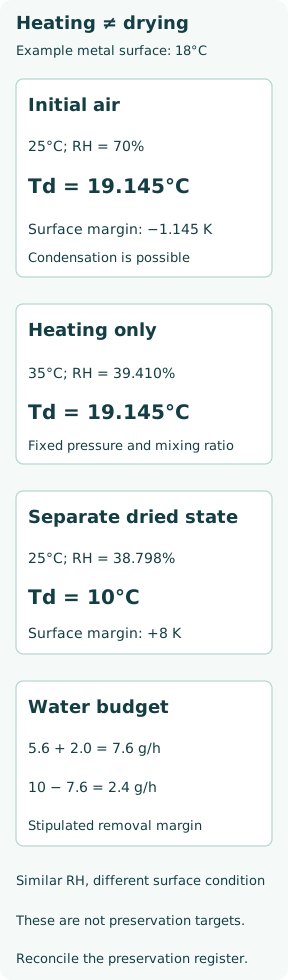
At 25°C and 70% RH, Td is about 19.145°C. A surface at 18°C is 1.145 K below that dewpoint and is susceptible to condensation. If the same air is warmed to 35°C at essentially constant pressure without changing its water-vapour mixing ratio, RH falls to about 39.410%, but dewpoint remains 19.145°C. A surface still at 18°C remains below it. This assumes no moisture exchange or condensation during the heating comparison, not a rigid sealed-volume process.
Drying and warming have different effects
For the same example, reducing the dewpoint to 10°C would correspond to about 38.798% RH at 25°C. The 18°C surface would then be 8 K above dewpoint. Notice that the two RH readings, roughly 39%, look similar although their cold-surface implications differ. The comparison is explanatory, not a required humidity target or a universal condensation safety margin.
Heating can protect when it actually keeps vulnerable surfaces sufficiently warm, while dehumidification removes water vapour. An enclosure must support the chosen method, including leakage, wet contents and access openings. The simple calculation uses an ambient approximation and excludes salts, wet deposits, sensor errors and transient gradients; absence of visible condensation is not proof that every corrosion mechanism is controlled.
A separate moisture budget tests the drying assumption
Assume incoming air brings 0.80 kg of dry air per hour with humidity ratio 0.014 kg water/kg dry air. If the target internal ratio is 0.007, its moisture load relative to that target is 0.80 × (0.014 − 0.007) = 0.0056 kg/h = 5.6 g/h. Add a stipulated 2.0 g/h from desorption of wet materials: the total load is 7.6 g/h.
If the removal capacity actually available at that duty is 10 g/h, the simple margin is 2.4 g/h. If it falls to 5 g/h, the shortfall is 2.6 g/h; maintaining those assumed rates for 8 h would accumulate 20.8 g. Real leakage, desorption and removal vary with humidity and temperature, so this is not a prediction of when condensation begins. It shows why a nominal dryer rating alone cannot establish preservation performance.
Stationary contact surfaces can still move microscopically
SKF describes false brinelling in stationary loaded bearings exposed to vibration. Small repeated movements at rolling contacts can damage the contact region without normal operating revolutions. Consequently, “not running” does not mean “not mechanically loaded”, and the nearby vibration environment matters during storage.
Lubricant distribution, protective films and the approved shaft-position or turning programme must be considered together. Do not invent a universal turning interval or rotate equipment with an unverified lubrication and isolation state. Some transport or preservation arrangements intentionally restrain components; moving them can defeat the protection. The machine’s programme determines whether motion is required, how it is supported and what must be restored afterwards.
Preservation is a maintained boundary, not a one-time coating
A preservation register should identify temporary blanks, covers, desiccants, dry-air connections, drain arrangements, heaters and corrosion-protection products. Record what each item protects, its inspection basis and its eventual disposition. A temporary cover that leaks, a saturated desiccant or an unpowered heater can change the stored condition while the machinery still looks untouched.
MAN’s historical cold-lay-up recommendation separates preservation maintenance from restarting the named engines. The transferable lesson is that protection continues during the idle period. It does not establish current universal inspection intervals or a single suitable chemical. Product compatibility, environmental conditions and the equipment’s current instructions determine those choices.
Recommissioning must resolve each temporary change
Before return to service, reconcile the preservation register against the physical installation. Remove the temporary items that must be removed, restore required openings and connections, and document items allowed to remain. Do not assume all preservation oils must be washed out: some approved products may remain compatible, while other coatings or inserted materials require complete removal.
Restore the specified fluid condition, lubrication path, electrical and control configuration, and mechanical readiness through the approved sequence. Evidence of water ingress, corrosion, sticking or disturbed alignment must be resolved before treating a start as the diagnostic test. Long lay-up is a change of condition, so the pre-lay-up acceptance record cannot simply be copied as the new one.
The handover should explain what was preserved and what was verified
Keep the initial condition, protection method, environmental records, boundary openings, power or dryer interruptions, inspections and corrective actions traceable to the equipment. At recommissioning, record the disposition of every temporary item and the results of the specified checks and progressive functional verification. An unresolved exception needs an identified engineering decision rather than an unmarked gap.
The useful chain is defined stored state → maintained environmental and mechanical protection → recorded exceptions → controlled restoration. Dewpoint arithmetic clarifies the moisture mechanism; the moisture budget checks one capacity assumption; neither replaces the physical register and equipment-specific procedure. Preservation succeeds when both the idle period and the return to service are controlled.
Sources
- MAN Energy Solutions — Preservation of Disassembled Engine, 0743102-7.12 (2018).
- MAN Diesel — SL09-510/SBJ: Preservation of engines for cold laying-up (2009).
- Vaisala — The many faces of water vapor: relative humidity, dewpoint and mixing ratio.
- Sensirion — SHT1x and SHT7x Sample Code, version 2.07 (2010).
- SKF Evolution — Golden opportunities.