Knowledge / Rules and safety management
Enclosed-space atmospheres: stratification, sampling and changing conditions
Understand why one gas reading cannot characterize an entire shipboard space, how sampling transport and ventilation models are limited, and why conditions can change.
On this page
An atmosphere reading describes the gas that reached a particular sensor at a particular time. It does not automatically describe every part of an enclosed space or the conditions that will exist later. Ship structures, cargo, residues, connected spaces and changing work can create important differences in composition. Understanding those differences helps explain the need for a space-specific assessment and representative testing. This article explains the measurement problem; it is not an entry permit or an enclosed-space work procedure.
Use the current source and the applicable framework
IMO adopted MSC.581(110), revised enclosed-space recommendations, on 27 June 2025. Its preamble places the recommendations alongside national rules and ship-specific procedures. The relevant operating framework therefore needs to be identified for the actual ship and work, rather than inferred from a generic article or a historical checklist.
The UK’s MGN 659 Amendment 3, published on 6 January 2026, incorporates that IMO guidance within its explanation of the UK 2022 regulations. Its application and exceptions are jurisdiction specific. A reader should distinguish a recommendation, a national duty and the actual ship’s controlled procedure. The physical measurement limits discussed below remain relevant without treating all those documents as interchangeable.
Think in connected volumes, not one empty box
A tank or hold can contain structural members, ladders, recesses, cargo and residues that affect air movement. A connected access trunk can exchange gas slowly with a larger space. A reading near an opening can therefore differ from one in a less ventilated region. The geometry and connections matter to whether the sampled gas represents the place where a person would be exposed.
Gas density relative to air can influence stratification, but it is not a complete dispersion model. Temperature differences, turbulent mixing, release momentum, changing ventilation and ongoing generation also matter. Assuming that every hazardous gas must be at the bottom, or that every lighter gas must remain at the top, can miss relevant locations. An assessment needs the actual substances and conditions.
Separate the quantities measured
Oxygen concentration, flammability and toxicity are different questions. An oxygen reading close to ordinary air does not exclude a toxic contaminant. A combustible-gas indication does not measure every toxic gas, and a sensor calibrated for one substance may respond differently to another. The required channels and their limitations follow from the substances that can actually be present.
A multi-gas label does not mean all gases are measured. Record the installed sensors, target substances, ranges, response characteristics and relevant interferences. The measurement also depends on the instrument’s condition and use within its stated environmental limits. A valid display is evidence about its measured quantities; it is not a universal statement that the atmosphere is harmless.
Account for remote-sampling transport
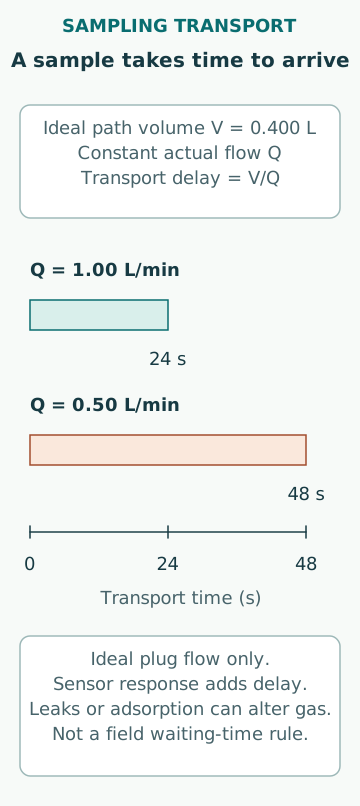
Gas drawn through a hose must reach the sensing element before a reading can represent the remote location. In an invented ideal plug-flow example, an effective internal sample-path volume of 0.400 L and actual flow of 1.00 L/min give a transport time V/Q = 0.400 min, or 24 s. The calculation excludes sensor response, mixing and interactions with the line.
At half that actual flow, the ideal transport time becomes 48 s. A leaking connection, obstructed filter or unsuitable tubing can change more than the delay: the sample composition reaching the sensor may differ from that at the inlet. The simple calculation is not an instrument waiting-time instruction. Manufacturer guidance and a verified sampling arrangement are needed to interpret actual response.
Use ventilation arithmetic only within its assumptions
For a separate teaching model, consider a perfectly mixed 100 m³ volume with fresh contaminant-free air entering at 500 m³/h and equal outflow. Assume constant volume and flow, no further contaminant source, and no surface release or absorption. The mass balance gives C(t)/C₀ = exp(−Qt/V). The time constant V/Q is 0.20 h, or 12 min.
After 36 min, the model predicts exp(−3), approximately 4.98% of the initial concentration. This is not an entry criterion or a demonstrated clearing time. Real spaces can short-circuit the airflow, retain pockets, have uncertain effective flow or continue generating gas. Even a correct whole-volume average would not establish the worst local concentration. Elapsed ventilation time cannot replace representative atmospheric evidence.
Treat location and time as part of the result
A useful atmosphere record identifies the space and sampling location, time, instrument, relevant channel, units and conditions affecting interpretation. A value without its location can lose the distinction between an opening and an internal recess. A value without its time can conceal that transfer, cleaning, temperature or ventilation changed afterwards.
MGN 659 Amendment 3, section 9.3 emphasizes different levels and locations, relevant gases and repeated testing as atmospheres change. The assessment must also account for regions that cannot be characterized adequately from available sampling points. A favourable accessible sample does not turn an inaccessible region into a known condition.
Consider how the work itself changes the atmosphere
Disturbing residues, opening a connected line, introducing cleaning products or changing a tank’s contents can introduce a new source. Work in an adjoining or connected area can alter the condition even if no one touches the tested space. A control that was effective for one activity may not address the atmosphere created by another.
A simple example is a concentration that falls while a source is isolated, then rises after material is disturbed. Extrapolating the earlier downward trend would be wrong because the governing mass balance changed. The same issue arises when a ventilation path is altered by temporary equipment or cargo movement. The physical source and transport paths should remain part of the assessment throughout the activity.
Keep instrument checks within their evidence scope
An instrument self-check, a response check with a known gas and calibration address different aspects of measurement assurance. None proves that the chosen sample locations represent the whole space. Conversely, a well-designed sampling plan cannot compensate for an instrument that does not measure the relevant substance or is used outside its specified conditions.
The UK COSWP 2026 publication page identifies the current edition and notes that its freely available reference PDF is not the onboard inspection version. The relevant controlled guidance and manufacturer instructions should support competent use of equipment. A secondary summary should not replace them or convert a general numerical example into a field-testing procedure.
Preserve the boundary between evidence and authorization
Atmospheric evidence is one part of a broader assessment that also includes physical hazards, isolation, access, communication and emergency arrangements. A gas reading does not assess every hazard in the space. The people responsible for the actual work need the current evidence and its limitations within the applicable shipboard process.
If a person collapses in an enclosed space, an unprotected impulsive entry can expose another person to the same atmosphere. The planned trained rescue response is essential; a normal-looking earlier reading does not justify assuming conditions remain unchanged. Understanding sampling uncertainty is valuable precisely because it prevents a single number from being treated as permission that it cannot provide.
Sources
- MSC.581(110): Revised recommendations for entering enclosed spaces aboard ships · IMO · Source check date: 2026-10-07
- MGN659(M+F) Amendment3,6January2026 · UK Maritime and Coastguard Agency · Source check date: 2026-10-07
- Code of safe working practices for merchant seafarers2026 edition · UK MCA · Source check date: 2026-10-07