Knowledge / Rules and safety management
Engine-room noise exposure: time weighting and the limits of personal protection
Calculate a changing engine-room noise exposure in energy units, distinguish eight-hour and full-day normalization, and explain why nominal hearing-protector ratings do not establish protection.
On this page
A short machinery round can contribute more to daily noise exposure than several hours in a quieter control room. The reason is logarithmic energy accounting, not a special property of a particular engine. An exposure assessment has to follow the person through changing tasks and sound fields, then distinguish the measured environment from the protection actually achieved at the ear.
Identify the airborne quantity
The sound considered here is airborne pressure at a worker's position. For the conventional airborne sound-pressure level, the reference pressure is 20 μPa. A-weighting applies a defined frequency response before the mean-square pressure is integrated. Neither an underwater hydrophone level referenced to 1 μPa nor a machine's sound-power rating can be inserted directly into this personal exposure calculation.
MSC.337(91), definitions 1.4.3 and 1.4.33, gives the airborne reference and equivalent-level framework. A location, frequency weighting, integration interval and operating condition belong with each result. A reading marked simply 94 decibels omits information needed to interpret it. Here every assigned task level means an A-weighted equivalent continuous level over that task's entire interval.
Separate three different meanings of weighting
Frequency weighting, instrument response and duration normalization solve different problems. A-weighting changes the contribution of frequencies. A Fast or Slow display setting smooths a fluctuating indication in time. The duration in an equivalent-level calculation determines how much mean-square pressure has accumulated. A slowly changing display is not evidence that the exposure has been averaged across the entire shift.
For piecewise intervals, write the normalized level as LEX,T0 = 10 log10[Σ Ti × 10^(Li/10) / T0], with Ti and reference duration T0 in the same units. Li must represent each interval's equivalent level. The logarithm is applied after the weighted energy terms are added. A peak needs its own measurement and assessment; it cannot be recovered from this average alone.
Declare an original eight-hour task record
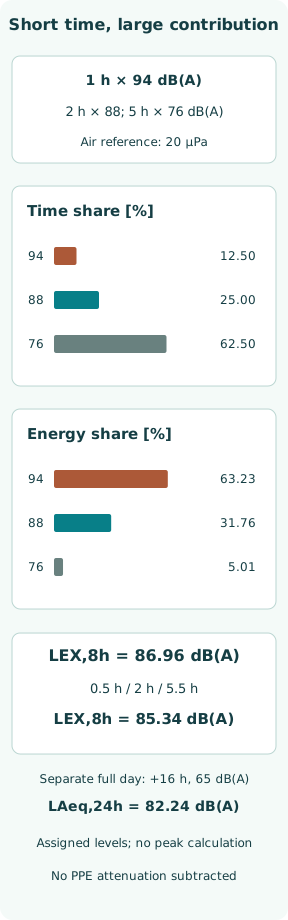
Assign a fictional worker one hour at 94 dB(A), two hours at 88 dB(A) and five hours at 76 dB(A). The first period represents a noisy machinery task, the second rounds, and the last control and documentation work. These are teaching inputs, not measurements of an identified ship. They cover eight hours without overlap and omit no time within that invented record.
To make the arithmetic readable, use 80 dB(A) solely as a calculation baseline. Define qi = Ti × 10^[(Li − 80)/10]. The three terms are 25.1189, 12.6191 and 1.9905 baseline-equivalent hours. This baseline is a mathematical convenience, not a chosen exposure criterion. Changing it would rescale every q while leaving the final physical level unchanged.
Sum exposure before taking logarithms
The terms total 39.7285 baseline-equivalent hours. Normalizing to eight hours gives 80 + 10 log10(39.7285/8) = 86.9601 dB(A), reported as 86.96 dB(A) for the fictional inputs. The loudest hour supplies 63.23% of the accumulated energy quantity, the two-hour interval 31.76%, and the five quieter hours 5.01%. Their time shares alone therefore conceal the dominant contribution.
A direct duration-weighted average of the displayed decibels would be (94 + 2 × 88 + 5 × 76)/8 = 81.25. That arithmetic result does not represent the equivalent noise exposure. The original figure compares time and energy shares to show the error's mechanism. It does not draw a safe/unsafe line or assign a predicted injury probability to either number.
Test a bounded task-time change
For a second invented schedule, halve the 94 dB(A) task to 0.5 hour and move the released 0.5 hour into the 76 dB(A) interval. The durations become 0.5, 2 and 5.5 hours. Holding all three task levels constant gives 27.3682 baseline-equivalent hours and LEX,8h = 85.3416 dB(A). The modeled reduction is 1.6186 dB, rather than half the original decibel value.
This comparison assumes the task can change without creating another exposure or transferring work to somebody unaccounted for. It is not a proposed staffing or maintenance instruction. A real intervention might also change machinery load, the worker's distance, task quality or another person's exposure. The calculation isolates duration so that those additional physical and organizational questions remain visible instead of being silently treated as solved.
Keep eight-hour and full-day results distinct
An eight-hour reference does not mean a person was observed for twenty-four hours. Extend the first case explicitly by assigning another sixteen hours at 65 dB(A). The complete day then contains 40.2345 baseline-equivalent hours, and LAeq,24h = 80 + 10 log10(40.2345/24) = 82.2439 dB(A). This lower numerical level uses a different denominator and includes additional exposure; it does not mean the noisy task became quieter.
The IMO Code defines a twenty-four-hour exposure quantity and identifies chapter 5 and appendix 4 as recommendatory or informative under paragraph 1.1.3. UK maritime MGN 658 Amendment 1 instead discusses daily and weekly occupational exposure under its national regulations. A comparison needs the same quantity, scope and applicable regime; the article's eight-hour and full-day values cannot be exchanged without their definitions.
Make the task log support the measurements
A credible record connects machinery state, place and duration. An integrating meter at one fixed position may describe that location well while missing time spent close to a different source. A worn dosimeter follows movement but can record contact noise, unusual positioning or unrepresentative tasks. Calibration checks, instrument settings, work observations and reasons for excluding suspect intervals should travel with the resulting exposure estimate.
The three clean intervals above deliberately contain no measurement uncertainty. In practice, variable load and uncertain task duration can change which contribution dominates. Preserve individual observations before averaging repeated workdays. A lone unusually quiet day may not represent routine service. An uncertainty allowance is also not permission to dismiss an exceedance; its treatment belongs to the applicable assessment method and the responsible competent person's evaluation.
Distinguish a rating from achieved ear protection
A package attenuation rating describes performance under a specified test and calculation system. It is not a direct measurement of the protection that one worker achieved throughout a particular engine-room task. Noise spectrum, fit, wearing time, condition and compatibility with other equipment affect the interpretation. Subtracting a nominal rating from 86.96 and presenting the answer as a measured protected exposure would therefore make an unsupported claim.
HSE's technical guidance emphasizes correct fitting, maintained seals, compatible equipment and consistent use. A suitable assessment may use the relevant standardized prediction method and supporting fit evidence, while clearly labeling predictions. This example has neither such inputs nor at-ear measurements, so it calculates no protected level. Communication and alarm recognition must also remain possible within the selected protection arrangement.
Reduce exposure at its cause and verify the change
A quieter source, effective acoustic enclosure or changed transmission path can reduce exposure before it reaches the worker. The effect should be checked at the actual occupied locations and relevant machinery states. A closed enclosure that impairs cooling or access introduces another engineering problem; the acoustic improvement alone cannot approve the modification. Task planning has similar interfaces with staffing, supervision and necessary maintenance.
MGN 658 Amendment 1 places risk assessment, exposure control, protection and health surveillance within the UK maritime framework. HSE separately cautions against using hearing protection as a substitute for technical and organizational noise control. Neither source makes this fictional schedule a compliant work plan. The useful verification compares equivalent tasks and records what changed, whom it affected and whether the intended reduction persisted.
State the boundary of the final finding
MSC.337(91) took effect on 1 July 2014 and addresses new ships of 1,600 gross tonnage and above, subject to its defined exclusions and SOLAS application. Its provisions have different mandatory and recommendatory status. An older or excluded ship still needs its applicable occupational framework established; absence from one design code does not establish absence of a noise hazard. MSC.1/Circ.1509/Rev.1 updates instrument-calibration interpretation, with application no later than 1 June 2026. The texts were checked on 8 October 2026; the original resolution alone is not a complete current instrument specification.
The calculation demonstrates unequal energy contributions, a bounded duration sensitivity and a distinct full-day normalization. It establishes no permissible task duration, hearing-protector specification, peak limit or individual health outcome. A defensible operational conclusion would add representative measurements, the worker's complete exposure record, the governing requirements and evidence that source controls and personal protection perform as intended in that vessel's conditions.
Sources
- IMO Resolution MSC.337(91): Code on Noise Levels on Board Ships. Adopted 30 November 2012; took effect 1 July 2014; actual public resolution read 8 October 2026 — Sections 1.1.3, 1.3, 1.4.3/10/33; chapters 3, 5 and 7; recommendatory status retained
- MCA MGN 658 (M+F), Amendment 1: Control of Noise at Work Regulations 2007. Amendment 1, 2025; current public HTML read 8 October 2026 — Sections 3–8 and 13; UK maritime occupational exposure and personal protection
- HSE: Hearing protection. Current public guidance checked 8 October 2026 — Selection, compatibility, condition, correct fit and continuous use
- IMO MSC.1/Circ.1509/Rev.1: Unified interpretations of the Code on Noise Levels on Board Ships. 17 June 2024; actual IMO circular in ClassNK TEC1335 attachment 15; checked 8 October 2026 — Cover paragraph 2: revised section 2 calibration interpretation applied at next calibration due date, no later than 1 June 2026