Knowledge / Rules and safety management
Fatigue and rest hours: compliance records and actual alertness
Distinguish statutory work/rest accounting from sleep opportunity and fatigue risk, including rolling periods, interruptions, circadian timing and the quality of records.
On this page
A rest-hours record and a fatigue assessment describe related but different things. The record establishes when work and rest occurred under the applicable accounting rules. Fatigue concerns a person’s capacity to perform reliably in the actual conditions. Sufficient recorded time away from work does not prove that restorative sleep occurred, while an apparently normal performance at one moment does not establish that the schedule is sustainable. Both the formal limits and the physical opportunity to recover matter.
Identify the applicable work and rest regime
The ILO Maritime Labour Convention text, Standard A2.3, provides alternative national frameworks based on maximum work or minimum rest. The minimum-rest route includes 10 h in any 24 h and 77 h in any seven days, subject to the instrument’s detailed provisions and applicable implementation. Under the paragraph 6 baseline, rest is split into at most two periods, including one of at least six hours, with no gap between successive rest periods exceeding fourteen hours. Applicable exceptions and implementation still require checking. The choice of regime is not a daily option for a ship to select whichever calculation is more convenient.
IMO’s work-and-rest overview separately explains STCW fitness-for-duty provisions for watchkeeping and designated safety, security and pollution-prevention duties. The actual ship, role, flag-state implementation and permitted arrangements must be identified. This article uses baseline arithmetic to explain the accounting; it does not determine an individual seafarer’s legal entitlement or approve a roster.
Do not replace a rolling-period check with a daily total
Any 24-hour period is not necessarily the same as midnight to midnight. A work concentration across a date boundary can be hidden by separate calendar-day totals. A seven-day requirement likewise needs the relevant moving window, not only a calendar-week summary. Accurate timestamps and consistent treatment of changes are necessary to examine those windows.
For a simple baseline example, exactly 10 h of rest in each of seven non-overlapping 24 h periods totals 70 h. That is seven hours below the 77 h minimum-rest baseline for the complete seven-day interval. Meeting a daily total alone therefore does not establish the weekly requirement. This example assumes no applicable exception and is not a recommended schedule.
Separate recorded rest from sleep obtained
IMO’s fatigue guidelines emphasize sleep quality, circadian timing and sleep debt alongside hours of rest. Time outside work includes activities other than sleep, and sleep can be delayed or interrupted. A rest record should not be relabelled as a sleep record without actual evidence.
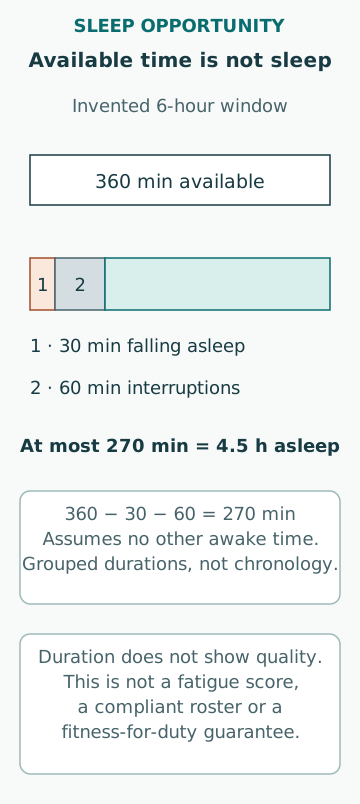
In an invented six-hour sleep opportunity, suppose 30 min pass before sleep and interruptions total another 60 min. At most 4.5 h remain for sleep within that window, assuming no other awake time. The arithmetic does not measure sleep quality or diagnose fatigue. It illustrates why a six-hour block on a timetable cannot be interpreted automatically as six hours of restorative sleep.
Account for timing as well as duration
Circadian timing affects the tendency to sleep and remain alert. A rest opportunity during the biological day can differ from one during the biological night, and changing schedules or time zones can complicate recovery. Two schedules with the same total hours may therefore provide different opportunities for useful sleep.
A shipboard assessment should consider the actual pattern rather than assume that an equal number of hours makes arrangements equivalent. Port calls, watch changes, alarms and maintenance can place demands at difficult times. The relevant question is how the combined pattern affects the next task and recovery, not whether each isolated activity appears manageable on its own.
Consider workload and environment
NIOSH’s fatigue overview identifies nonstandard schedules, demanding work, stress and heat among relevant factors, and describes effects on attention, reaction and judgement. These general occupational mechanisms are relevant to maritime tasks, but they do not provide a numerical fatigue score for a particular crew member.
Noise, vibration, vessel motion, cabin conditions and interruptions can also affect the practical opportunity for rest. A planned break can be displaced by an unplanned repair or a call-out. The assessment should connect the conditions people actually experience with the tasks they are expected to perform, especially when several safety-critical demands arrive together.
Keep the records truthful and useful
A planned roster describes intention; actual work/rest records describe what happened. Call-outs, drills, handovers and other required tasks should be reflected according to the applicable rules. Copying the planned pattern after interruptions conceals the exposure that fatigue management needs to understand.
A good record supports both compliance review and operational learning. Recurring interruptions can identify a machinery reliability problem, an unrealistic workload assumption or an organizational issue. Treating the record only as a form to be made compliant misses that information. Errors should be corrected through the proper process with the underlying timing evidence retained, rather than adjusting entries to produce a favourable total.
Avoid turning one indicator into a fitness guarantee
Self-reported sleepiness, observed performance, sleep records and fatigue-prediction tools can each provide information with limitations. A person may not recognize every performance impairment, and a model depends on its inputs and validation scope. A favourable score cannot replace the actual assessment of the task, condition and available safeguards.
Conversely, a fatigue report should be usable information rather than treated as an admission of personal failure. The operating response belongs within the ship’s safety-management and authority arrangements. The purpose is to address the work and recovery conditions that affect safe performance, including organizational contributors, instead of relying solely on individual determination to remain alert.
Examine recovery after interruptions and accumulated demands
A single rest period does not describe the recent sequence of work and sleep. Repeated short or disrupted sleep opportunities can leave a person with insufficient recovery even if the latest calendar entry looks acceptable. A longer break also should not be assumed to reverse every effect instantaneously; the relevant pattern and actual sleep opportunity matter.
The response should be based on the applicable requirements, operational demands and competent assessment. Scheduling, manning, task allocation and the sleeping environment are connected controls. A plan that depends on uninterrupted rest should be reconsidered when routine call-outs repeatedly make that assumption false. This is a system-level learning issue, not merely an arithmetic correction to one day’s form.
Use compliance evidence and fatigue evidence together
A useful review retains the applicable rule basis, actual work/rest timing, interruptions, recent duty pattern, sleep opportunity and task demands. It distinguishes confirmed information from assumptions and records what changes when the plan is disrupted. The goal is to make both legal accounting and operational capability visible.
Rest-hour limits are important safeguards, but passing a numerical check is not a certificate of alertness. Fatigue management needs truthful records and attention to how work, timing and environment influence recovery. Keeping those questions connected helps prevent an apparently compliant schedule from concealing conditions that undermine the next watch or maintenance task.
Sources
- MLC2006 as amended, including2022 amendments · ILO · Source check date: 2026-10-07
- Seafarers hours of work and rest · IMO · Source check date: 2026-10-07
- MSC.1/Circ.1598: Guidelines on fatigue · IMO · Source check date: 2026-10-07
- Fatigue and Work,updated14July2026 · CDC/NIOSH · Source check date: 2026-10-07