Knowledge / Rules and safety management
Hot work: heat transfer and hazards in adjacent spaces
Understand how conducted heat, radiation, sparks and changing atmospheres can carry hot-work hazards beyond the visible work face, including concealed shipboard spaces.
On this page
The visible work face is not necessarily the boundary of a hot-work hazard. A steel partition can carry heat to material on its opposite side, openings can pass sparks to a lower level, and vapours can migrate from another activity. A location that appears clear from the welder’s position may therefore remain connected to an ignition hazard elsewhere. The engineering question is where energy and combustible material can meet, including places that are difficult to see.
Define the affected volume, not only the task location
A shipboard hot-work assessment needs the geometry around the work: the opposite side of bulkheads and decks, enclosed voids, cable and pipe routes, penetrations and spaces below. The boundary follows credible heat and material-transfer paths. It is not necessarily the same as the compartment named on a work order.
The US shipyard fire-watch rule, 29 CFR 1915.504, explicitly addresses ignition on opposite sides of boundaries by conduction or radiation and hazards through openings. That is a jurisdiction-specific regulation, used here to identify the physical mechanism. Its detailed applicability and requirements must not be silently substituted for another ship, port or employer’s governing framework.
Separate the energy-transfer mechanisms
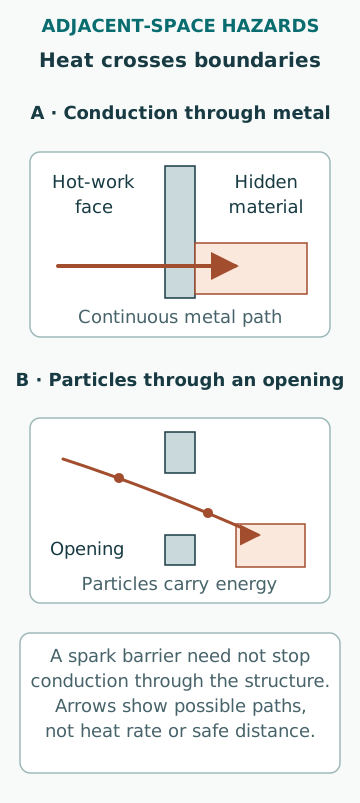
The DOE heat-transfer handbook distinguishes conduction through material from convection and radiation. In a hot-work context, conduction can move heat through a continuous metal path without sparks crossing the boundary. Radiation can heat an exposed surface across a gap. Hot particles can transport energy through an opening and lodge in material elsewhere.
These mechanisms can coexist. Shielding that intercepts sparks may not address heat conducted through the deck beneath it. An apparently closed metal boundary can block particle travel while still transferring heat. Identifying the mechanism helps explain why observing only the work face, or only the place where sparks are visible, can leave a material part of the hazard unexamined.
Use an energy balance without claiming an ignition prediction
For an invented lumped-capacity example, suppose a net 500 W enters a 2.0 kg object for 120 s. Assume uniform temperature, constant specific heat 500 J/(kg·K), no phase change and no other net energy path. Energy increase is 500 × 120 = 60,000 J. The modelled temperature rise is 60,000/(2.0 × 500) = 60 K.
The 500 W is the assumed net input to that object, not a welding-machine setting or a measured transfer through a real bulkhead. The uniform-temperature assumption excludes local hot spots. The result does not establish an ignition temperature, safe separation distance or observation duration. It simply shows that accumulated energy and thermal mass matter, and that a modest sustained input can change the condition of material away from the visible source.
Account for concealed combustible material
Insulation systems, coatings, cable coverings, residues, packaging and material stored against the opposite surface can create different ignition and smoke hazards. The metal surface visible from one side may hide those materials. An old drawing can identify intended construction but may not represent later repairs, contamination or temporary storage.
The relevant question is not merely whether the boundary itself is combustible. A metal boundary can conduct energy to combustible material in contact with it. A concealed gap can allow hot particles to settle where direct observation is poor. Evidence about the adjacent construction and actual contents is therefore necessary to define the affected area and the limits of any protective arrangement.
Keep atmosphere and solid-fuel questions separate
The US Chemical Safety Board’s hot-work recommendations emphasize the potential for flammables in surrounding tanks and adjacent spaces. A local atmosphere reading does not describe every connected volume or establish that concealed solid combustibles cannot ignite. Conversely, removing visible combustible material does not establish that a vapour source is absent.
A tank that once contained a flammable material can retain residues or receive material through a connection. Another operation can introduce vapours after an earlier assessment. The work review should identify those sources and pathways within the applicable permit and testing process. This article provides no gas-free declaration or numerical atmospheric condition that authorizes hot work.
Understand what observation can and cannot cover
Observation arrangements need to correspond to the areas in which ignition could occur, including blind or separated spaces. One person who can see the work face may not be able to see an opposite compartment or several levels at once. Communication and authority to respond to changing conditions are part of the function, not just the presence of someone holding an extinguisher.
Thermal imaging or temperature measurements can add evidence, but line of sight, surface emissivity and hidden interfaces limit their interpretation. A cool accessible surface does not necessarily describe an inaccessible layer. A measurement method should be selected for the question it can answer and should not be used to declare unobserved material safe by implication.
Recognize that the hazard can persist after energy input stops
Stopping the work removes the active source but does not instantaneously remove stored heat or an already developing concealed fire. Heat can continue redistributing, and material that has begun to smoulder may be difficult to recognize from the original work position. The post-work condition is therefore a separate assessment question.
Applicable rules and the work-specific assessment determine monitoring and completion criteria. A generic minimum time quoted from another jurisdiction is not a universal guarantee that the hazard has ended. The evidence should address the actual affected spaces and mechanisms. Administrative completion of the work order should not be confused with a demonstrated absence of continuing fire risk.
Review interactions with nearby activities
Painting, cleaning, fuel transfer, opening lines or changing ventilation can alter the hazard while hot work is under way. The activity may be in another compartment and controlled by another team. Separate permits do not by themselves show that the combination has been assessed. The affected boundary must include relevant material and ventilation connections.
An interruption can also change the starting condition for resumed work. Materials may have been moved, protective arrangements disturbed or another operation started. A previously valid assessment has a configuration and time basis. The process for recognizing and communicating changes should be clear to the people carrying out and overseeing the actual work.
Record the mechanism and the evidence of control
A useful hot-work record explains the work boundary, heat and particle paths, actual adjacent contents, atmospheric concerns and arrangements that address each mechanism. It identifies any inaccessible area and how that limitation affects the decision. The evidence should connect the assessed hazard to the actual condition at the time of work, rather than merely reproduce a generic form.
Hot-work safety around ship structures depends on understanding connections that the visible work face can conceal. Conduction, radiation, particles and migrating vapours follow physical paths, not administrative compartment labels. Keeping those paths explicit helps the applicable work-control process address the whole hazard without turning a single inspection, gas reading or temperature value into a permission it cannot supply.
Sources
- 29 CFR1915.504: Fire watches · US OSHA · Source check date: 2026-10-07
- Safe Hot Work Practices · US Chemical Safety Board · Source check date: 2026-10-07
- DOE-HDBK1012/2-92: Heat Transfer · US Department of Energy · Source check date: 2026-10-07