Knowledge / Rules and safety management
Near-miss reporting: exposure, reporting bias and useful learning
Interpret near-miss reports as evidence about mechanisms and barriers, distinguish recorded counts from underlying occurrence, and follow findings through to verified change.
On this page
A near-miss report can reveal a weakness before it produces serious harm. Its value depends on what is learned from the event and what changes afterwards, not simply on adding another entry to a database. Reported counts are influenced by exposure, recognition and willingness to report. Understanding those influences helps an organization avoid both complacency when reports are few and a mistaken conclusion that increased reporting necessarily means deteriorating safety.
Describe the event and its potential separately
IMO’s MSC-MEPC.7/Circ.7 frames near-miss reporting as a way to learn from sequences that could have led to loss. Record what actually happened before describing the plausible potential consequence. The two descriptions should remain distinct so that the report neither minimizes the event because no one was harmed nor presents an imagined outcome as an observed fact.
For an original machinery example, a connection intended for one service is found attached to an incompatible point before operation. The observed event is the wrong connection and its discovery. The potential depends on what would have happened if the system had been energized or used, including the actual fluids, pressures and barriers. Those details are needed before assigning a severity category.
Identify why the loss did not occur
A loss may have been prevented by a functioning protective measure, an unplanned intervention or a favourable circumstance. Distinguish these. A robust independent check that detected the wrong connection provides different evidence from a person happening to notice it while passing. Both can prevent harm in the observed event, but they support different claims about recurrence.
Also examine whether the apparent recovery can be relied upon in the next occurrence. A chance observation may not be available at night or under a different workload. A barrier that worked on this demand may still have a limited coverage. The near miss can therefore provide evidence about successful control as well as failed control, provided the conditions and limitations are retained.
Understand the reporting process as a measurement system
The recorded count depends on actual event occurrence, whether someone recognized the event, whether it was reported and whether it was coded into the dataset being reviewed. A change in any of those stages can alter the count. A new reporting tool, clearer definition or more supportive response can increase recorded reports without increasing the underlying occurrence rate.
The reverse is also possible: workload, fear, cumbersome forms or lack of feedback can reduce reports while the underlying hazards remain. A zero count is therefore ambiguous. It can mean few events, little exposure or weak observation and reporting. Interpret the count alongside the operational context and other evidence of barrier condition.
Work through a reporting-bias example
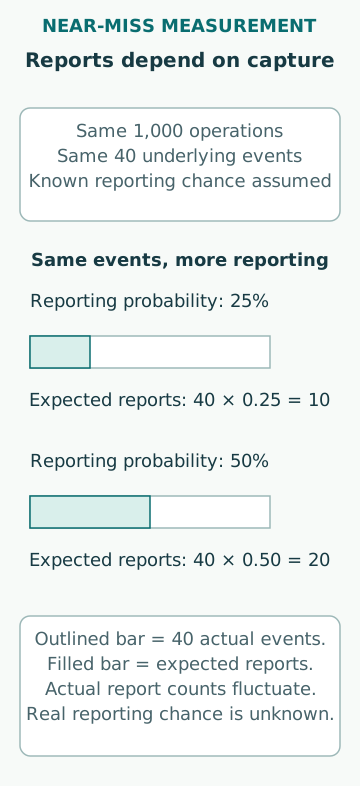
Suppose, only for a teaching model, 1,000 comparable operations contain 40 actual near-miss events. If each event has an independent 25% chance of being reported, the expected reported count is 10. If reporting probability improves to 50% while actual events remain 40, the expected count becomes 20. The underlying rate remains 40/1,000 = 0.040 events per operation.
The expected recorded rates rise from 0.010 to 0.020 events per operation even though the modelled underlying occurrence has not changed. The reporting probabilities in this example are assumed and known; real observations usually do not reveal them directly. Dividing a real reported count by a guessed reporting fraction would not produce a defensible estimate of the true event rate without supporting evidence.
Keep causal evidence separate from labels
HSE HSG245 recommends structured investigation rather than jumping to an operator-error conclusion. In the connection example, record the sequence, available information, equipment identification, work conditions and checks. Wrong connection describes an event; it does not explain why the system made that error possible or why the usual control did not prevent it.
Possible explanations should be tested against evidence. Similar connectors, unclear labelling, an inaccurate drawing or a misunderstood handover are different hypotheses, not a ready-made list of proven causes. A useful report shows what is known, what is inferred and what remains unresolved. Preserving that distinction makes later review and comparison much more informative.
Prioritize credible potential and recurrence
A near miss with no actual injury can still reveal a serious vulnerability. The investigation depth should consider credible potential consequences, likelihood of recurrence and the controls that remain, rather than only the absence of loss. Credibility requires a plausible physical or operational path, not simply the worst imaginable outcome.
Reports also should not be reduced to a universal accident triangle that promises a fixed number of major losses from a given number of minor events. Different mechanisms, exposure and reporting processes can produce different relationships. It is more useful to identify recurring causal patterns and barrier weaknesses than to treat every near miss as an interchangeable unit in a predictive ratio.
Make reporting credible to the people involved
People need to understand how information will be used, who will see it and how the organization distinguishes learning from accountability. A broad promise that no conduct can ever have consequences may be unrealistic, while an automatic blame response discourages useful information. The applicable reporting policy should explain its boundaries clearly and be applied consistently.
Collect information needed to understand and correct the event, while handling personal details according to the applicable requirements and confidentiality arrangements. Sharing a lesson rarely requires broadcasting every identifying detail. Internal learning also does not cancel external reporting duties where they apply. A company near-miss category is not itself a legal determination that no authority needs to be notified.
Verify that the action changes the mechanism
HSE’s learning-organizations guidance distinguishes identifying lessons from embedding them in practice. In the original example, an instruction to be more careful may leave the same ambiguous interface. A proposed change should address the supported cause and have an observable completion criterion related to the required function.
A revised label, changed connector or improved check each needs evidence that it addresses the relevant scenario without creating another problem. Record the owner, completion condition and verification result. A closed action count says that tasks were administratively closed; it does not necessarily show that the near-miss mechanism has been removed or controlled.
Build a record that supports later learning
Use consistent event and causal definitions so that similar reports can be found across time, while preserving the original facts. Feedback should explain what was investigated, what changed and why an action was or was not adopted. Recurring reports after an apparently completed action should trigger examination of its effectiveness and scope.
The purpose of near-miss reporting is a better understanding of how harm nearly occurred and what can prevent recurrence. Counts help organize attention, but they are not a direct measure of safety without exposure and reporting context. The strongest evidence of learning is a demonstrated change in the relevant barrier or work system, together with continued observation of whether that change performs as intended.
Sources
- MSC-MEPC.7/Circ.7: Guidance on near-miss reporting,10October2008 · IMO; official copy hosted by Estonian Transport Administration · Source check date: 2026-10-07
- HSG245: Investigating accidents and incidents,2004 · UK HSE · Source check date: 2026-10-07
- Learning organisations · UK HSE · Source check date: 2026-10-07