Knowledge / Rules and safety management
Simultaneous operations: permit interfaces and interacting hazards
Assess combinations of shipboard work through shared boundaries, utilities, resources and time, rather than assuming that individually authorized tasks are jointly compatible.
On this page
Two activities can each have a well-prepared work permit and still create an unassessed hazard when performed together. One can introduce vapour, remove power, change ventilation or block access needed by the other. Simultaneous-operations assessment examines the combined state of the ship and worksite. Its central question is whether the assumptions that make each task controlled remain valid when other planned or actual work is added.
Treat the combination as a separate question
HSE HSG250, paragraph 22 explains that one permitted activity must not endanger another, including work that does not itself need a permit. The general principle applies to the interaction assessment: do not limit the review to the list of formal permits if ordinary cargo, machinery or housekeeping activities can change the conditions.
For an illustrative shipboard case, consider hot work, solvent-based cleaning and a ventilation-system task in connected areas. The combined concern is not just three copies of their individual hazards. Cleaning can introduce a source, hot work an ignition mechanism, and ventilation work a change to transport or removal. The actual substances, connections and work methods determine whether the combination is compatible.
Map the shared physical interfaces
The interaction boundary can follow pipes, cables, ventilation, structure, access routes and drainage rather than departmental or compartment labels. A job in another space can affect a common supply or discharge path. A local isolation can also remove a utility credited by someone else’s task assessment.
A practical interface record identifies what each activity introduces, removes, changes or requires. Examples include heat, vapour, pressure, electrical energy, noise, visibility, access and communication. Pairwise discussion helps, but a combination of three activities can create a state that no isolated pair captures adequately. The aim is an engineering explanation of the interaction, not a matrix filled with unexplained colour codes.
Include shared protective and emergency resources
IMO MSC.581(110), paragraph 3.10 specifically addresses additional SIMOPS risks when an operation includes enclosed-space entry, including personnel and emergency resources. Its scope should be retained. More generally, a plan needs to establish whether simultaneously credited resources can perform their functions for the combined work state.
The same trained person, communication channel, access route or piece of equipment may appear in several task plans. Listing it repeatedly does not multiply its capacity. The assessment should consider conflicting duties, travel and access, and the effect of one incident on the other activity. This is not a formula for staffing; it is a requirement to make the actual resource assumptions explicit.
Use time windows rather than only a daily task list
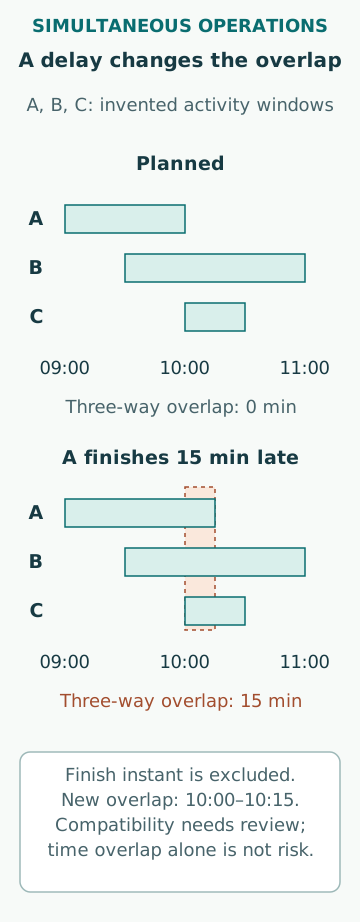
Consider a purely illustrative schedule. Activity A runs from 09:00 to 10:00, B from 09:30 to 11:00 and C from 10:00 to 10:30. Treat the intervals as ending immediately before the stated finish time, so an exact boundary contact is not counted as overlap. A and B overlap for 30 min; B and C overlap for 30 min; A and C do not overlap.
There is no three-way overlap in that planned schedule. If A overruns to 10:15, all three activities overlap from 10:00 to 10:15, or 15 min. A delay can therefore create a new combined state without any task description changing. A schedule that was assessed once needs a way to recognize when actual start, interruption or completion times alter its assumptions.
Link shared isolations and restoration decisions
The US shipyard rule 29 CFR 1915.89 includes coordination for simultaneous servicing and multi-employer energy-control arrangements. It illustrates why an isolation supporting more than one job cannot be treated as belonging only to the first completed work order. The provision’s legal scope remains specific to the applicable US shipyard work.
If one task is finished while another still relies on the same isolated state, restoration is a shared-interface decision. The work-control record must show all relevant dependencies and the actual status of affected work. A contractor’s local completion report does not by itself demonstrate that everyone relying on the boundary is ready for the energy or process condition to return.
Make compatibility conditional and specific
An assessment can conclude that activities are incompatible, that they can occur with specified controls, or that they do not interact materially within a defined boundary. Each conclusion needs a reason. A generic statement that both jobs are low risk does not address a source from one meeting an ignition mechanism from the other.
Conditional compatibility should state the conditions that must remain true and how a change is recognized. If the conclusion relies on a ventilation path, a spatial separation or an exclusive resource, the status of that dependency matters. A broad approval label without these conditions makes it difficult for the work teams to know when the assessed state no longer exists.
Coordinate across employers and functions
The ship, terminal, repair contractor and specialist service provider may each hold part of the information. One knows the cargo or fluid inventory, another the work method, and another the system configuration. An interface review needs those facts to be combined before the work relies on assumptions owned elsewhere.
Communication should identify who maintains the current combined work picture, who can resolve conflicts and how changed conditions reach affected teams. A meeting is not sufficient evidence of coordination if no one can explain the present status. The arrangement must also cover work introduced after the meeting and activities that stop or change unexpectedly.
Define interruption and restart as state changes
A paused job can leave temporary equipment, open boundaries, partially completed isolations or residual material. The pause does not necessarily restore the original safe condition. Restart can also occur after another activity has changed the environment. The combined assessment should therefore distinguish active, paused, completed and restored states where those differences matter.
A handover needs to transmit the relevant residual conditions, not merely whether a permit is open or closed. If a control becomes unavailable or an unexpected interaction appears, the response should follow the applicable work-control and authority arrangements. This article does not provide a universal stop/restart sequence or authorize any particular combination of hazardous work.
Preserve evidence that the combined state was assessed
A useful record links the activities, time windows, physical interfaces, shared resources, restrictions, responsible roles and communication route. It shows why the combination was judged compatible within its scope and what evidence supports critical assumptions. Changes and the resulting reassessment should remain traceable.
SIMOPS quality is not measured by how many permits can be issued at once. It is measured by whether the actual combination of work retains the protective conditions on which each task relies. Keeping the combined state visible helps prevent individually reasonable plans from becoming collectively inconsistent as the ship, people and schedule change.
Sources
- HSG250: Guidance on permit-to-work systems · UK HSE · Source check date: 2026-10-07
- MSC.581(110): enclosed-space recommendations,2025 · IMO · Source check date: 2026-10-07
- 29 CFR1915.89: hazardous energy coordination · US OSHA · Source check date: 2026-10-07