Knowledge / Navigation and marine safety
Bridge alert management: priorities, acknowledgement and persistent hazards
Distinguish alert priority, handling category, acknowledgement and recovery, with a worked event timeline and workload example.
On this page
The purpose of bridge alerts is to make a condition understandable in time for a useful response. Acknowledging a message changes its presentation and handling state; it does not necessarily change the condition that caused it. That distinction is central to effective alert management.
An alert is a claim about a condition
An alert draws attention to a condition detected or inferred by a system. Its value depends on whether the bridge team can identify the source, understand the consequence and connect it to an appropriate response. Sound alone carries little explanation. A display that is quiet after acknowledgement can still represent an unresolved hazard.
IMO resolution MSC.302(87), adopted 17 May 2010, establishes the bridge alert management framework. Its installation recommendations and modules should be read with the applicable equipment approvals. It is not a universal retrofit statement for every bridge or a substitute for the individual system’s operating manual. The following examples examine information and response states rather than prescribing alarm settings.
Priority and category answer different questions
The standard distinguishes emergency alarms, alarms, warnings and cautions by urgency and the kind of attention required. Separately, categories A, B and C concern where the information needed to evaluate or acknowledge the alert is available. Category A needs task-station information; category B can be handled with the information available at the central interface; category C cannot be acknowledged on the bridge.
Therefore “category A” does not simply mean the highest urgency, and “caution” does not mean irrelevant. A useful training exercise identifies both axes for an actual documented alert: what attention it requires, and where the necessary understanding and acknowledgement belong. Guessing from colour alone or from alphabetical order can conceal the intended handling arrangement.
Silenced, acknowledged and rectified are distinct states
Temporary silencing changes the audible presentation. Acknowledgement records that an alert has been recognized through the intended interface. Rectification concerns the underlying condition. These states can occur at different times and have different consequences. In the standard’s alarm-state model, an acknowledged alarm remains visually indicated while its condition persists; detailed exceptions and equipment-specific behaviour must be read in the applicable documentation.
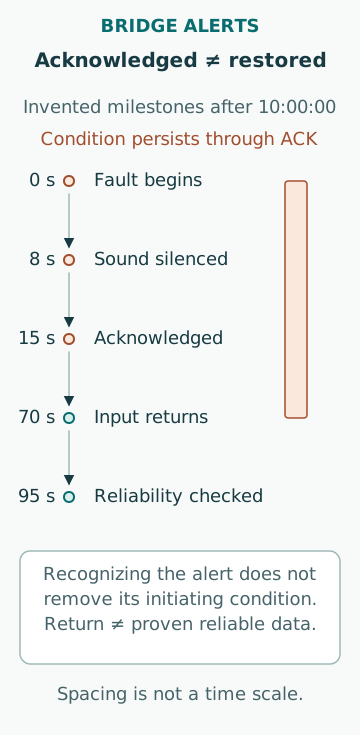
For an original example, a source fault begins at 10:00:00, the sound is silenced at 10:00:08, the alert is acknowledged at 10:00:15, the input returns at 10:01:10 and its reliability is checked at 10:01:35. Those are five milestones, not one event called “alarm cleared.” A restoration indication at 70 seconds also does not by itself prove that the restored data are plausible.
Many announcements can arise from one initiating fault
A heading-source interruption can affect radar stabilization, chart orientation and other dependent functions. Several alerts may therefore describe consequences of one failed source rather than several unrelated failures. Conversely, similar-looking messages can arise from independent problems. The task is to preserve source identity and causal relationships without suppressing information that matters.
In a fictional six-minute replay, 24 announcements arrive, an average of four per minute. If each consumes an assumed fifteen seconds of exclusive attention, the nominal processing demand is 360 seconds, the entire six-minute interval. This is not a measured human-performance limit or an alarm-rate standard. It illustrates how duplicate or poorly explained messages can consume the time needed for navigation and diagnosis.
A central display is not a new source of truth
Central presentation can make alerts easier to find and compare, but it still depends on interfaces, source messages, network health and time synchronization. A source system and the central display may show different states if an acknowledgement or update is delayed. A healthy-looking central screen cannot prove that every connected source is healthy or that every expected alert arrived.
An effective technical test therefore checks the path from the originating condition through detection, transmission, presentation and the permitted acknowledgement response. Testing only a buzzer or a screen icon establishes a much narrower claim. The test record should say which links were challenged and which were assumed, including what happens when communication with a source is lost.
Explain the condition in operationally useful language
An alert message should help distinguish a process hazard from an instrument fault. “Position unavailable” and “predicted grounding” are not equivalent, even though losing position information can impair grounding protection. The bridge team needs to know what remains available, what assumptions are invalid and which task station contains the supporting information.
For a learning exercise, rewrite an ambiguous fault description into a statement containing source, affected function and current state, then compare it with the actual manufacturer’s terminology. Do not invent a new operational meaning for an established alert. The exercise should reveal information gaps and documentation needs, rather than create unofficial labels that conflict with the installed system.
Alarm reduction must address causes
Repeated alerts can result from a genuine recurring condition, unstable input, inappropriate configuration or maintenance impairment. They do not become harmless merely because they are familiar. A review should examine the trigger history, the actual operating context and whether each announcement led to a meaningful response. Removing the sound alone changes attention, not the physical condition.
Any change to thresholds, delays, suppression or grouping belongs within the approved configuration and change-control process. A setting that reduces nuisance announcements can also delay or remove a useful warning. Evaluate the trade-off with evidence and retain the intended safety function. This article supplies no recommended threshold, delay or blanket rule for disabling a repeated alert.
Handover must carry unresolved conditions
An acknowledged alert can be easy to overlook because it no longer demands attention in the same way. Handover should therefore communicate the underlying unresolved condition, its effect on available functions, actions already taken and evidence still required. Reading only the new-alert list can omit the most consequential continuing limitation.
For an original comparison, two watches each report zero new alerts. One has no active fault; the other has three acknowledged faults affecting a shared sensor chain. The count is identical but the available navigation capability is different. A useful status description includes active conditions and dependencies, not just the number of fresh sounds.
Measure response quality rather than button speed
A fast acknowledgement is easy to time, but it is not the whole response. A debrief can separately measure recognition, source identification, assessment, communication, action and verification of the resulting state. Record uncertainty when timestamps come from unsynchronized systems. A reconstructed sequence should not pretend to be more precise than its clocks.
Common errors are treating silence as restoration, confusing category with priority, counting duplicate messages as independent hazards and clearing the list to create a tidy display. The useful outcome is a shared understanding of what remains wrong and what evidence would demonstrate recovery. Bridge alert management supports that understanding; it cannot replace it.
Sources
- MSC.302(87): Performance standards for bridge alert management · IMO · Source check date: 2026-10-06