Knowledge / Navigation and marine safety
Heading errors: gyro bias, magnetic deviation and independent comparison
Separate variation, deviation and gyro correction, then test sign conventions, circular angles and shared heading dependencies.
On this page
A heading discrepancy can come from different north references, a local magnetic effect, sensor bias, timing or shared input errors. The first task is to define what each indication represents. Clear sign conventions make the subsequent comparison reproducible.
A heading value needs a north reference
Heading describes the orientation of the vessel’s fore-and-aft axis relative to a stated north reference. True north, magnetic north and the north indicated by an installed magnetic compass are not necessarily the same. A number marked simply “heading” can therefore be incomplete. Record the source, true or magnetic reference, any correction applied and the time of the reading.
Course over ground describes the direction in which a reference point moves over the Earth. It can differ from heading because of current, leeway or manoeuvring. Comparing a compass directly with COG and calling the difference a compass error assumes away those physical effects. That assumption can be especially poor at low speed, when COG itself may be unstable or poorly defined.
Variation and deviation arise from different causes
Magnetic variation, or declination, is the angle between magnetic and true north at a location and time. The NOAA/British Geological Survey World Magnetic Model 2025 represents the main magnetic field for its stated 2025–2030 interval. It does not measure the magnetic field created by a particular ship’s steel, equipment or cargo. The model version, date and location belong with any value derived from it.
Deviation concerns the installed compass’s departure from the local magnetic reference because of the vessel and its surroundings. It can depend on heading and the ship’s magnetic condition. A deviation card is therefore associated with a particular installation and condition, not a universal correction for every compass aboard. A current variation value cannot repair an obsolete or unsuitable deviation record.
Define the sign convention and calculate once
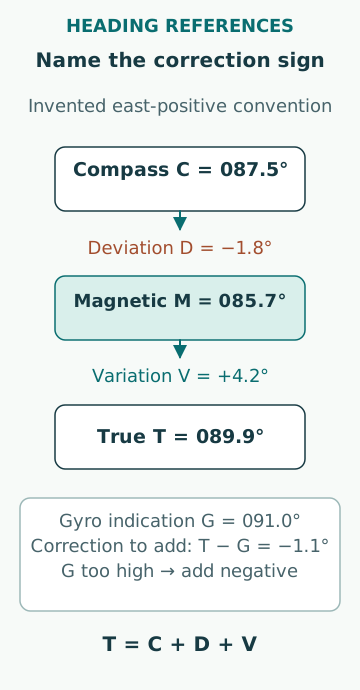
Use an explicit east-positive convention: magnetic heading M = compass reading C + deviation D, and true heading T = M + variation V. For an original example, C = 087.5°, D = −1.8° (west) and V = +4.2° (east). Then M = 085.7° and T = 089.9°T. The total compass-to-true correction is +2.4°.
If the same moment’s gyro indication is G = 091.0°T, its reading is 1.1° higher than the independently estimated true heading; the correction to add to G is −1.1°. Naming both the comparison and the correction prevents ambiguity over “positive gyro error.” The example assumes valid deviation and variation values, synchronized observations and no unaccounted observation error. It is not a calibration result for any ship.
Wrap angles correctly at north
Angles repeat every 360°. A true bearing of 001° and an indicated bearing of 359° differ by +2° in the shortest signed true-minus-indicated comparison, not −358°. A robust calculation normalizes the difference to a declared interval such as −180° to +180°. The chosen treatment at exactly 180° should also be explicit in software or a worksheet.
Averaging angles as ordinary numbers can fail for the same reason. The arithmetic average of 359° and 001° is 180°, although both observations point near north. For this symmetric example, vector averaging of sine and cosine components gives 000°. That does not make averaging appropriate during a real turn; time and physical changes must still be considered.
Gyro behaviour has its own dependencies
A north-seeking gyro system and a magnetic compass use different physical references. Gyro performance can depend on design, latitude, motion, settling behaviour and corrections supplied to the system. Modern inertial and satellite heading devices add other architectures. The word “gyro” on a repeater is not sufficient evidence of the underlying sensor or its current operating state.
Identify whether speed, latitude or position inputs support corrections, and what the system does when those inputs fail. A nominally independent heading channel may share power, processing or external aiding with another channel. A steady output can be frozen, delayed or biased. Stability of the displayed digits is therefore different from demonstrated heading accuracy.
An independent bearing can test the whole heading chain
A comparison with a known true bearing can test heading error when the object, observer position, timing and bearing instrument are sufficiently reliable. A charted transit or an appropriately determined celestial azimuth provides a different evidence path from another repeater fed by the same heading source. Each method has its own uncertainty and practical conditions.
For an original example, an independently established true bearing is 075.0°T while the corresponding gyro-referenced observation is 077.0°. The true-minus-indicated correction is −2.0°. Repeating the observation can reveal scatter, but repetition does not remove a wrong object identity or an error in the assumed true bearing. Record the method and assumptions rather than retaining only the correction.
Small heading errors propagate into other displays
At range R, a pure angular rotation error δ produces an approximately transverse displacement R sin δ. For R = 3,000 m and δ = 2°, that component is 104.70 m. The calculation is geometric and is not a radar accuracy specification. It explains why a common heading bias can create an increasing overlay mismatch with range.
Heading also enters vector reconstruction, autopilot or track-control functions and the positioning of hull outlines relative to antennas. The exact effect depends on each system’s inputs and logic. Correcting a display offset by eye can hide the shared source error while introducing another one elsewhere. A diagnosis should trace the source and distribution path before attributing every disagreement to separate sensors.
Magnetic changes need documented follow-through
MCA MGN 610 Amendment 1, Annex D discusses residual-deviation records, changes to nearby magnetic or electrical equipment, cargo effects and separate treatment of transmitting magnetic compass installations. These are UK implementation and maintenance provisions; their detailed applicability must be checked for the actual vessel. They illustrate why a deviation card should not be treated as timeless.
Portable equipment, structural work or a changed magnetic environment can invalidate an earlier assumption. A comparison should record heading, vessel condition and recent changes. Adjusting magnetic correctors is a specialized task under the applicable requirements; a general calculation does not authorize it. The immediate analytical objective is to identify and communicate the discrepancy with its evidence.
Compare evidence paths rather than instrument count
Common errors include applying variation twice, confusing the sign of error with the sign of correction, averaging across 360° arithmetically, using COG as an independent heading reference and accepting several repeaters as several sensors. A separate enclosure or screen does not establish independence.
A useful heading-error record names the actual source, reference north, correction convention, observation method, time, uncertainty and downstream functions affected. It distinguishes a measured discrepancy from its suspected cause. That record supports competent maintenance and navigation decisions without pretending that a single comparison proves which instrument is wrong.
Sources
- World Magnetic Model 2025 · NOAA NCEI/British Geological Survey · Source check date: 2026-10-06
- MGN 610 (M+F) Amendment 1 · UK MCA · Source check date: 2026-10-06