Knowledge / Navigation and marine safety
Overtaking encounters: persistent status and evidence under COLREG Rule 13
Read Rule 13 through the correct vessel-relative aspect, the doubt provision and the overtaking duty that continues until past and clear.
On this page
Overtaking is a continuing encounter relationship, not merely a label attached to the latest radar picture. Correct interpretation needs the initial aspect, the applicable visual context and the history of the pass. The examples below keep those elements explicit.
Start with the rule’s visual context
International COLREG Rules 11 and 13 in the USCG compilation place overtaking within the section for vessels in sight of one another. Rule 3(k) defines that context through visual observation. A radar or AIS symbol alone does not establish it. The compilation includes separately identified US Inland wording and annotations, which must not be silently treated as international text.
The following scenarios assume vessels are visually in sight and the relevant facts are stipulated for learning. They do not select a manoeuvre in a real encounter. Restricted visibility when vessels are not in sight requires the applicable Rule 19 framework instead. Establishing the context first prevents a neat geometric sketch from being used under the wrong set of assumptions.
The aspect is referenced to the vessel being overtaken
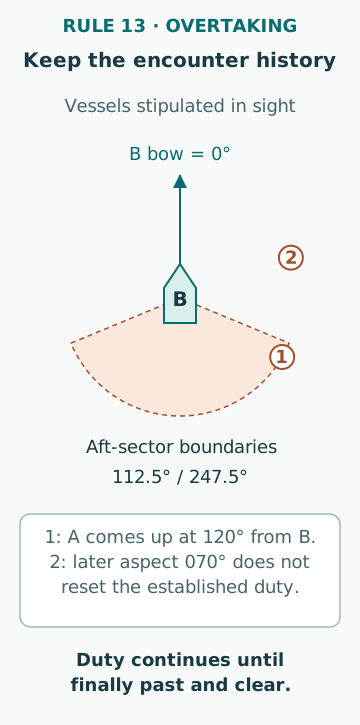
Rule 13(b) describes coming up from more than 22.5° abaft the other vessel’s beam, corresponding at night to the position from which only its sternlight, rather than either sidelight, would be visible. With relative bearing measured clockwise from that vessel’s bow, the aft sector lies between 112.5° and 247.5°, with the rule’s “more than” wording and doubt provision retained.
This is not the bearing of the target measured from the overtaking vessel’s own bow. Reversing the line of sight and then using the wrong vessel’s heading can produce a confident but incorrect classification. The other vessel’s COG is also not necessarily its heading. Current and leeway can separate the two, so an AIS track arrow alone is an incomplete representation of visual aspect.
An original bearing example fixes the reference
Let vessel B, the vessel being approached, have true heading 030°T. The true bearing from B to vessel A is 150°T. A’s relative bearing from B’s bow is 150 − 30 = 120°, which lies 30° abaft B’s starboard beam and 7.5° inside the stated aft-sector boundary. Assume A is coming up with B and both are in sight. Under those stipulated facts, A is overtaking B.
The reverse true bearing from A to B is 330°T. If A heads 340°T, B appears at relative bearing 350°, only 10° on A’s port bow. That forward-looking view from A does not turn the encounter into a crossing situation. The two relative bearings answer different questions because each uses a different vessel’s bow as zero.
Uncertainty near the boundary is not resolved by extra decimals
Consider a fictional relative-aspect estimate of 113° with an uncertainty range of ±3°. The plausible interval spans 110° to 116° and crosses the 112.5° boundary. Reporting 113.00° does not eliminate that ambiguity. The uncertainty may come from heading, bearing, visual identification, target extent or a mismatch in observation time.
Rule 13(c) addresses doubt directly: a vessel unsure whether it is overtaking must assume that it is and act accordingly. That provision should not be replaced by a software rounding rule or a majority vote among correlated displays. The example illustrates why the evidence and the rule’s treatment of doubt belong together; it does not calculate the probability of legal status.
The duty persists through a changing bearing
Rule 13(d) is essential to the encounter’s time history. A later bearing change does not convert the overtaking vessel into a crossing vessel or remove its keeping-clear duty before it is finally past and clear. The encounter is therefore not reclassified from scratch at each display refresh solely because the geometry has changed.
In a continuation of the original example, suppose A later moves to relative bearing 070° from B’s bow during the pass. Looking only at that snapshot could suggest a crossing-like picture. The earlier established overtaking status remains relevant under Rule 13(d). A record that discards the initial approach and retains only the latest positions loses information needed to interpret the continuing duty.
Passing a reference point is not necessarily being clear
A point-target diagram omits hull length, beam, overhangs, a tow and the sea room available for continued motion. One antenna becoming ahead of another does not by itself establish that the vessels are finally past and clear. The rule does not supply a universal distance or a fixed elapsed time that this article can substitute for the complete circumstances.
For an original geometry check, two vessels each 180 m long have their centre reference points separated longitudinally by 100 m while alongside. Their longitudinal hull projections still overlap by 80 m in an ideal parallel alignment. This is only a projection calculation, not a collision-risk or clearance criterion, but it shows why centre-point order cannot establish complete passage.
Keep the remaining rules and waterway context in view
Rule 13(a) requires an overtaking vessel to keep out of the way of the vessel being overtaken, notwithstanding Rules 4–18; vessel categories under Rule 18 do not replace that overtaking duty. It must still be read with the rest of the applicable rules, including lookout, safe speed, risk assessment and effective action. Narrow-channel overtaking has additional provisions in Rule 9(e), including the circumstances in which the vessel being overtaken must take action to permit safe passing. The international text expressly preserves the overtaking vessel’s Rule 13 obligation.
This is why a radio agreement or a passing signal cannot be treated as a transfer of all responsibility. Nor does being overtaken confer an unlimited right to ignore a developing danger. The conditions of the applicable stand-on provisions and the general responsibilities still require careful reading. No manoeuvring side or signal sequence is selected here for a real channel.
Build an encounter history that can be reviewed
A useful learning record retains the visibility context, vessel headings, bearings, evidence of coming up, relevant lights or aspect, uncertainty and the time when overtaking status was first supported. Later observations should be added without overwriting that earlier basis. Distinguish what was visually seen from what an instrument reported and what was inferred.
For a simulator debrief, vary the initial aspect slightly, add heading uncertainty and then change the bearing during the pass. The learning objective is to explain why the initial doubt provision and continuing duty matter. It is not to reward an algorithm for switching labels at an exact angle while ignoring the rule’s temporal structure.
Avoid snapshot-based shortcuts
Common errors are using the overtaking vessel’s own relative bearing for the aft-sector test, substituting COG for heading, treating a later bearing change as a fresh crossing encounter and declaring the duty complete when a point symbol moves ahead. Each error discards part of the rule’s context or evidence.
The useful conclusion is a clearly supported encounter history with uncertainty and continuing responsibilities intact. This explanatory text, including the Turkish version, is not an official translation or a determination of liability. Actual navigation and legal interpretation require the complete applicable rules, the full circumstances and competent professional judgement.
Sources
- Amalgamated International and US Inland Navigation Rules · US Coast Guard NAVCEN · Source check date: 2026-10-06