Knowledge / Navigation and marine safety
Visual lookout: contrast, blind sectors and detection limits
Examine visual detection through angular size, contrast, horizon geometry, blind sectors and the time needed to understand a target.
On this page
A target can be physically in view yet remain undetected, or be detected without being understood. Visual lookout therefore depends on geometry, the optical environment and attention together. Quantitative examples clarify those limits without inventing a universal range at which every target should be seen.
Detection, recognition and assessment are separate
International COLREG Rule 5 in the USCG official compilation requires proper lookout through sight, hearing and appropriate available means. The compilation also contains separately marked US Inland provisions; those should not be imported into an international-rule discussion. Visual observation contributes information about lights, aspect, objects and the surrounding scene, but seeing something does not immediately establish its identity or motion.
A small glint can be detected before it is recognized as a vessel light. A vessel can be recognized before its movement is understood. A target can be tracked while its full extent remains uncertain. These stages consume time and rely on different evidence. A training record should distinguish the first sighting from the first reliable identification and from a defensible assessment of its relevance.
Angular size is only one part of visibility
For a small object of transverse width W at range R, angular width is approximately W/R radians. In an original example, a 6 m feature at 3 NM, or 5,556 m, subtends 0.001080 rad, approximately 0.0619° or 3.71 arcminutes. This is geometry, not a human detection threshold. The same angular size can be easy or difficult to see depending on contrast and context.
A dark hull against a dark shore, a white object among breaking waves and a navigation light among shore lights present different recognition problems. Haze reduces contrast and glare can mask a small signal. Increasing magnification does not restore contrast that the atmosphere or optical path has removed, and a narrower field can make systematic coverage harder.
A geometric horizon is not a detection promise
Ignoring atmospheric refraction and using a spherical Earth radius of 6,371 km, approximate line-of-sight range between heights h1 and h2 is sqrt(2Rh1) + sqrt(2Rh2), with consistent metre units. For eye height 15 m and a target point 3 m above the surface, this gives 20,007.7 m, or 10.80 NM. It estimates geometric visibility of that point, not visibility of the entire hull.
Actual refraction, wave crests, haze, object contrast and lighting can change what is detectable. A light’s luminous range is a different concept from geometric range. Seeing a high masthead light does not imply that a low object nearby would be visible at the same distance. Do not use the horizon calculation to certify an unobstructed lookout or a safe detection distance.
Blind sectors depend on the observer’s position
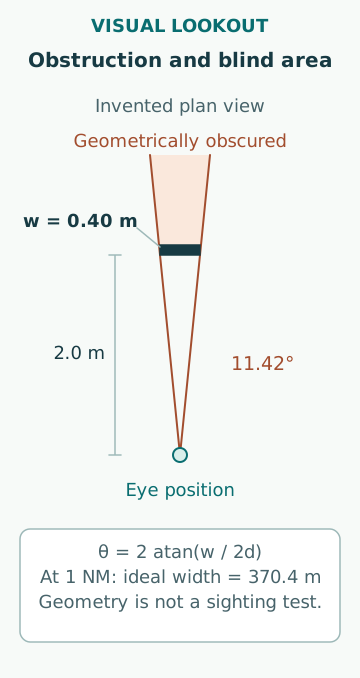
For an ideal rectangular obstruction width w at distance d from the eye, the horizontal angular sector is 2 atan(w/(2d)). A 0.40 m obstruction 2.0 m away subtends 11.42°. At 1 NM, the corresponding ideal geometric width is 370.4 m. These invented dimensions illustrate how a narrow nearby frame can hide a substantial distant region.
MCA MGN 610 Amendment 1, section 29 explains the UK treatment of navigation-bridge visibility under SOLAS V/22, including vessel-specific applicability. Design compliance does not make every observation position equally effective in every loading condition. Cargo, trim, deck equipment and the observer’s height can change practical coverage. The actual bridge arrangement and procedures determine how coverage is maintained.
Night conditions change contrast and adaptation
The MAIB James 2/Vertrouwen safety flyer, report 2/2018 identifies deck-light backscatter as a contributor to impaired night vision and emphasizes effective lookout. That is a maritime accident-learning source, not a universal numerical limit on illumination. Reflections in windows and bright internal displays can also compete with weak external cues.
The FAA Aeronautical Information Manual, section 8-1-6 explains dark adaptation and the effects of bright light and coloured lighting. It is used here only for general visual physiology, not as a maritime operating rule. Lighting choices must still support accurate chart and instrument reading, colour recognition, safe movement and the vessel’s approved bridge arrangements.
Attention is a limited observation resource
A view can be physically available while attention is directed elsewhere. Chart work, communications, equipment troubleshooting and conversation can interrupt observation. Familiar surroundings can encourage an expectation that nothing unusual will appear. Once one target attracts attention, another can remain unexamined even though it is in the field of view.
This is not solved by simply stating that someone “looked outside.” A useful exercise records which sectors were observed, what interrupted the task and how responsibility was maintained. Binocular use, screen work and direct observation have different fields of view and purposes. The bridge team’s task allocation should account for those differences within the vessel’s actual watchkeeping requirements.
Detection delay consumes distance
For an original constant-closure example, suppose separation is reducing at 18 kn. A twenty-second delay before detecting or correctly interpreting a target corresponds to 18×20/3,600 = 0.10 NM, or 185.2 m of closure. A further thirty seconds consumes another 0.15 NM. These intervals are invented and are not acceptable lookout gaps.
The calculation establishes neither stopping distance nor collision probability. It explains why detection and understanding need time before physical action can be effective. A target that becomes obvious at short range may have been difficult to distinguish earlier; a debrief should examine the actual earlier contrast, occlusion and workload instead of assuming that later visibility existed throughout the encounter.
Use complementary observations without assuming completeness
Radar, AIS, sound and visual observation have different detection mechanisms and omissions. An AIS symbol can direct attention toward a region but does not prove that every nearby craft transmits. A radar echo can prompt a visual search, while a visual object may have a weak radar return. Absence from one source should be interpreted within that source’s demonstrated capability.
Correlation also needs care. A visible light, a radar echo and an AIS identity may not belong to the same object. Preserve the evidence for linking them, especially in dense traffic or near shore lights. Adding more observations is useful only if their time, bearing, range and identity relationships remain understandable.
Review coverage rather than blaming eyesight alone
Common errors are treating geometric horizon as guaranteed detection, applying a laboratory angular threshold directly at sea, assuming a clear window means a covered sector and using a screenshot to infer what an observer noticed. A meaningful review includes physical sight lines, lighting, target contrast, attention and corroborating evidence.
The purpose is to identify specific improvements in observation arrangements and training, under the applicable procedures. It does not certify individual fitness, specify watch manning or provide a universal safe detection range. “Not seen” is a report about the observation process; it is not proof that no object was present.
Sources
- Amalgamated International and US Inland Navigation Rules · US Coast Guard NAVCEN · Source check date: 2026-10-06
- MGN 610 (M+F) Amendment 1 · UK MCA · Source check date: 2026-10-06
- James 2 and Vertrouwen: safety lessons flyer · UK MAIB · Source check date: 2026-10-06
- Aeronautical Information Manual, Medical Facts for Pilots · US FAA · Source check date: 2026-10-06