Knowledge / Machinery and energy
Vacuum freshwater generation: boiling temperature, entrainment and salinity
Follow heat, water and salt through a vacuum evaporator, with balances that distinguish distillate production from brine carry-over and low salinity from drinking-water safety.
On this page
A vacuum freshwater generator uses reduced pressure to evaporate water at a temperature compatible with an available heat source, often a ship’s waste-heat circuit. Producing vapour is only one part of the process. Entrained seawater droplets must be separated, the vapour must be condensed and the product must be routed according to its measured quality and intended use. A good vacuum reading alone does not prove that all those functions are working.
Follow the four material paths
A representative Alfa Laval AQUA description separates evaporation, droplet removal and condensation, with brine and non-condensable-gas handling linked to the ejector arrangement. Its heat source can be engine jacket water or another suitable heating circuit. That published arrangement is an example, not a drawing to reproduce on every ship. The exact feed, cooling, brine and product connections depend on the installed model.
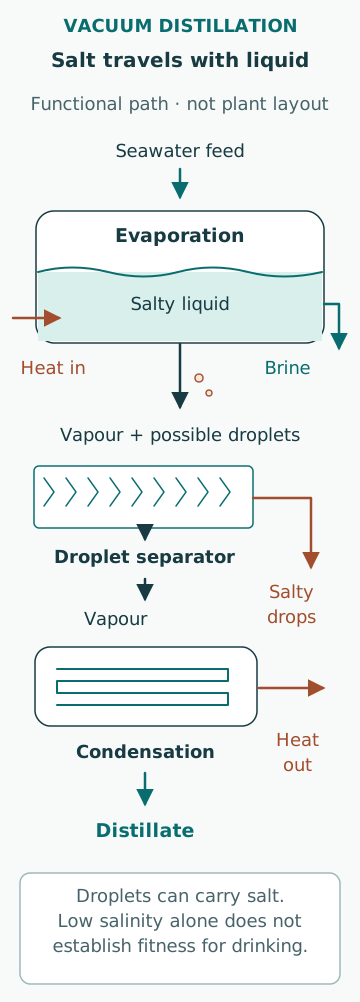
Trace feed seawater into the evaporating region, concentrated liquid out as brine, vapour toward the condenser and distillate toward its destination. Add the heating and cooling circuits as energy paths with their own possible leakage interfaces. This separation of paths helps distinguish failure to produce enough vapour from failure to condense it, contamination of the product or a routing error after production.
Use absolute pressure to interpret boiling
At a given composition, boiling is linked to pressure and temperature. Lowering pressure lowers the saturation temperature of pure water. NIST’s saturation table gives approximately 12.35 kPa absolute at 50°C. This illustrates why useful evaporation can occur well below 100°C. It is not an instruction to operate a marine evaporator at that point: seawater composition, boiling-point elevation, temperature differences and the plant’s design all matter.
A percentage-vacuum indication is incomplete unless the reference atmospheric pressure is known. For example, 85% vacuum referenced to 101.3 kPa corresponds to about 15.2 kPa absolute. The same percentage referenced to another atmospheric pressure gives another absolute pressure. Retain the instrument definition and avoid confusing a negative gauge value with the positive absolute pressure used in steam-property tables.
Keep evaporation and salt removal conceptually separate
Ordinary dissolved salt is largely retained in the liquid during the intended distillation process. It can nevertheless reach the product by a physical bypass or by liquid droplets carried with the vapour. A separator or demister addresses entrained droplets; it does not need to remove salt molecules from pure water vapour. This distinction directs attention toward liquid carry-over, leaks and downstream contamination when product salinity rises.
Separation depends on the actual vapour velocity, droplet behaviour and element condition. Increasing heat input may increase production, but it can also change entrainment and the demand on the condenser. A higher production rate is not automatically a better operating point. The required comparison joins quantity, quality and the allowed equipment envelope rather than optimizing one display value.
Work a feed, distillate and brine balance
Assume a hypothetical steady unit receives 1,000 kg/h of feed with salt mass fraction 0.035. Let distillate production be 250 kg/h and, for the initial ideal balance, assume its salt content is negligible and no liquid is stored or lost elsewhere. Brine flow is 750 kg/h. The salt entering is 35 kg/h, so the brine salt mass fraction is 35/750 = 0.04667, or 4.667%. Water recovery by mass is 25%.
These results depend on the stated balance boundary. A sample salinity in practical-salinity units, conductivity or grams per litre cannot be inserted as a mass fraction without the appropriate interpretation. A changing liquid level also means storage is not zero. If feed, distillate and brine instruments disagree, investigate measurement basis, timing and storage before forcing the numbers to close.
See how little liquid carry-over can change the product
Now use the previous illustrative brine composition and suppose 0.050 kg/h of brine droplets is carried into 250 kg/h of otherwise salt-free condensate. The carried salt is 0.050 × 0.04667, about 0.00233 kg/h. Dividing by the combined product mass of approximately 250.05 kg/h gives about 9.33 mg/kg salt. The droplet flow is only about 0.020% of the clean condensate flow, yet it makes a measurable difference in this invented example.
The calculation does not set an acceptable salinity or predict a particular demister’s efficiency. It shows that a small liquid pathway can matter even when almost all product water came from vapour. A high salinity result should therefore prompt a search for specific transport paths. Conversely, a low value does not prove that every other contaminant is absent or that the sampling cell is functioning correctly.
Account for the heat needed, not only the nominal capacity
Take a separate ideal heat example: 200 kW is assumed to be available specifically for evaporation after sensible heating and losses have already been accounted for. With an illustrative latent enthalpy of 2,380 kJ/kg, the corresponding evaporation rate is 200/2,380 = 0.0840 kg/s, or about 303 kg/h. At an assumed product density of 1.00 kg/L, that is approximately 7.26 m³/day if the condition persists continuously.
If 200 kW instead meant total heat entering cold feed, the same calculation would overstate production because some energy would heat the feed and cover losses. Likewise, actual availability of jacket-water heat changes with engine operation and temperature approach. Capacity stated at one heating and cooling condition should not be expected unchanged when seawater is warmer or the heat source is cooler. Record the conditions behind any daily-production comparison.
Read vacuum deterioration as a system symptom
A rise in absolute pressure can accompany air ingress, degraded ejector performance, inadequate cooling or increased vapour load, among other causes. Pressure alone does not distinguish them. Compare cooling-water conditions, heat input, brine behaviour, non-condensable removal and recent changes. A condenser that cannot reject the required heat can limit vacuum performance even if the air-removal device itself is healthy.
The product pump also operates within the actual pressure and temperature environment. Liquid near its saturation condition does not have unlimited suction margin, so the installation’s elevation and losses matter. This is another reason to preserve the complete arrangement when evaluating performance. General explanations do not authorize a change to ejector supply, liquid level or pump routing.
Distinguish low salinity from potable-water acceptance
The WHO Guide to Ship Sanitation, third edition explains that low-temperature distillation alone does not guarantee a pathogen-free product and places water production within a wider potable-water system. WHO’s desalination risk guidance also addresses source-water, treatment and distribution-related hazards. These are public-health frameworks, not proof that a salinometer reading certifies drinking water. The applicable water-safety plan and requirements govern the actual use.
A salinity instrument monitors a defined property, commonly through a conductivity-related measurement and its calibration. It does not test every microbial or chemical hazard. Product diversion, treatment, storage and distribution are distinct protective functions. Evidence should show that off-specification water reaches the intended reject path and that accepted water receives the controls required for its end use; a valve command alone does not prove the physical destination.
Make troubleshooting a comparison of balances
A useful record includes absolute pressure, the location and basis of temperature readings, heat-source conditions, seawater conditions, feed and product flow bases, salinity method and product-routing state. Identify steady periods separately from startup, load changes and maintenance recovery. Changes in both capacity and salinity are often more informative than either alone.
The conclusion should state which balance failed to explain the observation: heat supply, phase change, water/salt flow, non-condensable removal or product routing. Then seek evidence specific to that path. This keeps the evaporator’s working principle understandable while avoiding two weak shortcuts, assuming that good vacuum guarantees good water or that low salinity alone establishes fitness for every use.
Sources
- AQUA titanium plate freshwater generator · Alfa Laval · Source check date: 2026-10-06
- NISTIR 5078, Table 1: Saturation (Temperature) · US National Institute of Standards and Technology · Source check date: 2026-10-06
- Guide to Ship Sanitation, third edition, 2011 · World Health Organization · Source check date: 2026-10-06
- Safe drinking-water from desalination, WHO/HSE/WSH/11.03 · World Health Organization · Source check date: 2026-10-06