Knowledge / Machinery and energy
Gas-engine knock and misfire: mixture limits and fuel composition
Distinguish end-gas autoignition from a failed burn, calculate how composition changes excess-air ratio, and separate methane number from heating value and methane content.
On this page
A premixed lean-burn gas engine must release heat reliably without allowing the unburned end gas to autoignite uncontrollably. Adding excess air can reduce combustion temperature, but sufficiently weak or poorly ignited mixtures may burn inconsistently or fail to burn. The useful operating region lies between several constraints that move with load, fuel composition and engine condition. A single air–fuel number cannot define that region for every engine.
Identify the combustion principle first
This discussion concerns gas engines with a substantially premixed gas–air charge, including suitable spark-ignited and low-pressure dual-fuel gas modes. A liquid pilot may initiate combustion in a dual-fuel engine; a spark or pre-chamber may initiate it in other designs. High-pressure direct gas injection following a diesel-like combustion process is a different case and should not inherit a premixed-engine operating map.
CIMAC distinguishes gas-engine combustion principles and separates pre-ignition, misfiring and knocking. These distinctions matter because an alarm called “combustion abnormality” does not identify one physical cause. First establish the installed engine’s combustion mode and the meaning of its measured signals.
Knock, pre-ignition and misfire are different events
In normal premixed combustion, an intended ignition source establishes a flame that travels through the charge. End gas is the unburned mixture ahead of that flame. As it is compressed and heated, its chemical ignition delay can become shorter than the time until the flame arrives. Rapid end-gas autoignition can excite strong pressure oscillations: this is the central mechanism of knock.
Pre-ignition begins before the intended ignition event, for example from an unwanted hot ignition source. It can create conditions that also promote knock, but the terms are not synonyms. Misfire means that a cycle does not develop the intended combustion reliably; excessively lean mixture is one possible cause, not the only one. Ignition faults, unsuitable fuel delivery, poor mixture distribution and other mechanical or control problems can also matter.
Define excess-air ratio without confusing richer with rich
The excess-air ratio λ is actual air divided by stoichiometric air for the same fuel quantity and composition. λ = 1 is stoichiometric; λ > 1 is lean. The equivalence ratio φ is its reciprocal, 1/λ. A mixture moving from λ = 1.9 to 1.7 becomes richer relative to its earlier state while remaining lean. “Richer” does not necessarily mean less air than chemically required.
The stoichiometric requirement changes when the fuel changes. A fixed air flow and fuel valve position do not prove a fixed λ, particularly if composition, density or supply conditions change. Exhaust oxygen can inform mixture control, but its interpretation depends on the measurement basis, combustion completeness, air leakage and the particular engine. An aggregate exhaust signal also cannot guarantee that every cylinder has the same mixture.
Fuel quality has several dimensions
ASTM defines methane number as a measure of gaseous-fuel resistance to autoignition or knock. It is not the percentage of methane in the delivered fuel. A methane number calculated by a specified method describes a knock-related property; it does not by itself state the heating value, stoichiometric air requirement or permissible engine power.
Heating value measures released energy on a specified basis. Wobbe index combines a volumetric heating value with relative density, commonly as W = H/√SG, using a consistent higher- or lower-heating-value convention and reference conditions. It addresses an interchangeability aspect of fuel flow through a given restriction, not the entire combustion response. Caterpillar’s fuel guide treats composition, methane number, heating value and Wobbe index separately when assessing a gas.
Worked example: calculate the required oxygen first
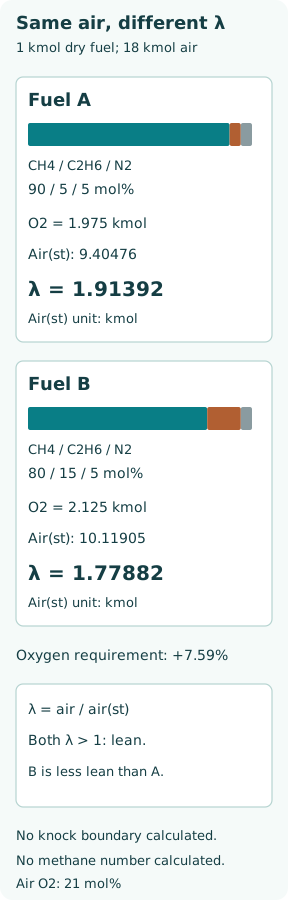
Use a dry ideal-gas molar basis of 1 kmol of fuel mixture. Fuel A contains 90 mol% methane, 5 mol% ethane and 5 mol% nitrogen. For complete combustion, CH4 + 2O2 → CO2 + 2H2O and C2H6 + 3.5O2 → 2CO2 + 3H2O. Nitrogen is treated as inert in this stoichiometric calculation. Required oxygen is therefore 0.90 × 2 + 0.05 × 3.5 = 1.975 kmol.
Assume dry air contains exactly 21 mol% oxygen and ignore minor components. Stoichiometric air is 1.975/0.21 = 9.40476 kmol per kmol of this fuel mixture. If actual air is 18.00 kmol on the same basis, λA = 18/9.40476 = 1.91392 and φA = 0.52249. Excess air is 91.39%. These values follow chemical bookkeeping; they are not an engine setpoint or a prediction that combustion will be stable.
Changing composition moves λ even before controls respond
Now Fuel B contains 80 mol% methane, 15 mol% ethane and the same 5 mol% nitrogen. Keep the supplied fuel amount at 1 kmol and actual air at 18 kmol. Oxygen requirement rises to 0.80 × 2 + 0.15 × 3.5 = 2.125 kmol, 7.59% above Fuel A. Stoichiometric air becomes 10.11905 kmol, so λB = 1.77882 and φB = 0.56217. The mixture is still lean but less lean than before; excess air is 77.88%.
Maintaining the same purely arithmetic λ as Fuel A would require 19.36709 kmol of air for Fuel B on this basis. This is a comparison of compositions, not an instruction to alter an engine’s air setting. The actual control response also depends on requested energy input, fuel-metering behaviour, boost, ignition and the approved operating map.
Neither mixture’s methane number has been calculated here. Methane number is not obtained by inserting methane percentage into λ, or by linearly averaging component methane numbers without a validated method. The example establishes a shift in stoichiometric demand, not whether a particular cylinder will knock or misfire.
Why load and transients move the operating region
Higher load can increase cylinder pressure and end-gas temperature, while charge cooling, compression ratio, ignition phasing, dilution and fuel chemistry alter the time available for autoignition. On the lean side, slower flame development and cycle-to-cycle variability can reduce stable combustion margin. These competing effects explain why “add more air” is not a universal solution.
During a rapid load change, fuel admission, turbocharger response, manifold filling and ignition control do not necessarily change together. One cylinder may also differ from the average through its gas valve, ignition source or charge distribution. A steady operating point that has adequate margin does not automatically prove that the transition to it stays inside the permitted region. The specific engine’s transient limits and cylinder controls must be respected.
Use several signals to distinguish the mechanisms
Depending on design, evidence can include cylinder-pressure traces, knock-band vibration, crankshaft-speed irregularity, combustion phasing, exhaust temperature, oxygen, gas pressure and ignition-system status. No single temperature or sound identifies every case. A low exhaust temperature can be consistent with poor firing, but it can also reflect sensor or load-distribution issues. A failed or incorrectly interpreted knock sensor is not evidence of knock-free combustion.
Woodward’s lean-burn control description combines manifold pressure and temperature, speed, exhaust oxygen, ignition and combustion diagnostics. This is an example of the variables an engineered controller may use, not a calibration recipe for a marine engine. Preserving source identity, timestamps and the active combustion mode makes the evidence far more useful than a screenshot of one alarm value.
Fuel changes require a composition-based review
Record the actual gas analysis, molar or mass basis, sample time, heating-value convention, reference temperature and pressure, methane-number method and engine fuel specification. A supplier’s unchanged label “natural gas” does not establish unchanged composition. Liquid carryover or contaminants also require separate assessment; the gas-phase stoichiometric model does not represent them.
Knock or misfire protection should not be bypassed to test whether a fuel “works.” Repeated abnormal combustion can threaten components and allow unburned fuel into downstream systems. Follow the maker’s response and approved fuel-change procedure, using safe sampling and competent technical support. The useful conclusion is a bounded compatibility assessment: what fuel changed, which combustion property changed, which margin is affected and what evidence supports the response.