Knowledge / Machinery and energy
Inert-gas systems: oxygen concentration, tank pressure and barrier boundaries
Separate flammability control from breathable air, use a bounded dilution model and examine gas quality, pressure, sampling and backflow protection as distinct functions.
On this page
Inerting limits the oxygen available for combustion in a defined atmosphere. It does not make a cargo tank harmless, remove every toxic vapour or establish that a person can enter. The system must supply suitable gas, distribute it to the intended spaces, control pressure and prevent hazardous reverse flow. These functions interact but cannot be verified by one oxygen reading or by confirming that a generator is running.
Start with the protected atmosphere and the applicable scope
The FSS Code chapter adopted through MSC.367(93) describes an inert-gas system as more than its generating plant: distribution, reverse-flow prevention, instruments and controls are included. Its application is linked to the relevant SOLAS requirements. This article uses that system boundary without declaring that one installation rule applies to every tanker, cargo or construction date. The vessel’s actual requirements and approved arrangement remain essential.
Name the tank, its contents, connected spaces and operating condition. Flammability depends on fuel, oxidant, temperature and pressure as well as an ignition source. A single generic oxygen percentage cannot replace a cargo-specific and regulation-specific criterion. Likewise, an atmosphere described as inert for fire prevention may still contain hazardous concentrations of other substances.
Distinguish inerting from gas-freeing and entry acceptance
HSE’s inerting guidance explains oxygen reduction as an explosion-prevention measure and identifies asphyxiation and loss of the inert atmosphere as hazards. This industrial guidance supplies the general physical distinction, not a shipboard entry procedure. Reducing oxygen deliberately creates a condition incompatible with ordinary breathing even when the intended flammability control is successful.
Gas-freeing, cleaning, testing and personnel-entry approval answer different questions. Oxygen adequate for breathing does not prove that flammable or toxic substances are absent, while a low flammable-gas reading can be misleading if the instrument is unsuitable for the atmosphere. The correct instrument principle, calibration, sampling method and interpretation must match the task. No entry or rescue decision follows from the illustrative model below.
Use a perfectly mixed model only as a teaching boundary
Imagine an ideal constant-volume gas space with equal inlet and outlet volumetric flow at the same pressure and temperature. Assume perfect mixing, constant inlet composition, no leaks, no chemical reaction and no gas released from cargo. If C is oxygen volume fraction, the balance is dC/dt = (Q/V)(Cin − C). Its solution is C = Cin + (C0 − Cin)e^(−N), where N = Qt/V is the number of volume exchanges.
This model describes dilution in a well-mixed space, not plug displacement and not a real tank with baffles or stratification. Standard-volume flow must be converted before it is combined with actual tank volume unless both use the same basis. Changing liquid level also changes the available gas volume. Each departure from the assumptions changes how the result should be interpreted.
Work the dilution arithmetic without creating an operating target
Use invented oxygen values of C0 = 21%, Cin = 2% and a comparison marker C = 10%. The ideal model needs N = ln[(21 − 2)/(10 − 2)] = ln(19/8), approximately 0.865 volume exchanges. After one ideal exchange, oxygen is 2 + 19e^(−1), approximately 8.99%. The 10% marker is chosen for arithmetic; it is not an inerting limit, safe-entry criterion or approved target for any cargo.
If the comparison marker were 3%, the same ideal calculation would require ln(19/1), approximately 2.944 exchanges. Reaching exactly the 2% inlet concentration takes an infinite number in this ideal asymptotic model. These results show why counting one tank volume of gas cannot universally establish a final atmosphere. They do not predict actual purge duration, gas consumption or the worst local concentration in a ship tank.
Keep supply-gas quality separate from tank composition
A satisfactory reading in the supply main describes gas at that measurement point. It does not prove that all tank regions have the same composition or that gas reached every intended branch. Local mixing, cargo-vapour release, leakage and the history of the tank can produce differences. Sampling must represent the relevant locations and conditions rather than only the most accessible point.
Conversely, a tank reading can remain favourable for a period after supply quality or availability has degraded. Storage of a previously established atmosphere can mask an emerging supply problem. The analysis should distinguish current generating capability, distribution continuity and the condition already present in each protected space. These are different states with different evidence.
Treat pressure as a second controlled quantity
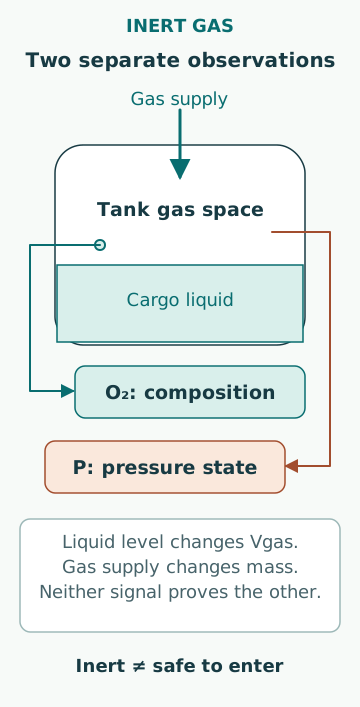
The 2019 FSS amendment MSC.457(101) expressly addresses recording pressure downstream of the non-return devices and oxygen content while inert gas is supplied. Pressure and composition are therefore separate observations. A tank can have acceptable measured composition but an unsuitable pressure state, or positive pressure with unsuitable gas composition. Neither reading proves the other.
Liquid movement changes ullage volume, while gas heating and cooling alter pressure and density. In a separate sealed, fixed-volume ideal-gas example with constant gas quantity, warming from 293 K to 313 K would multiply absolute pressure by 313/293, about 1.068. Starting at 101.3 kPa absolute gives about 108.2 kPa absolute. This is a physical sensitivity example, not an allowed tank pressure; real tanks also have vapour equilibrium, gas supply, leakage and pressure-control devices.
Examine reverse-flow prevention as its own barrier
Gas distribution connects spaces whose contents and pressure can change. Preventing cargo vapour from reaching an unintended machinery or other protected space is a separate function from producing low-oxygen gas. Identify the non-return arrangement, its supporting conditions and the evidence that it remains effective in the actual configuration. The number of components alone does not establish independence.
A water-based device depends on its required liquid condition; a valve-based arrangement depends on the actual device function and permitted configuration. Maintenance, isolation or a shared support loss can change what the arrangement provides. A control command or schematic symbol is not proof of the physical barrier state. Evaluation must follow the approved system, without transplanting a different maker’s device layout or test sequence.
Include connected spaces and personnel exposure
The MCA’s enclosed-space guidance notes that hazardous gas or liquid can migrate through connections and small openings, and that conditions can change with other work. This supports looking beyond the tank named on a permit or display. A release at an opening, vent or connected space can affect a person who never entered the original tank. The cited guidance is UK-specific in its legal provisions; the physical exposure pathway is more general.
An assessment should trace where discharged or leaking gas can go and how simultaneous work can alter the boundary. A local display may be convenient yet located in an exposure path. Remote indication, communications and defined responsibility are useful only when tied to the actual arrangement and procedures. A successful fire-prevention function does not cancel the oxygen-deficiency hazard it can create.
Make assurance a chain of observations
A useful record identifies the protected space, operating mode, gas source, oxygen instrument and sampling location, pressure reference, distribution state and reverse-flow protection. Preserve timestamps and note whether values were steady or changing. If a reading is from a sample transported to another location, record the transport and conditioning that may affect its meaning.
The conclusion should distinguish gas production, atmosphere establishment, ongoing maintenance of that atmosphere, pressure control and personnel protection. A discrepancy between them is a question to investigate, not a reason to choose the most reassuring signal. The dilution calculation explains one ideal mechanism; actual acceptance depends on representative measurements, the applicable criteria and the approved operating system.
Sources
- MSC.367(93), replacement FSS Code chapter 15 · International Maritime Organization · Source check date: 2026-10-06
- Inerting · UK Health and Safety Executive · Source check date: 2026-10-06
- MSC.457(101), amendments to FSS Code · International Maritime Organization · Source check date: 2026-10-06
- Enclosed spaces on sea-going vessels · UK Maritime and Coastguard Agency · Source check date: 2026-10-06