Knowledge / Machinery and energy
LNG boil-off: heat ingress, tank pressure and vapour-management limits
Relate heat ingress to an explicitly bounded evaporation estimate, compare natural boil-off with fuel demand and distinguish tank-pressure control from protective relief.
On this page
LNG is stored far colder than its surroundings, so heat ingress remains relevant even with effective insulation. What happens to that energy depends on pressure, composition, liquid and vapour states, and how gas is removed or processed. A single boil-off percentage cannot describe every loading condition or predict how long a tank can remain within its pressure limits. The useful starting point is a combined mass-and-energy balance with a clearly defined operating mode.
Distinguish fuel storage from cargo carriage
IMO’s IGF Code overview identifies its scope for ships using gas or other low-flashpoint fuel, outside vessels covered by the IGC Code. LNG fuel tanks and LNG cargo tanks share thermodynamic principles, but their applicable arrangements and approval bases are not interchangeable. State which system is being discussed before applying a published example or a pressure-control requirement.
Likewise, LNG is a mixture rather than a universal pure substance. Methane-rich liquid can include other hydrocarbons and nitrogen, and its vapour composition need not equal its liquid composition. Boiling temperature, latent enthalpy, density and fuel quality depend on composition and pressure. A value used for pure methane is a useful educational reference only when that limitation remains visible.
Trace the incoming energy
GTT’s February 2019 public technical newsletter identifies heat ingress and operating conditions among the causes of boil-off. Heat enters through the containment’s thermal boundary and is redistributed between liquid, vapour and structure. Loading, cooldown and motion can change the situation, so the heat-leak case of a settled tank does not represent every transient.
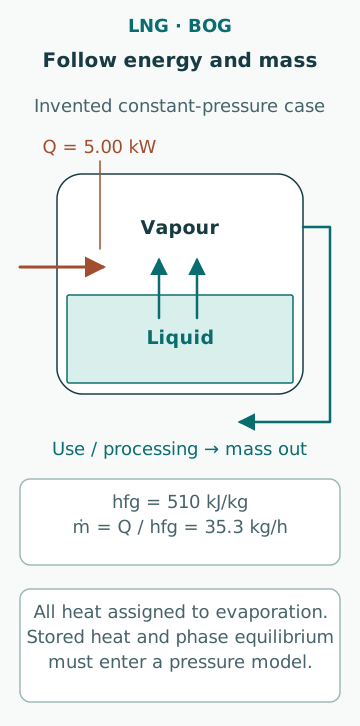
An energy balance should specify whether the liquid is already near equilibrium at the considered pressure, whether sensible warming occurs and whether mass is entering or leaving. “All heat becomes boil-off” is a useful limiting approximation for a stated near-constant-pressure evaporation condition. In a closed tank whose pressure and temperature rise, energy can instead accumulate in the contents and structure, so the same shortcut cannot predict pressure history.
Build a bounded latent-heat estimate
The NIST methane data include a vaporization enthalpy of 8.17 kJ/mol at 111.7 K and molar mass 16.0425 g/mol. Their ratio is approximately 509 kJ/kg; use 510 kJ/kg as an explicitly rounded methane-like input. For an invented net heat ingress of 5.00 kW, assume all of that heat supplies vaporization at approximately fixed pressure, with other energy terms negligible.
The equivalent evaporation rate is then 5.00 kJ/s divided by 510 kJ/kg, equal to 0.00980 kg/s or 35.3 kg/h. This is not a guarantee of actual LNG boil-off, because real mixture properties, heat distribution and operating state can differ. It is also not a tank-pressure model or a sizing result for a compressor, relief valve or gas consumer.
State the denominator behind a boil-off rate
If the hypothetical initial liquid inventory is 1,000 tonnes and the preceding mass rate persists for 24 hours, about 847 kg would evaporate. Relative to that stated initial mass, the calculated rate is 0.0847% per day. The denominator is part of the result. A percentage expressed against nominal tank volume, initial liquid volume or current liquid mass is not automatically the same quantity.
Even with an unchanged heat input, a percentage based on remaining inventory changes as the inventory changes. Heat ingress itself may also change with filling level and thermal conditions. Compare absolute kg/h as well as the percentage, and retain the property and inventory basis. A low published design percentage does not establish the actual pressure response during a particular period in port or after bunkering.
Compare natural gas generation with fuel demand
Take a separate invented engine example: useful output 3.00 MW, efficiency 45% on a lower-heating-value basis and supplied gas lower heating value 50.0 MJ/kg. Required gas flow is 3.00/(0.45 × 50.0) = 0.1333 kg/s, or 480 kg/h. The preceding natural-boil-off estimate of 35.3 kg/h would cover only about 7.35% of that demand. The numbers are illustrative, not the performance of a named engine or fuel composition.
At a much smaller useful output of 0.050 MW with the same assumed efficiency and heating value, the arithmetic demand is 8.00 kg/h, below that boil-off estimate. Keeping efficiency fixed at such different loads is deliberately artificial; a real comparison needs the actual performance map. The example shows the direction of the balancing problem: gas demand can exceed natural generation in one mode and fall below it in another.
Do not convert a mass imbalance directly into a pressure rise
The difference between vapour generation and vapour use is an important balance term, but it does not by itself give bar per hour. Tank pressure is coupled to temperature, phase equilibrium, vapour volume and composition. As liquid level changes, ullage volume changes too. A uniform-temperature model may miss thermal stratification, and one sensor cannot establish that the entire inventory shares its temperature.
A defensible holding-time calculation requires an initial condition, heat-transfer model, inventory/composition data, defined gas handling and a stated pressure endpoint. A quoted duration without those assumptions cannot be transferred to another loading state. Emergency relief should not be inserted into a normal-operation calculation as though it were routine balancing capacity.
Evaluate gas-handling capability as a system
Depending on the approved arrangement, vapour may be used by suitable consumers or processed by dedicated equipment. The Wärtsilä BOG-reliquefaction entry provides a public example of recovering vapour and returning liquid to LNG cargo tanks. Its particular process conditions are not adopted here. The general point is that removing vapour, conditioning gas and recovering liquid are different functions with supporting requirements.
A consumer’s nameplate capacity is not the same as continuously available demand. Its operating mode, permitted gas quality, supply pressure, supporting power and maintenance state matter. Similarly, a processing machine can be running without achieving the required net vapour handling. Assess the physical mass and energy paths, including what happens when a shared auxiliary service is lost, rather than adding nominal capacities without their conditions.
Keep pressure control independent from relief
The IGF amendment adopted in MSC.475(102) expressly distinguishes pressure-control systems from independent pressure-relief systems in its fuel-containment provision. The detailed applicable rules and the actual approved containment design govern an installation. This source is used for that functional separation, not to prescribe a pressure setting or claim that every LNG tank has the same permitted operating range.
Pressure measurement, normal control, alarm, shutdown and relief each have an intended role. A pressure value below a relief setting does not prove that normal control is healthy or that adequate time remains under the current heat balance. A safe assessment considers the failed or degraded function and the evidence for the remaining functions. No venting, isolation or setpoint-change procedure is implied by the educational calculations.
Make the record useful across operating modes
Record liquid inventory and its basis, relevant liquid and vapour temperatures, absolute pressure, composition information, measured gas use or processing, heat-source assumptions and active operating mode. Separate bunkering, transit, low-demand periods and maintenance. Retain measurement locations and any corrections from actual to standard gas volume. A mass-flow comparison is only meaningful when both streams use compatible units and conditions.
The conclusion should answer which energy enters, where it is stored or removed and how the resulting vapour is handled within the approved envelope. Where information is missing, identify the missing state or dependency instead of assigning a generic daily percentage. This approach makes boil-off understandable as a coupled physical process while keeping operating decisions with the vessel-specific system and procedures.
Sources
- International Code of Safety for Ships Using Gases or Other Low-flashpoint Fuels · International Maritime Organization · Source check date: 2026-10-06
- GTT Inside, February 2019, no.14 · GTT · Source check date: 2026-10-06
- Methane, NIST Chemistry WebBook SRD69 · US National Institute of Standards and Technology · Source check date: 2026-10-06
- Boil-off gas recovery system, BOG reliquefaction plant · Wärtsilä · Source check date: 2026-10-06
- MSC.475(102), amendments to IGF Code · International Maritime Organization · Source check date: 2026-10-06