Knowledge / Machinery and energy
Marine incinerators: combustion quality, feed limits and emissions context
Relate waste composition, moisture and heating value to combustion behaviour, then distinguish a chamber-temperature reading from complete treatment and lawful operation.
On this page
A shipboard incinerator receives a variable material stream, not a uniform fuel with a permanently fixed heating value. Water, inert material, combustible components and the way they are fed affect the thermal process. The equipment must also remain within its approved waste and operating scope. Understanding the heat and material balance explains why a hot chamber, a running burner or a smaller volume of residue cannot alone establish satisfactory incineration.
Establish what the equipment is allowed to receive
IMO’s Regulation 16 overview distinguishes general shipboard-incineration restrictions from provisions applying to particular installed incinerators, and notes prohibited materials, type approval, manuals and training. The equipment’s approval and the waste identity must therefore be checked before treating a material as feed. This overview is not a substitute for the actual applicable regulation, certificate or local port restriction.
A waste label such as “plastic,” “sludge” or “oily waste” can hide important differences in composition and origin. Unknown material does not become suitable because it fits through a charging door or appears combustible. Segregation and traceability are part of the control system: identify what was collected, what contamination may be present and whether the installed equipment’s instructions cover it. A thermal calculation cannot create legal permission.
Separate mass throughput from heat input
A capacity expressed in kilograms per hour needs a feed specification. Two streams with the same mass rate can have very different combustible fractions and moisture contents. The burner and chamber encounter heat release and heat demand, not merely a count of waste bags. Solids, emulsions and sludge can also present different preparation and residence behaviour.
Define the heating-value basis before using it. A dry-material value applies to the dry fraction, while an as-received value describes the delivered mixture under its stated convention. Higher and lower heating values also account for product water differently. Applying a dry value to total wet mass overstates the energy available. Subtracting a moisture penalty again when it is already included in the reported as-received value can create the opposite error.
Work a bounded moisture-energy example
The historical US EPA incineration handbook explains that moisture consumes heat during vaporization and subsequent heating. Use that physical point in an original example: a hypothetical 100 kg/h stream contains 20 kg/h of water and 80 kg/h of dry combustible matter. Assume the dry fraction releases 18 MJ/kg on a consistently chosen basis. Its nominal heat release is 1,440 MJ/h, or 400 kW.
For a separate illustrative evaporation allowance of 2.30 MJ per kilogram of incoming water, vaporizing the 20 kg/h requires 46 MJ/h, or 12.8 kW. The remainder is not usable output: heating the feed and combustion air, heating vapour further, flue-gas discharge, wall losses and other terms remain. The example does not predict chamber temperature or auxiliary-fuel demand. It also assumes the dry heating-value basis has not already charged this incoming-water penalty.
Understand why one temperature is insufficient
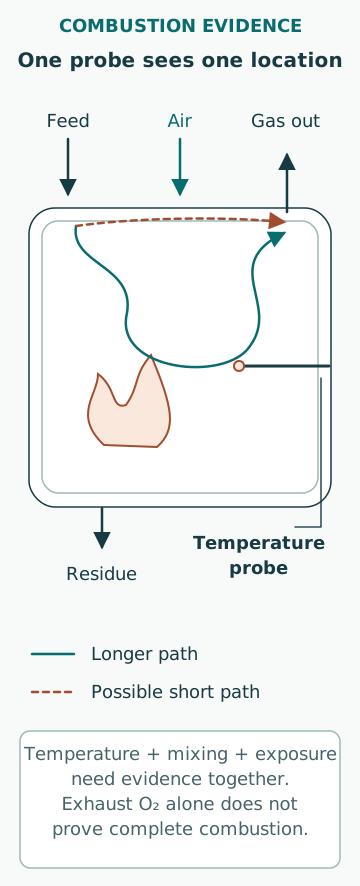
EPA’s thermal-oxidizer overview identifies temperature, residence time and mixing as relevant combustion factors. A temperature probe observes its own location and response, not every parcel of gas or waste. A hot measured zone can coexist with colder regions, inadequate mixing or short flow paths. This source concerns general thermal oxidation; its land-based application is not a marine-incinerator approval standard.
A residence-time estimate from chamber volume divided by gas flow also needs the gas volume at the actual temperature and pressure. Standard cubic metres per hour cannot be divided directly into a hot chamber volume without conversion. Even a correctly calculated average does not establish the minimum exposure of every flow path. Geometry, staging and operating condition must be assessed using the equipment’s validated design and test basis.
Read excess oxygen as one part of the evidence
Oxygen in the exhaust can show that some oxygen remains after combustion, but it does not prove that it mixed effectively with every combustible region. Poor distribution can leave oxygen-rich and fuel-rich zones at the same time. Air leakage downstream of the combustion zone can also alter an exhaust reading without improving the earlier reaction. Sensor location therefore matters as much as the displayed percentage.
Excess air can support mixing while also adding gas that must be heated and discharged. More air is not an unlimited cure for incomplete combustion. The relevant control relationship depends on the approved equipment and feed. A useful analysis compares the oxygen measurement with temperatures, feed history, flame supervision and other available evidence; it does not propose an improvised air or fuel adjustment.
Distinguish drying, burning and residual solids
A solid feed may dry, release volatile material and leave a residue that burns or remains as ash. A change in feed size or moisture can change the timing of those stages even at the same average mass rate. Liquid or sludge feeding has its own distribution and preparation requirements. Mixing different waste streams can therefore create an uneven heat-release history rather than the simple average predicted from their totals.
Residue is not automatically harmless because it is small or no longer visibly burning. Non-combustible constituents remain, and the relevant waste-management route must be maintained. EPA’s municipal-waste combustion explanation separates energy recovery and residue handling within the broader process. It is a general material-accounting reference, not permission to adopt land-plant waste acceptance or ash disposal practices aboard ship.
Keep safety functions separate from production controls
Flame supervision, chamber-pressure control, temperature monitoring, feed interlocks and ventilation each address a defined condition in an actual installation. A command to stop feed is different from proof that material has stopped entering. Likewise, a fan running does not by itself demonstrate the required airflow or pressure state. Trace each safety function from initiating condition through sensing and logic to the physical effect.
An interlock that prevents production may be revealing a real limit, a failed instrument or an unsuitable operating state. The proper investigation must distinguish those possibilities without treating the interruption itself as evidence that the protection is unnecessary. This article does not provide a start sequence, bypass method, charging procedure or response to a combustion upset; those belong to the approved equipment procedures and trained personnel.
Interpret emissions within a stated measurement basis
Concentration, mass emission rate and visible smoke are different observations. For a simple arithmetic illustration, a hypothetical measured concentration of 100 mg/m³ in a consistently defined gas stream of 500 m³/h corresponds to 50,000 mg/h, or 50 g/h. If concentration is reported on a dry standard-gas or reference-oxygen basis, the flow must be expressed on the matching basis before multiplication. Mixing hot actual flow with normalized concentration gives a false mass rate.
This invented number is not a compliance limit, a predicted incinerator emission or a suggested measurement method. It demonstrates why gas temperature, pressure, moisture and any reference-oxygen correction must accompany the result. A clear plume does not establish low emissions of every regulated substance, just as a transient visible plume does not quantify the mass of a particular pollutant without additional evidence.
Make the operating record explain the event
A useful record connects feed identity, mass or batch history, moisture/heating-value information where available, burner and fan states, temperature locations, relevant alarms and residue routing. Mark startup, steady operation, changes in feed and shutdown separately. A daily waste total can hide a short feed surge that challenged the process, while a daily average temperature can hide a period outside the required envelope.
The conclusion should state which evidence demonstrates the intended combustion function and which issue remains uncertain: feed suitability, heat balance, mixing, exposure, measurement or a protective function. Keeping these questions separate makes the plant’s behaviour understandable without turning a high temperature or reduced waste volume into a blanket claim of complete treatment or lawful operation.
Sources
- Shipboard incineration — Regulation 16 · International Maritime Organization · Source check date: 2026-10-06
- Engineering Handbook for Hazardous Waste Incineration · US Environmental Protection Agency · Source check date: 2026-10-06
- Monitoring by Control Technique — Thermal Oxidizer · US Environmental Protection Agency · Source check date: 2026-10-06
- Energy Recovery from the Combustion of Municipal Solid Waste · US Environmental Protection Agency · Source check date: 2026-10-06