Knowledge / Machinery and energy
Methanol as marine fuel: leakage, fire characteristics and detection choices
Distinguish methanol liquid leakage, flammable vapour, toxic exposure and fire detection using concentration units, sensor principles and explicit measurement limits.
On this page
Methanol changes the questions asked of a marine fuel system. A visible liquid leak, a flammable atmosphere, a harmful exposure and an established fire are related hazards, but they are different states. Each needs evidence appropriate to that state. A detector described only as a gas detector does not establish which substance, concentration range or physical phenomenon it can recognize. Understanding these distinctions makes a detection assessment more useful than comparing the number of installed instruments.
Define the fuel and the observation
IMO’s methyl/ethyl alcohol interim guidelines address containment, monitoring and protective functions for ships using these alcohols as fuel. Their existence does not make every alcohol mixture or every legacy fuel arrangement equivalent. Identify the actual product specification, water content and relevant approval basis before borrowing a property or a detector response from another fuel. The following discussion explains public physical principles; it does not provide an installation design or a bunkering procedure.
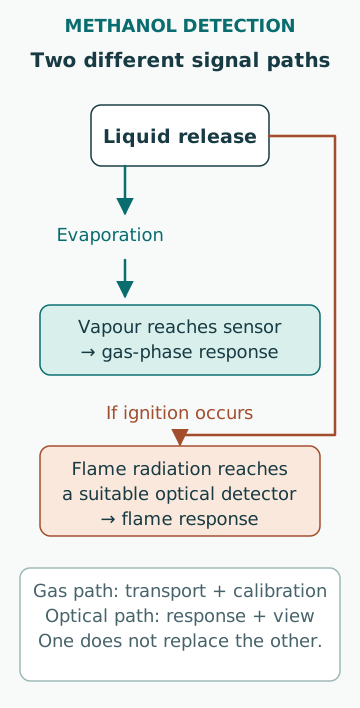
Write the observation in a complete sentence: liquid has reached a collection point, methanol vapour has reached a sensor, an optical device has detected a flame signature, or a person may have been exposed. Those observations have different boundaries. A dry collection point cannot rule out vapour elsewhere, and a vapour reading cannot establish whether liquid has contacted skin. Avoid allowing one available signal to answer every safety question.
Separate toxicity from flammability
The NIOSH methyl-alcohol entry identifies inhalation, skin absorption and ingestion as exposure routes, and lists a lower explosive limit of 6.0% by volume. It separately gives a recommended occupational time-weighted exposure value of 200 ppm with a skin notation. These values describe different endpoints and averaging concepts; they are not interchangeable safe-operation limits for a ship.
A low reading on a combustible-gas scale does not by itself assess toxic exposure, and an air reading cannot account for liquid absorbed through skin. The applicable occupational regime, exposure assessment and shipboard procedures determine the required controls. A numerical comparison is useful for understanding scale, not for deciding that an unassessed atmosphere is suitable for entry or work.
Read percent LEL and ppm correctly
Using the stated 6.0% volume LEL only as a reference for arithmetic, 100% LEL corresponds to 60,000 ppm by volume. A reading of 10% LEL would therefore represent 6,000 ppm if the instrument were correctly measuring methanol on exactly that basis. It would not mean that the atmosphere contains 10% methanol. A display of 1% LEL would correspond to 600 ppm on the same assumptions.
The illustrative 6,000 ppm is thirty times the cited 200 ppm time-weighted occupational value. This ratio does not compare equal exposure durations or define an emergency threshold; it shows why a fire-oriented measurement scale cannot automatically answer a health question. Keep the calibration gas, conversion basis and averaging interval attached to every displayed number. A generic hydrocarbon calibration must not be silently treated as a methanol calibration.
Understand why a PID may miss the target
A photoionization detector requires photons energetic enough to ionize the target substance. ION Science’s sensor guide places methanol’s ionization energy above a common 10.6 eV lamp; its 11.7 eV sensor datasheet explicitly includes methanol among the additional detectable compounds. This is a concrete example of why the label VOC detector is insufficient. A sensor can respond to other vapours while failing to provide the intended evidence about methanol.
Lamp energy alone is not a complete selection criterion. The documented response factor, measurement range, humidity behaviour, service condition and certification also matter. Nor does a response prove that the target is the only compound present: a nonspecific instrument may respond to a mixture. Use the actual instrument’s verified specification and calibration evidence rather than extrapolating from a technology name or another model.
Distinguish vapour detection from flame detection
NOAA’s CAMEO methanol entry warns that a methanol flame can be invisible. In practice, visual conspicuity depends on lighting, fuel composition and the surroundings, so the absence of a familiar bright flame or smoke plume is weak evidence. A fire detector must have demonstrated suitability for the relevant fuel and installation conditions; a device proven on one hydrocarbon fire is not automatically proven for methanol.
Vapour sensing addresses material reaching a sensor before or during an event. Optical flame sensing addresses radiation from a burning region and depends on the available view and the instrument’s response. Neither function is a direct substitute for the other. Obstructed sightlines, contamination of an optical window and unrepresentative sampling locations are different failure mechanisms and need different evidence.
Interpret a concentration model without treating it as a safe limit
For an isolated unit-conversion example, assume 0.0100 kg of methanol is already fully in the gas phase and uniformly mixed in a final gas volume of 100 m³ at 25°C and approximately one atmosphere. Use molar mass 32.04 g/mol and ideal molar volume 24.45 L/mol as explicit rounded inputs. The methanol amount is 0.3121 mol, equivalent to about 7.63 L at that state. Its volume fraction is therefore approximately 76.3 ppm.
This is an inventory-to-average-concentration calculation, not an evaporation-rate or dispersion prediction. It omits a liquid pool, heat transfer, ventilation, stratification, surfaces and any continuing release. A real local concentration can differ greatly from the compartment average. The example cannot determine where a detector belongs or establish that an atmosphere is acceptable; it demonstrates how little a mass figure means without a volume and thermodynamic basis.
Treat location and sample transport as part of the measurement
The detector-placement provisions in MSC.1/Circ.1621 consider compartment size, layout and ventilation and call for gas-dispersal analysis or a physical smoke test to help determine arrangement. They also distinguish gas detection from fire detection and call attention to toxicity. This supports assessing the path from a possible release to a measurement, rather than assuming that any sensor in the compartment has complete coverage.
For a separate timing example, suppose a sampling path has an effective internal gas volume of 0.300 L and an actual sample flow of 1.00 L/min. The simple volume/flow transport estimate is 18 s. Adding an assumed 8 s sensor response and 2 s logic delay gives 28 s in this simplified model. Halving flow doubles the transport term to 36 s and increases the total to 46 s. Real mixing, adsorption and response definitions can alter this result; it is not an alarm-performance guarantee.
Ask what the test actually demonstrates
A successful electrical input simulation may demonstrate controller logic while leaving the sensing element and sample path untested. A gas challenge at the sensor may demonstrate response there while leaving a remote sampling line outside the test. An indication that an isolation command was issued does not itself prove physical closure or removal of every trapped inventory. Specify the start and end points of the verification.
A useful record identifies the test medium, certified concentration and basis, instrument configuration, exposed path, observed response, resulting actions and restoration state. An unsuitable test gas or response factor can make a plausible-looking result irrelevant. Testing should follow the applicable approved procedure and manufacturer instructions; these distinctions are questions for assessing evidence, not instructions to create a live release.
Connect detection to a complete barrier picture
Containment, leakage collection, ventilation, detection, isolation and response have separate jobs. Their dependencies matter: a shared power loss can remove ventilation and detection together, while an incorrectly restored maintenance isolation can leave the intended flow path unavailable. Counting devices without checking those connections can exaggerate the available protection. The required arrangement and actions remain specific to the approved system.
Common mistakes are equating zero on one display with absence of every hazard, confusing percent LEL with volume percent, treating a PID as universally sensitive to all organics, and using visible flame as the only fire evidence. A strong assessment instead states the fuel, event, measurement principle, location, range, test boundary and required response. It then makes clear which hazards remain outside that measurement’s scope.
Sources
- MSC.1/Circ.1621: Interim guidelines for ships using methyl/ethyl alcohol as fuel · IMO · Source check date: 2026-10-06
- NIOSH Pocket Guide: Methyl alcohol · CDC / NIOSH · Source check date: 2026-10-06
- CAMEO Chemicals: Methanol · NOAA · Source check date: 2026-10-06
- Sensor product guide: Principle of PID · ION Science · Source check date: 2026-10-06
- MiniPID2 11.7eV datasheet · ION Science · Source check date: 2026-10-06