Knowledge / Machinery and energy
Water-mist firefighting: droplet behaviour, obstructions and approved application limits
Compare equal water volumes as fine and coarse droplets, then separate surface area, heat capacity, transport and approved nozzle arrangements.
On this page
A fine spray can exchange heat rapidly, but small droplets still have to reach a useful place. Water-mist performance depends on the coupled spray, fire, airflow and obstruction geometry. Equal-water calculations show why a surface-area advantage cannot be converted directly into an extinguishing result or permission to change an approved installation.
Follow water beyond the nozzle
Water passes through a supply system and nozzle before becoming a field of moving droplets. Nozzle pressure and delivered flow help establish that field, but neither alone describes its size distribution or destination. Some droplets can enter hot gases, some strike equipment and some travel away from the intended region. The important quantity depends on the claim: delivered mass, local flux, evaporation or surface cooling.
A room filled with visible mist does not reveal how much liquid reached a shielded hazard. Visibility is an optical observation influenced by droplet sizes and lighting. It is therefore a weak substitute for a measured distribution or an installation assessed within its approval conditions.
A spray has distributions, not one diameter
NIST’s 1995 nozzle-characterization report measured droplet size and velocity at different locations and operating conditions. That is the appropriate conceptual starting point: an actual spray contains a distribution. A quoted mean diameter must identify its weighting and measurement location. A number mean and a volume-weighted description can emphasize different parts of the same spray.
The worked example deliberately uses identical spherical droplets to isolate geometry. It does not claim that a commercial nozzle produces either distribution. Coalescence, breakup, evaporation and preferential transport can change the distribution after discharge, so even a well-characterized nozzle outlet is not automatically a description of the spray near the fire.
Compare equal volumes at two diameters
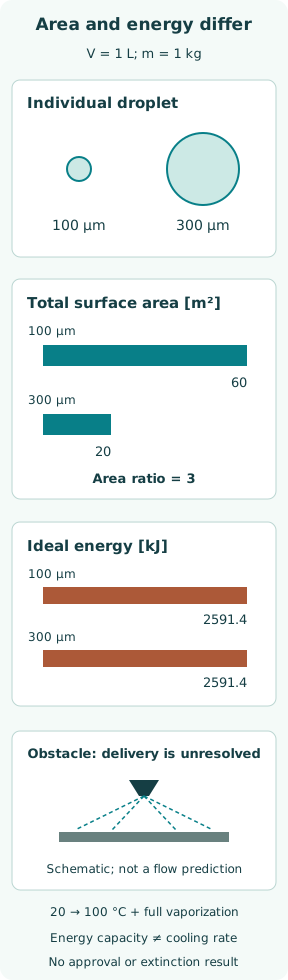
Take an original ideal population containing Vw = 0.001 m³ of water, equal to 1 L, with prescribed constant density 1,000 kg/m³. Its mass is 1 kg. Compare diameters d = 100 μm and d = 300 μm. The droplets are separate spheres and have not yet heated or evaporated.
One droplet has volume πd³/6 and area πd². Therefore the population count is N = 6Vw/(πd³), and the total surface area is A = Nπd² = 6Vw/d. Both calculations require diameters in metres. Counting droplets is an ideal continuous-population approximation; rounding the huge population to an integer has negligible effect here.
Calculate the geometric advantage
For 100 μm droplets, N is approximately 1.909859 billion and A = 60 m². For 300 μm droplets, N is approximately 70.735530 million and A = 20 m². Reducing diameter by three creates 27 times as many droplets and three times the total surface area at the same water volume.
The mass of one 300 μm droplet is 27 times that of one 100 μm droplet. If the individual droplets initially have the same speed, their individual momenta also have that ratio. This statement does not compare total spray momentum: the populations contain different numbers of droplets, and the total mass and speed were held equal.
Equal water has equal ideal heat uptake
Assume, for a separate energy budget, that every kilogram warms from 20 °C to 100 °C and fully vaporizes at the assumed atmospheric-pressure boiling condition. Use rounded teaching properties cp = 4.18 kJ/(kg·K) and latent heat hfg = 2,257 kJ/kg. Ignore superheating and other losses. The ideal uptake is m[cp(100 − 20) + hfg].
Both populations then absorb 2,591.4 kJ: 334.4 kJ of sensible heating plus 2,257 kJ of vaporization. The smaller droplets have more interface, but they do not create extra water mass or extra latent heat per kilogram. The figure places area and energy side by side so that a faster-transfer hypothesis is not mistaken for a larger total energy capacity.
Heat-transfer rate needs more than area
An illustrative instantaneous convection expression is heat rate = hA(Tgas − Tdrop). Tripling A would triple this expression only if the heat-transfer coefficient and temperature difference were unchanged. Neither condition can simply be assumed across different droplet populations in a fire. Their velocities, temperatures, evaporation and surrounding gas fields can differ.
Nor does the ideal 2,591.4 kJ establish a fire size that the litre can extinguish. It is energy, not power; comparing it with a heat-release rate requires a timescale and an account of where that energy is removed. Continued fuel supply, hot surfaces and heat feedback to fuel remain outside the simple budget.
Momentum and obstructions change the destination
NIST’s droplet/surface discussion describes how low-momentum droplets can be diverted by a rising fire plume and then cool nearby surfaces. Direct penetration is therefore not the only possible mechanism. However, indirect cooling is also not proof that a particular shielded fire receives enough cooling. The paths and interactions must be established for the relevant arrangement.
A plate or platform can intercept liquid, produce runoff, deflect a spray and alter the surrounding airflow. It may protect one region from direct wetting while creating another place for evaporation. A simple shadow drawn behind an obstacle helps identify a question; it cannot quantify the lost suppression performance or specify an untested nozzle relocation.
Match the application to its test basis
Water-based local application and whole-space protection address different duties. An approval for a particular protected engine area cannot be treated as unrestricted approval for an entire machinery enclosure. The intended fire scenarios, geometry, nozzle arrangement, supply conditions and ventilation assumptions must come from the applicable approval package rather than from the generic label “water mist.”
IMO MSC.1/Circ.1387, annex 3.2, explicitly relates local-application nozzle arrangements to successful fire tests and obstructions. The 8 September 2022 corrigendum replaces three appendix test-arrangement figures and belongs with that reference. This is a specific application example. Its clauses do not turn the two droplet populations above into a test, or establish that one diameter is acceptable for every marine water-mist system.
Installation changes can change the tested problem
A new cable tray, equipment cover or temporary platform may alter the route from nozzle to protected area even when the pump and pipe sizes remain unchanged. Moving a nozzle can change overlap, distance and orientation. Replacing a nozzle with one that merely has the same nominal flow can change the size and velocity distributions.
The useful review output is a trace from the as-installed geometry to the approved design and installation limits. Identify the changed feature, the performance assumption it may affect and the competent assessment needed. The article provides no permitted obstruction percentage or universal clearance because those quantities cannot be derived from the equal-volume geometry.
Keep geometric proof separate from fire performance
The calculation proves three results under explicit assumptions: a threefold area increase, a 27-fold population increase and equal ideal full-vaporization energy. It does not calculate a spray trajectory, evaporation history, local water flux or an extinguishment time. In particular, no percentage of the water is assumed to reach the fire without evidence.
A defensible performance statement combines the relevant test basis, approved equipment, installed geometry and demonstrated supply conditions. The area calculation is useful because it explains one mechanism and its boundary. Its greatest value is showing which additional quantities remain unknown before a plausible physical argument can support an installation claim.
Sources
- NIST: Determination of Water Spray Drop Size and Velocity From a Low Pressure, High Momentum, Water Mist Nozzle. 31 May 1995 report record — Abstract: measurements at varying spray locations and operating conditions
- NIST: Droplet/Surface Interaction: Relevance to Fire Suppression. 5 January 2011 publication record — Abstract: deflection by a fire plume, surface impact and evaporation
- IMO MSC.1/Circ.1387: Revised guidelines for approval of fixed water-based local application fire-fighting systems. 10 December 2010; read with Corr.1 of 8 September 2022 — Annex 3.2.1–3.2.2 and 3.3
- IMO MSC.1/Circ.1387/Corr.1: Corrigendum. 8 September 2022 — Corrigendum replaces appendix figures 3.4.2.4, 3.4.2.5 and 3.4.2.6