Knowledge / Shipyards and ship structures
Inventory of hazardous materials: from newbuilding records to ship recycling
Maintain ship-specific hazardous-material evidence through newbuilding and replacements, with an original concentration-basis and unknown-content example.
On this page
An inventory of hazardous materials is useful only if its entries still describe the ship. A supplier declaration can be authentic yet apply to another product revision, and a blank quantity can hide uncertainty rather than absence. The lifecycle task is to preserve the connection between material identity, location, evidence and change.
Start with the ship and the applicable framework
IMO records that the Hong Kong Convention entered into force on 26 June 2025. That date is a framework milestone, not a finding that every vessel has identical obligations. Flag, vessel size, operating pattern, construction dates, exemptions and the applicable implementation arrangements must be established for the ship under review before selecting certificates or deadlines.
The European Commission also describes an EU ship-recycling framework with additional requirements. Convention and regional compliance should not be assumed interchangeable. This article follows the engineering evidence behind an inventory; it does not decide a particular vessel's legal scope. A clear applicability note prevents a technically detailed list from being attached to the wrong regulatory basis.
Build the newbuilding record around installed identities
For a new ship, purchasing and installation records can connect product declarations to the items actually fitted. The key is the relation, not the number of PDFs collected. Product identity, revision, supplied quantity and final location must agree sufficiently to show why a declaration applies. A document for a similar model can inform a question but cannot silently close that question.
The 2023 IMO guidelines distinguish Material Declarations and Supplier's Declarations of Conformity, with product and document identifiers. The supplier's conformity statement supports the related declaration; it does not replace the link to installed equipment. An inventory entry should retain that evidence connection when procurement codes, yard tags and the vessel's equipment numbering use different naming systems.
Keep concentration, component mass and reporting basis distinct
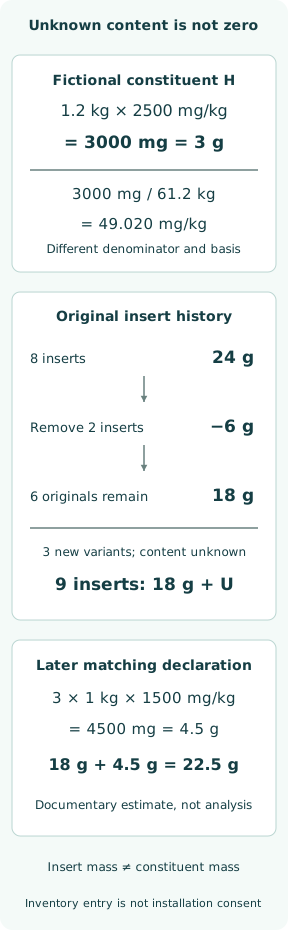
Invent a constituent H used only for bookkeeping. An original insert weighs 1.2 kg and has an assigned declaration of 2500 mg of H per kilogram of insert material. Multiplying gives 3000 mg, or 3.000 g, of H per insert. This is a declared estimate from fictional inputs, not an analysis of a real hazardous material or an installation proposal.
Suppose the insert belongs to an assembly with 60 kg of other material, making 61.2 kg in total. Dividing the same 3000 mg by 61.2 kg gives 49.020 mg/kg. The smaller number uses a different denominator; it cannot be compared as though it were the insert concentration. The relevant material and threshold basis must be established, rather than chosen to make a number appear favourable.
Use the current amendment to show why sample basis matters
MEPC. 405(83), adopted 11 April 2025, amends the 2023 guidelines by clarifying cybutryne thresholds for hull samples and wet-paint samples, including the declaration form. The distinction is a concrete reason to read amendments and footnotes. A concentration detached from its sampled material can be misinterpreted even when its laboratory unit is correctly written.
The fictional H example is not a cybutryne case and supplies no regulatory threshold. Its purpose is dimensional and documentary: a mass fraction needs a defined reference material. Inventory reporting is also distinct from permission to install or use a controlled substance. A quantity below a reporting trigger, where one applies, must not be treated as a general exemption from separate prohibitions or controls.
Record removal without erasing the evidence trail
Assume eight identical original inserts are documented at 3.000 g each. Their stated constituent total is 24.000 g. A later work record verifies that two complete original inserts were removed from the ship, leaving six. The documented reduction is 6.000 g and the remaining original subtotal 18.000 g. The calculation depends on the removed items really being the two identified complete inserts.
A work-order word such as replaced is not enough if the old component remains in stores or was moved elsewhere onboard. Location and custody determine whether it left the vessel inventory boundary. Preserve the historical entry and change reference so a later reader can distinguish removal from relocation, correction of an earlier error or deletion of a duplicate record.
Leave unknown replacement content unknown
Now add three inserts of a different variant, each weighing 1.0 kg. Their constituent concentration is initially unknown. The vessel has nine inserts in this example: six documented originals and three unresolved replacements. Its known original subtotal remains 18.000 g, but the current total must be written 18 g + U, where U represents the unknown contribution. It is not 18 g as a complete total.
The old declaration cannot be carried forward merely because the replacement fits the same housing. Model names, material formulation or supplier revision may differ. Nor does a blank concentration become zero through spreadsheet arithmetic. A calculation that skips blank cells can return a precise subtotal while falsely appearing to cover the whole installed population; the unresolved scope must remain visible beside it.
Resolve applicability before recomputing the estimate
Suppose a later declaration is obtained for the exact replacement variant and revision, and its identity, quantity and concentration basis are matched to the three installed inserts. Assign 1500 mg/kg of insert material. Each 1.0 kg insert then contributes 1.500 g; the three contribute 4.500 g. The documentary estimate becomes 18.000 + 4.500 =22.500 g, or 0.0225 kg, of H.
The current insert material itself totals 6 × 1.2 + 3 × 1.0 =10.2 kg, compared with 9.6 kg initially. These material masses are not the constituent mass and do not include the surrounding assemblies. Matching a declaration resolves the stated documentary applicability; it does not prove a laboratory measurement occurred or that all regulatory requirements are satisfied. The record should retain that evidence type rather than upgrading the claim.
Manage uncertainty and location through operational changes
The IMO guidelines address maintaining Part I through changes and distinguish material known to be present from material potentially present. An inaccessible or uncertain item therefore needs a reasoned status and location, not a silent zero. The appropriate investigation depends on the material, available documentation, access and the approved assessment arrangements; this article prescribes no sampling or disturbance procedure.
A location description should be recoverable after the ship changes owner, operator or naming conventions. A compartment nickname can disappear, while a referenced arrangement and equipment identity give later teams a way to find the entry. Quantities should retain units, estimation basis and revision history. Precision in a spreadsheet cannot repair uncertainty about which physical item its row describes.
Prepare for recycling without treating Part I as the whole package
The guidelines separate installed materials in Part I from operationally generated waste in Part II and stores in Part III for recycling preparation. This expands the evidence task beyond the original newbuilding equipment list. The ship's final operating condition may differ from the state in which Part I was first prepared or last surveyed.
The handover must connect the current inventory to the vessel and the recycling planning process, with the relevant verification and certification arrangements. An inventory does not itself authorize cutting, entry or material removal; those operations need their own controls. A declared quantity is useful for planning only when its physical location, uncertainty and material basis remain available to the people using it.
Report a defensible quantity and its unresolved boundaries
The original example separates three quantities: component-material mass, constituent mass and whole-assembly mass. It then shows how verified removal changes a known subtotal, how a new variant creates an unknown contribution, and how matching documentary evidence supports a revised estimate. None of those steps turns an authentic but inapplicable supplier declaration into evidence for a different installed item.
A useful lifecycle record preserves what is present, where it is, why the evidence applies, how quantity was estimated and what changed. Blank or unknown rows are never proof of zero hazardous material. The 22.500 g result is a fictional declared estimate, not a ship certificate, absence claim or handling instruction. That limit keeps the inventory informative when the vessel and its records evolve.
Sources
- IMO — Recycling of ships. Live official page checked 8 October 2026; Convention entry into force 26 June 2025 — Hong Kong Convention and ship-specific inventory context
- IMO Resolution MEPC.379(80) — 2023 Guidelines for the Development of the Inventory of Hazardous Materials. Adopted 7 July 2023; read with MEPC.405(83), adopted 11 April 2025 — §4 development and maintenance; §6 declarations; Appendices 1, 2, 6, 7
- IMO Resolution MEPC.405(83) — Amendments to the 2023 IHM Guidelines. Adopted 11 April 2025; application invited as soon as possible and no later than 26 June 2025 — Cybutryne threshold clarification and amended declaration entries
- European Commission — Ships and ship recycling. Live official overview checked 8 October 2026 — EU Ship Recycling Regulation scope and IHM obligations