Knowledge / Shipyards and ship structures
Sensitization in welded stainless piping: thermal history and intergranular corrosion
Separate thermal exposure, chromium-depleted grain boundaries and actual corrosive service using two original temperature histories and bounded residence-time calculations.
On this page
A stainless-pipe weld can retain its nominal grade while its local corrosion behaviour changes. Sensitization is one possible mechanism: the thermal history and composition can create chromium-depleted regions near grain boundaries. Whether those regions then suffer damaging attack depends on the environment and the actual material state, so a hot welding cycle alone is not a corrosion verdict.
Follow the local chromium distribution
Stainless behaviour depends on a protective surface state, supported by the alloy beneath it. In susceptible conditions, chromium-rich precipitation at grain boundaries can leave nearby material less able to maintain its corrosion resistance. The relevant change is local. A bulk chemical analysis can remain within the specified composition while missing the narrow depleted regions controlling intergranular susceptibility.
BSSA describes the link between boundary precipitation, chromium depletion and subsequent localized attack. This is not a claim that every stainless family follows identical kinetics. Grade, carbon content, prior processing and thermal exposure matter. A material label is a starting point for that investigation, not a complete description of the weld's microscopic condition.
Keep neighbouring corrosion mechanisms separate
Heat tint and surface oxidation, grain-boundary sensitization, chloride pitting, crevice corrosion and stress corrosion cracking can all be relevant near a weld, but they are not interchangeable names for the same process. Removing a surface oxide does not necessarily reverse a subsurface boundary condition. Likewise, intergranular susceptibility does not establish the rate of chloride pitting in the service fluid.
TWI's 2003 marine-weld paper lists metallurgical variation and surface oxidation as separate corrosion concerns. Its historical observations about common failures are useful context, not universal current service-temperature limits. Diagnosis should connect morphology, material condition and environment rather than attribute every discoloured or leaking joint to sensitization merely because it was welded.
Treat the heat-affected zone as a spatial history
Different positions next to a weld see different peak temperatures, residence times and cooling rates. The fusion boundary, a more distant heat-affected band and unaffected parent pipe do not share one temperature trace. Repeated passes can revisit a location with a different starting temperature; repairs and later service exposure can add further thermal history.
A thermocouple record therefore needs its location and attachment method, not just a peak reading. A sensor some distance from the critical band may miss the controlling excursion. For multipass work, the sequence and time between passes help define what the local material experienced. A temperature calculated for one ideal point cannot certify every grain boundary around a pipe circumference.
Construct two original histories with the same peak
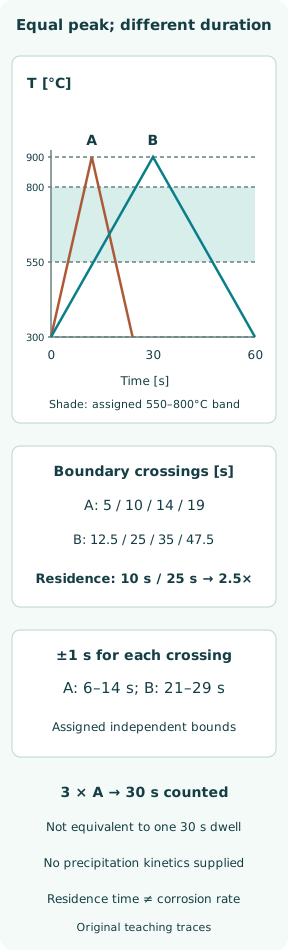
Assign history A the points (0 s,300°C), (12 s,900°C), (24 s,300°C), with straight lines between them. History B uses (0 s,300°C), (30 s,900°C), (60 s,300°C). Both have a 900°C peak; their heating and cooling slopes have magnitudes 50 and 20°C/s respectively. These are invented single-point traces, not measurements from a welding procedure.
For illustration only, select a 550–800°C counting band. Its boundaries are assigned bookkeeping choices, not a universal sensitization window. Linear interpolation identifies the intervals within that band. The selected band deliberately does not supply a grade, carbon level, precipitation-start curve or corrosion environment; those missing inputs prevent the arithmetic from becoming a metallurgical prediction.
Calculate residence instead of declaring damage
History A enters and leaves the band at 5 and 10 s on heating, then at 14 and 19 s on cooling. Its residence is (10 − 5) + (19 − 14) = 10 s. History B has crossings at 12.5, 25, 35 and 47.5 s, giving 25 s. Thus B spends 2.5 times as long inside the selected band despite having the same peak temperature.
The ratio is a ratio of durations, not a ratio of sensitization, corrosion rate or remaining life. The plot shades the counted temperature range and shows each straight-line trace. It includes no precipitation boundary or acceptance line. Comparing only the peak would miss the assigned duration difference; treating the duration difference as damage would invent a kinetic model that was never supplied.
Do not turn repeated exposure into an unproved damage sum
Three exact repetitions of history A would sum to 30 s in the counting band. This is valid time bookkeeping if the repetitions really are identical and separately recorded. It does not establish equivalence to one continuous 30 s dwell, because temperature varies within each excursion and the material state can change between and during cycles.
For a separate uncertainty illustration, assign each of the four crossing times an independent bound of ±1 s while keeping their order. Worst-case interval arithmetic gives A a residence range of 6–14 s and B 21–29 s. These are stipulated bounds, not confidence intervals from a sensor study. Even perfectly known residence would still leave the precipitation and service-corrosion questions unanswered.
Read low-carbon and stabilized grades in their intended scope
Reducing carbon or using a stabilized grade can reduce susceptibility under relevant conditions, but selection must still fit fabrication and service. A low-carbon label is not a guarantee against every weld-related corrosion mechanism. Stabilized grades also require a suitable thermal history; assuming that an alloying addition cancels every consequence of welding overlooks local changes near the fusion region.
The older marine paper's broad statement that modern low-carbon production had eliminated the historical problem should not be extended into unlimited immunity. The useful evidence is the actual grade and composition, product and heat-treatment condition, qualified welding basis and expected subsequent exposures. The question is not whether the pipe is generically “stainless,” but which material state will face which environment.
Select a susceptibility test for the actual alloy and question
ASTM's official listing identifies A262-15(2021) as active and publishes its scope for intergranular-attack susceptibility tests. The public scope explains that the screening applicability depends on the grade and chosen practice. It also limits what these results establish about other corrosive environments and mechanisms. A laboratory result must therefore retain the practice, specimen condition and interpretation basis.
Only the public abstract and scope were accessed here; no detailed acid-test procedure is reproduced. A test of suitably prepared material can address susceptibility without predicting the actual service penetration rate. Conversely, a favourable test for intergranular attack cannot be re-labelled proof of resistance to pitting, general corrosion or stress corrosion cracking. Different claims require their corresponding evidence.
Avoid an automatic heat-treatment remedy
A proposed heat treatment changes the material and the assembly, not merely the colour of a weld. It can affect precipitation, residual stress, dimensional stability and other components. TWI explains that most chromium-nickel austenitic weldments do not routinely require post-weld heat treatment and that any treatment must address a defined service need.
A full solution treatment and a lower-temperature stress-relief operation have different purposes and consequences. Rapid cooling can introduce fresh stresses, while unsuitable exposure can worsen the condition being addressed. No treatment temperature, dwell or quench instruction is selected by the residence-time example. An actual remedy needs the material-specific approved process, assembly constraints and a defined way to verify the intended outcome.
Build the conclusion from material, exposure and environment
A useful investigation links pipe and filler identity, local thermal history, surface condition, representative metallography or susceptibility testing, and the service fluid and temperature. If attack has occurred, preserve its location and morphology before choosing a mechanism. A grain-boundary feature, a surface stain and a leak are observations with different diagnostic value; none alone supplies the full causal chain.
The two invented traces establish only that equal peaks can hide unequal thermal residence. They do not prove that either pipe sensitizes or corrodes. The engineering conclusion should say which susceptibility is supported, which service conditions could activate it, and which evidence remains necessary. That keeps thermal history useful without turning a counting band into a guaranteed-corrosion threshold.
Sources
- TWI — Corrosion of welded components in marine environments. Stuart Bond, marine-corrosion conference, 2–3 April 2003 — Corrosion-resistant alloys and stainless steels: thermal history, surface oxidation, intergranular susceptibility and distinct chloride mechanisms
- BSSA — Sensitisation of stainless steels: effects of poor heat treatment on corrosion performance. Public technical explanation accessed 8 October 2026 — Chromium-rich boundary precipitation, local depletion, composition and thermal history
- ASTM A262 — Detecting susceptibility to intergranular attack in austenitic stainless steels. Official listing identifies A262-15(2021) as active on 8 October 2026 — Public scope 1.2–1.4: grade-specific screening and limits on predicting other corrosion mechanisms/environments
- TWI — Is post weld heat treatment normally required when welding chromium-nickel austenitic stainless steels?. Public FAQ accessed 8 October 2026 — Service-dependent need for treatment; solution treatment, precipitation and new stresses during rapid cooling