Knowledge / Decision analysis
EDAS: judging alternatives against their average
Author: Yönetici · Published:
Open the working calculator · Decision analysis
Instead of asking only how close an option is to the best observed performance, we can ask how it compares with the average of the available options. EDAS, Evaluation Based on Distance from Average Solution, uses this perspective. It separates favorable and unfavorable deviations for each criterion, weights them, and combines normalized totals into an appraisal score. Keshavarz Ghorabaee and colleagues introduced the method in their 2015 paper.
The words “positive” and “negative” distance describe desirability, not numerical signs. Both quantities are nonnegative. Positive distance records an advantage in the preferred direction, while negative distance records a disadvantage. For a cost criterion, being below the average is favorable. Getting this direction wrong changes the meaning of every later step.
Average solution and calculation
For m alternatives, AV_j = Σ_i x_ij/m is the arithmetic mean of criterion j. For benefits, use PDA_ij = max(0,x_ij−AV_j)/AV_j and NDA_ij = max(0,AV_j−x_ij)/AV_j. For costs, reverse the differences: PDA_ij = max(0,AV_j−x_ij)/AV_j and NDA_ij = max(0,x_ij−AV_j)/AV_j.
With nonnegative weights normalized to sum to one, calculate SP_i = Σ_j w_j PDA_ij and SN_i = Σ_j w_j NDA_ij. Then NSP_i = SP_i/max_k SP_k, NSN_i = 1−SN_i/max_k SN_k, and AS_i = (NSP_i+NSN_i)/2. Rank alternatives from the largest appraisal score to the smallest. All denominators must be defined for these equations to apply.
Follow a numerical example
Let cost, quality and support have weights 0.40, 0.35 and 0.25. The alternatives are A = (100,80,6), B = (120,90,8), and C = (90,70,5). Cost is minimized; quality and support are maximized. The averages are approximately (103.333333,80,6.333333). A's cost is 3.333333 below average, giving a favorable relative distance of 1/31. Its quality equals average; its unfavorable support distance is 1/19.
A therefore has PDA = (1/31,0,0) and NDA = (0,0,1/19). B has PDA = (0,1/8,5/19) and NDA = (5/31,0,0). C has PDA = (4/31,0,0) and NDA = (0,1/8,4/19). Their weighted (SP,SN) pairs are approximately A = (0.012903,0.013158), B = (0.109539,0.064516), and C = (0.051613,0.096382).
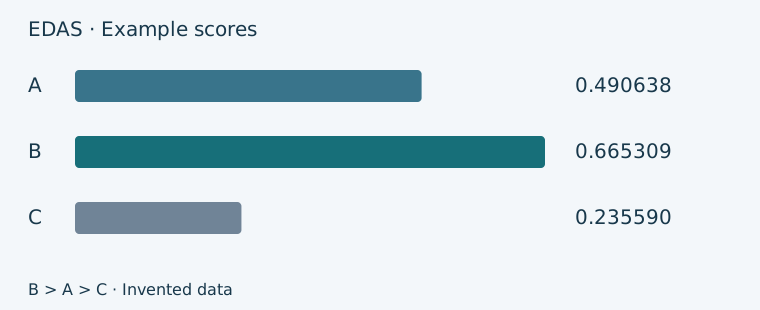
B supplies the maximum positive total; C supplies the maximum negative total. After normalizing these two totals and averaging them, the appraisal scores are A ≈ 0.490638, B ≈ 0.665309, and C ≈ 0.235590. The ranking is B > A > C. B's first place does not mean that it outperforms the average on every criterion: its cost is above average. The calculation balances its favorable and unfavorable components.
Domain restrictions and equal alternatives
A clear, conservative policy for this calculator is to require every performance value to be strictly positive. This is the tool's supported domain, not a claim that every EDAS extension universally requires positive individual observations. It guarantees positive criterion averages. Zero averages make the relative-distance formulas undefined; negative averages undermine the intended nonnegative-distance interpretation. Do not silently add an epsilon or offset to repair the data, because doing so changes the model.
A positive constant column generates PDA = NDA = 0 for all alternatives and cannot distinguish them. If every positively weighted column is constant, both maximum totals are zero and the original score equations are undefined. The calculator should report a shared rank. If it displays a common neutral score such as 0.5, label that explicitly as a software convention, not a score obtained from the original formulas. Missing values and nonfinite numbers must be resolved rather than treated as measured zeros.
Interpret and challenge the ranking
The average solution is neither an external target nor a mandatory standard. It is calculated from the current alternatives. Being above the average of a weak group does not establish absolute adequacy. Likewise, 0.5 is not a pass threshold and 0.8 is not an 80% probability of success.
An extreme observation can influence both the averages and the maxima used in final normalization. Adding, removing or duplicating alternatives can consequently change the result. Multiplying all values in a criterion by a positive constant preserves its relative distances; adding a constant generally does not. These properties follow from the stated equations and are reasons to avoid arbitrary offsets and poorly justified scales.
Test plausible weights and uncertain measurements, especially when leading scores are close. Keep hard eligibility requirements separate from a compensatory ranking. The linked calculator should be read from its intermediate results outward: inspect averages, the PDA/NDA matrices, and the SP/SN totals before interpreting the final appraisal scores. This makes the assumptions behind the preferred alternative visible and reviewable.
Source: Keshavarz Ghorabaee, M., Zavadskas, E. K., Olfat, L., & Turskis, Z. (2015). Multi-Criteria Inventory Classification Using a New Method of Evaluation Based on Distance from Average Solution (EDAS). Informatica, 26(3), 435–451. https://doi.org/10.15388/Informatica.2015.57 ; alternative publisher DOI: https://doi.org/10.3233/INF-2015-1070
Declared implementation rules
The calculator on this site accepts nonnegative data within a bounded teaching scope; nonzero values lie between 10⁻⁹ and 10⁹. Although the SAW formula supports a wider real-number domain, this interface does not accept negative observations. EDAS requires every value to be strictly positive. Weights must be zero or between 10⁻⁹ and 10⁶, with a positive total.
Test the example yourself
Recalculate with different matrix values and weights. Read the intermediate values alongside the sensitivity table.