Knowledge / Maintenance and reliability
Critical spares: failure exposure, lead time and common stock mistakes
Plan spares around the function at risk, replenishment exposure, compatibility and the evidence that a stocked item is ready to use.
On this page
A spare part can shorten an outage without making the installed component less likely to fail. The inventory question is therefore different from the component-reliability question. A useful shipboard spares policy connects the consequence of losing a function to expected demand during replenishment, delivery uncertainty, storage condition and the ability to fit and verify the replacement.
Define criticality through the lost function
A cheap control relay can be more operationally critical than an expensive nonessential pump. Consider what function would be lost, whether a genuine alternative is available, how long degraded operation can be sustained and what constraints govern repair. Price and historical consumption alone cannot rank that consequence. Low past demand can reflect a rare but severe failure rather than an unimportant item.
DNV’s process-safety management overview includes critical-spares registers alongside safety-critical elements and performance standards. That is a useful organizational connection, not a universal stock list for ships. A register should explain the supported function and the basis for stocking. A code reading “critical” without a consequence or replenishment rationale is difficult to maintain when equipment or routes change.
Measure the whole replenishment lead time
Lead time begins when a usable spare is required or a replenishment order is triggered and ends when an accepted, compatible item is available at the point of use. Manufacturing, approval, transport, customs, port coordination, receipt inspection and onboard transfer may all contribute. A supplier’s dispatch date is not the same as a verified spare on board.
Distinguish typical lead time from credible delay. A 14-day quotation may be unreliable for a remote itinerary or obsolete part. If replenishment is reviewed only monthly, the review delay also extends exposure. Define whether the stock policy uses continuous review or periodic review, and whether known planned demand has already reserved items. A shelf count that includes a part committed to another job overstates free stock.
Use demand exposure with explicit assumptions
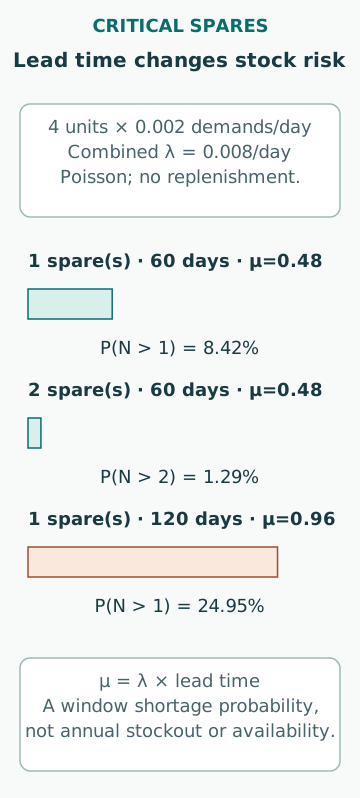
For an original teaching model, assume four identical pumps each create spare demand at a constant independent rate of 0.002 per day. Combined demand rate is λ = 0.008 per day. With fixed replenishment lead time L = 60 days, expected demand is μ = λL = 0.48. The NIST Poisson reference gives P(N = k) = exp(−μ) μ^k/k! for the count model.
With one spare and no replenishment arriving during that 60-day window, shortage occurs if two or more demands arrive. P(N ≥ 2) = 1 − exp(−0.48)(1 + 0.48) = 8.42%. Two spares make shortage require three or more demands, giving 1.29%. These are window probabilities under an assumed Poisson demand process, not annual stockout rates or availability values. The failure rate is invented and is not a marine benchmark.
Test delay and common demand before choosing stock
If the same model’s lead time doubles to 120 days, μ becomes 0.96. With one spare, the probability of at least two demands rises to 24.95%. The apparent stock adequacy was therefore strongly dependent on logistics. A scenario range often communicates that dependence more honestly than a single “optimal” quantity based on an optimistic delivery estimate.
Independent demand is particularly questionable when units share contamination, a defective batch, an installation practice or severe service conditions. One event can require several replacements. Planned overhauls also create clustered demand that is not well represented by a stationary Poisson model. Add explicit simultaneous-demand and scheduled-work scenarios rather than inflating a fitted rate until the model appears conservative.
Verify interchangeability rather than appearance
Part number, revision, material, seal compound, dimensions, electrical rating, firmware and required approvals can determine compatibility. A component that physically fits can still be unsuitable for pressure, temperature, fluid or protective function. Preserve the equipment bill of materials and approved substitution evidence. Similar packaging and a matching thread are not engineering approval.
HSE’s maintenance-procedure guidance identifies uncontrolled spares and out-of-specification replacements as contributors to major hazards. Its process-industry examples support the general principle of specification control; applicable marine requirements must be checked separately. Receipt inspection should verify identity and condition before the inventory system marks the item available. Discrepancies belong in quarantine rather than silently on the shelf.
Count serviceable stock rather than nominal stock
An electronic module damaged by moisture, an expired seal kit and a corroded bearing are not equivalent to ready spares. Storage requires suitable packaging, environmental conditions, preservation and periodic checks according to the item’s guidance. Shelf life may begin at manufacture rather than receipt. Opening a protective package for counting can itself change preservation needs.
Use condition states such as serviceable, reserved, awaiting inspection, repairable return and rejected. A repairable item sent ashore is part of a turnaround pipeline, not immediately available stock. Track repair lead time and rejection probability as well as purchase lead time. If the workshop returns a unit without required test evidence, the logistics loop is incomplete even though the box has arrived.
Include tools, consumables and restoration time
A spare pump cartridge is of limited value if the required lifting arrangement, alignment tools, gasket, lubricant or competent personnel are unavailable. Define a repair kit around the full restoration task. Replacing the central component may require single-use fasteners or seals that are not included in the vendor package. Verify the bill of work as well as the bill of materials.
Downtime comprises diagnosis, waiting, preparation, physical repair and functional verification. Holding stock mainly reduces some waiting terms. It may not reduce a difficult access or testing duration. In a simple example, cutting parts delay from 72 h to 4 h reduces an outage with 12 h of other work from 84 h to 16 h. The 68 h benefit is substantial, but neither repair duration nor component failure probability has become zero.
Choose the inventory service measure deliberately
The probability of any shortage, expected number of unfilled demands and expected outage duration are different measures. A stock policy can have a low chance of shortage but a severe consequence when a rare long delivery coincides with failure. A high fraction of demands supplied immediately can also conceal the one safety-critical item that was unavailable.
Do not turn the 60-day example into an annual probability by multiplying by the number of 60-day periods. Windows can overlap, stock is replenished and the available quantity changes after demand. A full continuing-inventory model needs reorder rules and delivery events. The simple example is useful for exposing sensitivity to lead time and quantity; it is deliberately not a complete fleet inventory optimization.
Review the policy after use and changes
After an issue, trigger replenishment and record why the item was consumed. Failure, planned replacement, damage in storage and transfer to another vessel imply different demand. Reconcile physical count and system count, including kit contents. An unopened box labelled as a complete kit should not remain unquestioned after several parts have been borrowed.
Review criticality when equipment is modified, suppliers discontinue parts, routes change or a new failure mechanism appears. Pooling stock across vessels can reduce total inventory but introduces transport and competing-demand constraints. State the actual access arrangement rather than counting a fleet spare as simultaneously available everywhere. The final policy should explain quantity, location, condition, replenishment trigger and the residual outage exposure it leaves.
Sources
- Process safety management · DNV · Source check date: 2026-10-06
- Engineering Statistics Handbook: Poisson distribution · NIST · Source check date: 2026-10-06
- Maintenance procedures · HSE · Source check date: 2026-10-06