Knowledge / Maintenance and reliability
Fine-filter performance: beta ratio, dirt-holding capacity and bypass effects
Turn a beta rating into a particle balance, calculate the damage from unfiltered bypass flow, and distinguish laboratory capacity from an actual replacement interval.
On this page
A fine-filter label answers only part of the contamination-control question. The size-specific capture rating describes the element under stated conditions. The assembly must also pass the required flow, retain its seals and keep an adequate fraction of the stream through the medium. Dirt-holding capacity describes another property again. Treating these three ideas as one number can make a highly rated element look more protective than the installed system really is.
A micron label needs a capture ratio
An element described only as “10 micron” leaves its efficiency unspecified. For a stated particle threshold x, beta is the upstream particle concentration divided by the downstream concentration, counting particles at or above that threshold. Concentrations must use the same volume basis and compatible sampling and counting methods. The calibrated notation µm(c) identifies the particle-sizing basis; it does not describe a simple sieve opening.
Donaldson explains the beta ratio and its conversion to efficiency: ηx = 1 − 1/βx. Thus beta 200 corresponds to 99.5% capture at the stated threshold. This is a particle-number efficiency, not a mass fraction, a dissolved-contaminant removal rate or a guarantee that every smaller particle is stopped.
Worked count example: keep the sample basis explicit
Consider two hypothetical, representative 100 mL samples at a threshold of 10 µm(c). The upstream sample contains 100000 counted particles and the downstream sample 500. Their concentrations are 1000 and 5 particles/mL. Therefore β10(c) = 1000/5 = 200, and η10(c) = 99.5%. These numbers illustrate the arithmetic; they are not reported test results or an instrument sampling instruction.
If sample volumes differ, divide each count by its own analysed volume before forming beta. A zero downstream count in a finite sample does not establish infinite physical beta or perfectly efficient filtration: detection limits, sample size and uncertainty still matter. Similarly, a system cleanliness class describes the fluid population at a sampling point; it is not the same quantity as a filter’s beta rating.
A multi-pass test has a defined laboratory basis
ISO 16889:2022 describes a multi-pass test with continuous contaminant injection and evaluation of particle removal, capacity and differential pressure. The test puts repeatable conditions around the element comparison. Its public scope should not be read as a universal promise about every machine fluid, loading pattern or contaminant mixture.
For a useful comparison, retain the particle threshold, beta curve or declared rating, test flow, fluid viscosity, terminal differential pressure and capacity basis. Two elements with the same nominal size may differ in their efficiency across particle sizes, clean pressure loss and capacity. A value averaged over a test can also conceal changes during loading; the applicable report should explain how the advertised rating was obtained.
The bypass path changes the outlet concentration
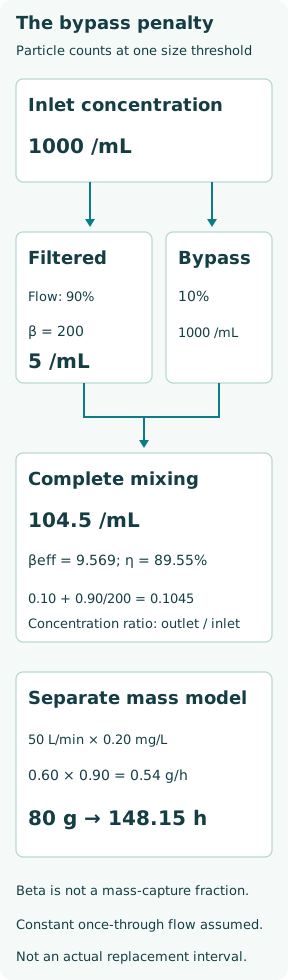
Here “bypass” means an unfiltered path around the main element, such as an open bypass valve or a sealing leak. It does not mean a separate offline filtration circuit sometimes called a bypass filter. Let b be the fraction of total flow taking the unfiltered path, not valve opening percentage. Assume both branches receive the same upstream concentration, the filtered branch retains its stated beta, and the two outlets mix completely without release or another contaminant source.
The particle balance is Cout/Cin = b + (1 − b)/βelement. The first term passes untreated; only the remaining fraction benefits from the medium. Effective capture is 1 − Cout/Cin, and effective beta is the reciprocal of that ratio. This simple steady mixing model isolates the bypass penalty; a real opening can simultaneously change flow through the element and its performance.
Worked bypass examples: a small flow can dominate
With beta 200 and b = 0.10, the outlet ratio is 0.10 + 0.90/200 = 0.1045. At the earlier 1000 particles/mL inlet, the mixed outlet contains 104.5 particles/mL. Effective capture is 89.55% and effective beta is only 9.569. The element’s 99.5% rating remains the assumed branch property, but it no longer describes the mixed flow delivered downstream.
Even a beta 1000 element with just 2% unfiltered flow gives a ratio of 0.02 + 0.98/1000 = 0.02098. Effective capture is 97.902%, with beta 47.664. These examples do not establish an acceptable bypass allowance. They show why element rating, sealing integrity and bypass behaviour must be evaluated together rather than improving media efficiency alone.
Differential pressure is a flow-and-condition signal
Parker discusses element loading, viscosity and housing bypass selection. Pressure drop can rise because the medium has accumulated solids, but also because flow or viscosity has increased. A cold start can therefore produce a large differential pressure without a newly dirt-loaded element. Temperature and flow should accompany a differential-pressure trend.
An indicator, bypass valve and element collapse limit serve different functions and may have different settings. The opening characteristic is not necessarily an instantaneous switch from zero to full bypass. Replacing an element solely from one unexplained pressure reading can miss the actual cause; removing or defeating a bypass can expose another part of the system to unacceptable restriction. The equipment’s approved arrangement determines the response.
Capacity is a mass quantity with a terminal condition
Dirt-holding capacity is the amount retained under the stated test and end condition, commonly linked to a terminal differential pressure. It is not simply the element’s physical empty volume. Contaminant shape and size distribution, medium structure, fluid viscosity and flow influence how retained material changes restriction. Equal masses of different contaminants need not produce equal pressure loss.
The beta count efficiency cannot be substituted automatically for mass capture efficiency. A few large particles can carry much more mass than many small ones. To forecast retained mass, use a separately justified mass balance or relevant loading data. A catalogue capacity is therefore a comparison input, not an unqualified number of operating hours.
Separate loading example: why the time is only illustrative
Assume a once-through stream of 50 L/min continuously brings new contamination at 0.20 mg/L. Incoming solids are 10 mg/min = 0.60 g/h. Independently stipulate a captured mass fraction of 0.90; retained mass then grows at 0.54 g/h. If 80 g of usable capacity remains under the assumed terminal condition, ideal time is 80/0.54 = 148.15 h.
This deliberately constant example ignores changing efficiency, release and pressure-dependent behaviour. It does not use the earlier beta rating to obtain 90% mass capture. In a recirculating reservoir, multiplying pump flow by reservoir concentration repeatedly counts the same inventory; it is not automatically the fresh contamination ingress rate. Actual replacement planning requires the system’s ingress, generated debris, operating cycle and measured restriction history.
Verify the installed protection, not only the element label
Record element identity, fluid and temperature range, flow duty, differential-pressure trend, indicator and bypass characteristics, seal condition, sampling location and the target cleanliness requirement. Investigate unexpected downstream counts alongside sampling quality and possible internal generation. A good element cannot remove particles produced downstream before they reach the protected component.
The useful chain is rated size-specific capture → actual filtered flow fraction → downstream particle population, with retained mass and pressure loss tracked separately. Compare elements on a common test basis, then verify performance in the approved installed arrangement. This keeps the beta rating informative without asking it to predict capacity, fluid chemistry and maintenance timing all at once.