Knowledge / Rules and safety management
Emergency drills: measuring capability without rehearsing only the script
Define drill objectives, observe decisions and interfaces, separate safe exercise conditions from real response, and verify that lessons change the capability being tested.
On this page
A drill can be completed exactly as scheduled while revealing little about emergency capability. Participants may know every cue in advance, equipment may be positioned unusually conveniently, or the final record may capture attendance rather than performance. Effective drills have a defined learning or assessment purpose, observable criteria and a safe exercise boundary. They should show what the team and equipment can do in the tested conditions, and what remains untested.
Define the capability before writing the scenario
Start with the function the exercise is intended to develop or assess: recognizing a cue, communicating a location, accounting for personnel, coordinating resources or demonstrating the use of equipment within its approved conditions. A broad label such as emergency drill completed does not identify which capability has been demonstrated.
The UK exercising best-practice guidance links exercise design to objectives and evaluation. Used as a general exercise-design reference, this supports writing observable outcomes before adding scenario detail. The ship’s applicable statutory drill requirements and emergency plans still govern its programme; a general evaluation method does not replace them.
Distinguish training from assessment
A coached training session can appropriately pause to explain a difficult task or correct an unsafe misunderstanding. An assessment exercise asks what participants can do under the defined conditions with specified assistance. Both are useful, but the record should say which occurred. A successful action after coaching is evidence of learning during the session, not the same evidence as an unprompted correct response.
Do not hide preparation that materially affects the result. Advance knowledge, pre-positioned equipment or a simplified access route may be appropriate for a particular objective, but they limit what can be inferred about another situation. The aim is not to make every drill a surprise. It is to make the relation between exercise conditions and the capability claim explicit.
Keep the exercise itself controlled
Realism should help the learning objective without introducing uncontrolled danger. Simulated casualties, scenario messages and safe representations of unavailable systems can test decisions without creating the actual hazardous condition. Any real equipment operation must remain within the appropriate procedures, equipment limitations and authorized arrangements.
The plan needs a clear distinction between exercise communication and an actual emergency, together with a way to pause or terminate the exercise when necessary. Participants should not be rewarded for unsafe speed. Weather, access, concurrent work and the condition of equipment can change what is appropriate to demonstrate on the day.
Measure a chain of performance, not one finish time
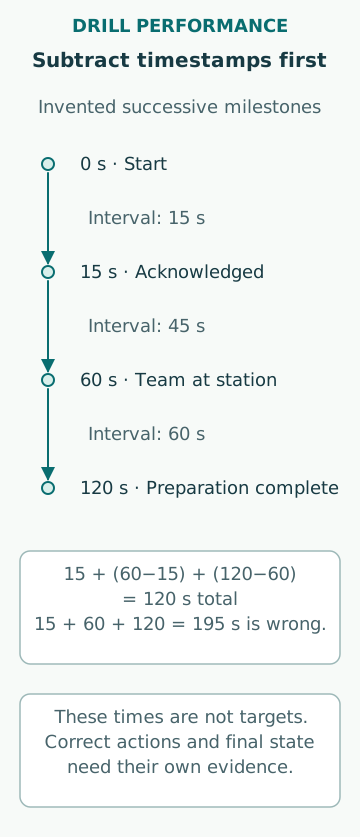
An original timing example records a common start at t = 0, acknowledgement at t = 15 s, the relevant team reaching the exercise station at t = 60 s, and completion of the specified simulated preparation at t = 120 s. The successive elapsed intervals are 15 s, 45 s and 60 s; the overall elapsed time is 120 s.
Adding the cumulative timestamps 15 + 60 + 120 would incorrectly report 195 s. Record whether each number is a timestamp or an interval and whether actions overlap. These illustrative times are not response targets. A useful performance assessment also asks whether information was correct, the required checks were made and the final state met the objective.
Test information and coordination interfaces
An emergency response depends on more than individual equipment handling. The location, nature of the problem, available resources and changing conditions must be understood by the people who act. A message transmitted is not automatically a message correctly received and interpreted. Observation should identify misunderstandings and their consequences for the exercise.
Safe scenario variations can examine those interfaces: an unavailable normal communication route represented by an exercise message, a changed location or a stated resource limitation. The variation should be tied to a credible learning objective and remain within the controlled exercise design. Adding complexity without a purpose can obscure the basic capability being assessed.
Keep participation evidence distinct from readiness
The UK MGN 570 Amendment 1 fishing-vessel guidance emphasizes crew engagement, debriefing and learning from weaknesses. Its vessel scope is specific. More generally, attendance can establish that someone was present, while capability requires evidence of relevant performance. A familiar task completed by one experienced person does not automatically demonstrate the whole team’s competence.
A percentage of completed exercise items also has limits. If four of five items are complete, the fraction is 80%, but the missing item may be the communication or verification on which the rest of the response depends. Preserve the meaning of each unmet criterion rather than treating readiness as the unweighted average of ticked boxes.
Use debriefing to connect observations to causes
A debrief should distinguish observed events, participant explanations and hypotheses about causes. A delayed action may reflect unclear information, equipment location, task conflict or unfamiliarity. Selecting a remedy before understanding the reason can leave the actual weakness unchanged. Record what worked as well as what failed, including the conditions that enabled success.
IMO MSC.581(110), paragraph 4.1 recommends reviewing the enclosed-space emergency response plan after drills. Within that specific scope, the point is to use the exercise evidence to improve the plan. For other drill types, the same learning question is useful while the applicable requirements remain distinct.
Verify the action and protect recovery time
An action should identify the capability to be improved, the responsible role, the completion evidence and how effectiveness will be checked. Moving equipment, revising a message format or changing a role description can each require a later demonstration. Closing the action administratively is not the same as showing that the exercise weakness has been resolved.
The MLC text, Standard A2.3 paragraph 7 also addresses minimizing disturbance of rest and avoiding fatigue during required drills. Planning learning without considering workload can undermine the capability the programme seeks to improve. Actual applicability and the ship’s operational framework should guide the timing and arrangement; no universal drill roster is proposed here.
Report the demonstrated scope honestly
A useful drill record includes the objective, participating roles, exercise conditions, simulated elements, observations, unmet criteria and follow-up evidence. It should identify what was not tested and why. Repeating the same favourable scenario can build familiarity, but it cannot by itself establish performance across every relevant emergency condition.
The value of a drill is the capability it develops or demonstrates and the weaknesses it helps resolve. A clear record allows the next exercise to build on that evidence. The objective is a team that understands its tasks and interfaces within the real ship arrangement, supported by working equipment and an improving plan, rather than a perfect-looking history of completed events.
Sources
- Exercising Best Practice Guidance · UK Government / resilience guidance · Source check date: 2026-10-07
- MGN570 Amendment1(F): Fishing vessels emergency drills · UK MCA · Source check date: 2026-10-07
- MSC.581(110): enclosed-space recommendations · IMO · Source check date: 2026-10-07
- MLC2006 as amended, including2022 amendments · ILO · Source check date: 2026-10-07