Knowledge / Navigation and marine safety
NAVTEX and SafetyNET: from receiving a warning to assessing route relevance
Connect receipt, identity, in-force status, geographic scope and passage timing, using an original fictional warning and route-overlap calculation.
On this page
Receiving a safety message establishes that information reached the ship. It does not establish that its meaning was assessed against the planned passage, that a later cancellation was linked to it, or that the assessment survived a watch change. Warning handling is an information lifecycle whose useful output is a traceable route-relevance decision.
Separate reception from route relevance
A receiver log and a bridge assessment answer different questions. The log can document delivery; the assessment connects the message to a ship, a route and a time. A warning far from the current position may matter to a later leg, while a geographically nearby warning may concern an activity or interval that needs more specific interpretation.
A compact assessment record therefore preserves the source text, issuing authority, message identity, issue and receipt times, affected geometry, event period and subsequent status changes. This is an explanatory information model, not a replacement for a ship’s required procedures. Its purpose is to prevent “received” from silently becoming “reviewed,” and “reviewed” from silently becoming “resolved.”
Understand what each delivery service contributes
The IMO NAVTEX Manual defines international NAVTEX reception on 518 kHz and separates transmitter, subject and numbering characters in its technical message identity. Those characters help manage delivery. They should not be confused with the full identity of the warning series contained in the text, particularly when information is relayed through more than one service.
Inmarsat describes SafetyNET as an Enhanced Group Calling service for MSI and search-and-rescue information. A satellite delivery path changes how a message reaches the receiver; it does not remove the need to check its applicability. Area settings, receiver position and equipment instructions belong in reception assurance, while the warning’s actual geographic scope belongs in the relevance assessment.
Preserve identity across the warning lifecycle
The current joint MSI Manual, Revision 2, retains warnings in force until cancellation by the originating coordinator and describes in-force bulletins. An event’s stated end, a warning’s cancellation and the end of repeated broadcasting are different facts. A message disappearing from a recent broadcast list is not, by itself, evidence of cancellation.
For a classroom record, use labels W-A, W-B and W-C rather than fabricated operational serial numbers. W-B may replace W-A; W-C may explicitly cancel W-B. The links must identify the intended earlier message and authority. A cancellation closes that warning’s lifecycle as stated; it does not certify that every hazard in the surrounding area has disappeared.
Translate the geometry without inventing precision
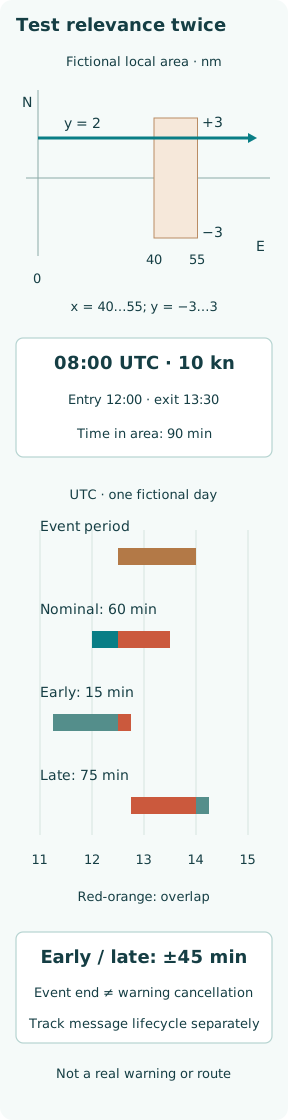
Create an original local exercise with eastward x and northward y in nautical miles. The fictional event occupies the rectangle 40 ≤ x ≤ 55 and −3 ≤ y ≤ 3. A straight classroom route follows y = 2. The centerline intersects the rectangle, so the geographic screen identifies a potentially relevant passage segment.
These coordinates are local teaching axes, not latitude and longitude. A real message may describe a point, radius, line or polygon, and its wording can qualify what that geometry means. Position uncertainty, ship dimensions and route corridor may enlarge the relevant area of examination. The rectangle calculation supplies none of those margins and grants no clearance outside its drawn edge.
Calculate the nominal time intersection
Assume departure from x = 0 at 08:00 UTC and constant speed 10 kn on the same hypothetical day. Entry at x = 40 occurs at 12:00; exit at x = 55 occurs at 13:30. The segment takes 90 min. Let the fictional event period be 12:30–14:00 UTC, deliberately different from the passage interval.
For passage [te, tx] and event [ts, tf], overlap duration is max[0, min(tx, tf) − max(te, ts)]. Here the intersection is 12:30–13:30, or 60 min. A nonzero overlap triggers relevance in this simplified screen; it is not a risk score, an instruction to proceed, or a statement that the other parts of the passage are safe.
Test timing uncertainty with explicit alternatives
Shift the whole passage 45 min earlier while retaining its speed and length. Occupancy becomes 11:15–12:45 and overlaps the event for 15 min. Shift it 45 min later instead: occupancy becomes 12:45–14:15 and overlap becomes 75 min. The early and late cases demonstrate that the same geographic route can have different temporal relevance.
These are chosen deterministic alternatives, not a forecast distribution or a confidence interval. The broad envelope of possible occupancy must not be reported as the duration of one actual transit. If the route, speed or event timing changes, repeat the appropriate intersection with the revised assumptions and identify which previous assessment it replaces. Retaining only the nominal arrival time hides that dependency.
Handle duplicates without deleting meaning
A repeated copy can confirm reception continuity without announcing a new event. Conversely, a similar-looking message may revise a coordinate, time, equipment status or cancellation reference. The useful comparison is against message identity and content, not merely the first line or the newest receipt timestamp. An automated duplicate label should not erase a consequential difference from the review trail.
In the classroom sequence, receiving W-A through another transport does not create a second independent hazard. Receiving W-B with a revised event interval does require reassessment even if the prose otherwise resembles W-A. Preserve the original and revised interpretations so that a later reviewer can tell which information supported the route decision at each point in time.
Make the handover carry the unresolved question
A watch handover can preserve the message yet lose the assessment. “Warning received” leaves the next watch to reconstruct affected legs and assumptions. A stronger record identifies the applicable message version, the planned passage interval, the relevance conclusion and any missing information that could change it. That makes the pending work visible without adding a false sense of closure.
For this exercise, the useful unresolved item might be confirmation of an amended event period before the affected leg. The record should identify the source from which that confirmation is expected and the point at which the decision depends on it. A vague instruction to “keep an eye on messages” supplies neither a testable condition nor an accountable handover.
Keep warnings and chart updates in their roles
UK navigational guidance describes broadcast warnings; UKHO separately publishes Notices to Mariners and chart correction files. Receiving a warning does not prove an ENC update was applied, and an up-to-date chart edition does not prove every relevant transient warning has been assessed. The two information paths can concern the same feature while fulfilling different roles.
A bridge annotation or assessment should retain provenance and status so it can be revisited when the warning changes. It should not be promoted into an official chart object merely because it is displayed beside chart information. Likewise, removing a local note after cancellation must follow the supported lifecycle rather than making unrelated chart or publication information disappear with it.
Close the loop with evidence and a trigger
The fictional calculation ends with a geographic intersection and three timing results: nominal 60 min, early 15 min and late 75 min. It also retains a separate lifecycle state for the warning. That separation matters: elapsed event time is part of applicability, whereas cancellation must be interpreted from the actual authoritative information and its references.
A completed assessment states what was checked, which message version and route assumptions were used, and what future change would reopen it. Appropriate current services, equipment configuration, official texts and shipboard decision procedures remain necessary in a real passage. The educational result is a traceable connection between received information and the decision it can actually support.