Knowledge / Navigation and marine safety
Surf-riding and broaching in following seas: from surge motion to loss of control
Separate wave-relative surge equilibrium, capture and coupled broaching through an original force-balance and local-stability example.
On this page
A ship can approach the speed of a following wave without automatically losing directional control. The important distinction is between remaining at one phase of the wave, being captured into that motion, and developing a coupled yaw-and-roll event. An intentionally limited surge model shows exactly where one conclusion ends and another begins.
Follow the ship relative to the wave
A shore-fixed position hides the most useful coordinate for surf-riding. Let x increase in the direction of a regular following wave and let its phase speed be c. The relative position is x − ct. A constant value means that the ship remains at the same phase, even while both ship and wave continue moving relative to the shore.
This is a phase-locking idea, not a claim that the ship sits on a particular crest. Which relative position supplies forward force depends on hull geometry, immersion and the force convention. The phase origin used below is defined by a prescribed sinusoidal force. Calling zero phase “the crest” would add physical information that the example does not contain.
Separate surf-riding from broaching
Surf-riding describes the longitudinal motion relative to the wave. Broaching involves loss of directional control and can couple yaw, sway and roll. A longitudinal equilibrium therefore cannot, by itself, prove a broaching event. It has no lateral displacement, heading or roll state with which to represent that event.
Maki, Sakai and Ueta’s 2024 review, read in its author version, distinguishes equilibria from the global dynamics of surf-riding capture. This distinction matters even before introducing yaw. Finding a possible resting point in wave coordinates does not show that every initial speed and phase will approach it; the route through the surrounding state space still matters.
Name the surge forces
Use effective surge mass m, including the inertia represented by the chosen model. Net calm-water thrust minus resistance at U = c is F₀. The local speed sensitivity is −Dq, where q = U − c and positive D makes an increase in relative speed reduce the net forward force. A prescribed wave contribution is A sin ξ.
These are three different pieces of evidence in a real assessment: propulsion and resistance data, their variation with speed, and the wave-induced force. A large wave height does not directly supply A without a hull-response calculation. Likewise, naming D a damping coefficient does not establish that the complete thrust-minus-resistance curve is linear over every speed encountered.
Build the wave-relative model
Choose a fictional deep-water regular wave of wavelength λ = 100 m, with g = 9.81 m/s² and no current. Then k = 2π/λ = 0.06283185 m⁻¹ and c = √(g/k) = 12.49524 m/s. These are properties of the assumed wave. They do not define a recommended ship speed or a threshold for a particular vessel.
Define ξ = k(x − ct), so ξ̇ = kq. The teaching equation is m q̇ = F₀ − Dq + A sin ξ, with m = 8,000,000 kg, D = 60,000 N·s/m and F₀ = −40,000 N. The units on each term are force. Constant coefficients and a single sinusoidal wave are deliberate simplifications, not a fitted ship model.
Find the candidate equilibria
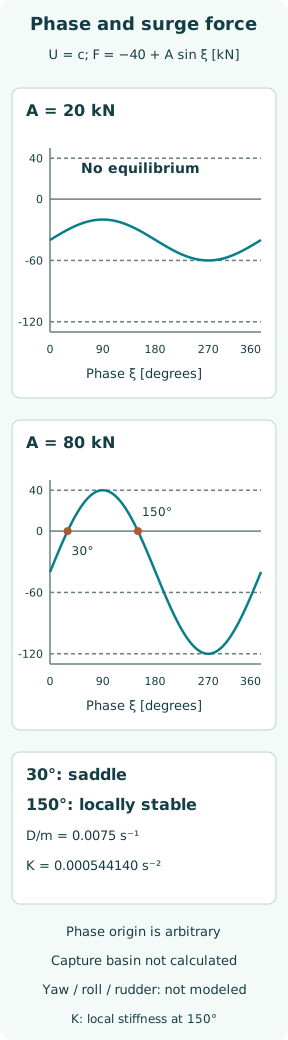
A fixed phase requires q = 0 and F₀ + A sin ξ = 0. With A = 20,000 N, the required sine is 2, which has no real solution. The net force at U = c ranges from −60 to −20 kN; the force never reaches zero. This rules out a stationary wave-relative state within this particular equation.
With A = 80,000 N, sin ξ = 0.5 and the roots are 30° and 150°, repeated every 360°. Both roots meet the same force-balance condition. The original figure plots the actual two force functions rather than guessed ship trajectories, making the difference between “no root” and “two possible equilibria” visible before any stability claim is made.
Test local stability without claiming capture
Write a small phase disturbance ε about a root ξ*. Linearization gives ε̈ + (D/m)ε̇ − (kA cos ξ*/m)ε = 0. At 150°, the coefficient of ε is +0.000544140 s⁻² and D/m = 0.0075 s⁻¹. Positive stiffness and positive damping make this equilibrium locally attracting in the two-state teaching model.
At 30°, the stiffness sign reverses. The linearized system has one growing direction and is a saddle, despite satisfying the force balance. Neither result supplies a basin of attraction or a capture probability. Local linearization describes sufficiently small disturbances around the selected root; it cannot prove what a ship starting far away in phase and speed will do.
Connect phase locking to yaw and rudder authority
A long residence near one wave phase can change the setting in which transverse forces and moments act. Directional response then depends on the relative wave heading, hull hydrodynamics, rudder inflow and available steering moment. Roll changes immersion and force geometry; yaw changes the wave encounter. These couplings can invalidate conclusions drawn from surge alone.
The equation above deliberately omits those states. It cannot indicate how much rudder would oppose a yaw excursion or whether that rudder force remains available. Adding a verbal arrow from “phase lock” to “broaching” is not equivalent to solving the coupled problem. The figure therefore separates the calculated force balance from a clearly labeled list of missing motion and control variables.
Read the stability framework carefully
IMO MSC.1/Circ.1627, dated 10 December 2020, treats surf-riding/broaching as a distinct failure mode in section 2.6. Its detailed threshold construction uses ship-specific resistance, thrust and wave-force information. The circular also distinguishes vulnerability assessment, direct assessment and operational measures; these are not interchangeable labels for this classroom calculation.
Here, the force amplitude and speed slope were selected to expose a mathematical distinction. No loading condition, hull form or propulsor was supplied. It would therefore be incorrect to turn the existence of a root into a result under the circular. In particular, the equilibrium calculation is not the circular’s global surf-riding threshold under the prescribed assessment framework.
Specify the evidence a real model needs
ITTC procedure 7.5-02-07-04.1, Revision 03 effective 2024, links broaching-related tests to an appropriate self-propelled model and basin. It also calls for defined model properties and steering characteristics. The testing arrangement must allow the motion being investigated, rather than restrain it out of existence and then interpret its absence as favorable behavior.
For a numerical model, a reviewable record would connect hull and loading data to the resistance and thrust curves, hydrodynamic coefficients, steering limits, wave description and validation cases. Sensitivity to starting phase and speed belongs in that record. Agreement with one surge trace is weaker evidence than validation of the coupled motions and control response relevant to the intended claim.
State what the example cannot decide
The example establishes a narrow chain: the smaller prescribed wave force has no phase equilibrium; the larger force has two; the sign of the local force slope distinguishes an attracting root from a saddle. Every one of these conclusions follows from the declared equation. None provides a probability of broaching, a capsize angle or an operating envelope.
The practical lesson for reviewing a model is to ask which state variables and initial conditions support each reported result. A real vessel decision requires its applicable approved information and assessment. The calculated wave speed remains an input to this explanation, while the uncalculated coupled response remains an open question. Keeping that boundary explicit prevents correct algebra from carrying an unsupported control or safety conclusion.
Sources
- Maki, Sakai and Ueta, Review of the analytical prediction method of surf-riding threshold in following sea, and its relation to IMO Second-Generation Intact Stability Criteria. Published journal record: 2024, Nonlinear Theory and Its Applications, IEICE 15(3), 588–617. Inspected body: arXiv v1. — Author version §§3–5: sinusoidal surge force, nonlinear surge equation, phase portraits and equilibrium versus global capture
- IMO MSC.1/Circ.1627, Interim guidelines on the second generation intact stability criteria. 10 December 2020; original IMO circular reproduced in ClassNK technical-information bundle. Dutch government record lists current version 1. — Circular cover; annex 2.2 (dead ship), especially 2.2.1 and 2.2.2, printed annex pp.10–14 / bundle PDF pp.214–218; annex 2.6 (surf-riding/broaching), especially 2.6.3.4; chapter 3 validation.
- ITTC 7.5-02-07-04.1, Model Tests on Intact Stability. Revision 03, effective 2024; approved September 2024 — 1; 2; 3.1 and 3.1.1–3.1.4; 3.2–3.5; 4