Knowledge / Navigation and marine safety
Reconstructing an incident from VDR data: time alignment, missing channels and evidence preservation
Preserve VDR originals while building a reproducible timeline, with an original drift-correction example, explicit uncertainty bounds and a separate missing-channel analysis.
On this page
A replay can look precise while its clocks, channel meanings and missing intervals remain unresolved. Reconstructing an incident from a voyage data recorder requires more than placing exported rows in time order. The useful result is a traceable relationship between preserved evidence, stated transformations and the physical events that the recordings can actually support.
Identify the recorder before interpreting its output
Establish the VDR or S-VDR identity, installation history, recording media, configured channels and available playback software. Two systems called voyage data recorders may preserve different detail and durations. A readable export is only one representation of that installation. A channel label such as speed is incomplete unless its source and meaning, including speed over ground versus through water, are known.
MSC.494(104) distinguishes installation eras and applies the amended MSC.333(90) standard to VDRs installed on or after 1 July 2022. Earlier periods have different referenced standards; the amendment concerns the float-free medium. The applicable equipment basis should therefore be established before interpreting a missing field as a fault or assuming another vessel's export procedure will preserve the same evidence.
Preserve the original evidence and acquisition history
Work from controlled copies while preserving the original acquisition. Record the equipment identity, requested time window, acquisition method, software version, operator, time and any reported errors. A digest can help detect later file changes, but cannot prove that an incomplete extraction captured every relevant channel. Keep associated configuration and decoder information so the same bytes remain interpretable later.
Within its UK scope, regulation 10 of SI 2026/430 requires its named persons, so far as reasonably practicable, to preserve relevant recordings without alteration or overwrite after reportable accidents. Preservation should follow the actual equipment instructions and competent investigation arrangements. It is not a reason to improvise disconnection or open a capsule. A corrected timeline belongs in a derived dataset; never rewrite the source timestamp merely to make the story appear consistent.
Treat the channel map as evidence
A channel may be absent, present but stale, intermittently unavailable or decoded incorrectly. These are different conditions. An unchanging rudder value might reflect a steady angle, a stopped source or a held last value. Compare validity flags, record intervals, configuration and any independent observations before choosing among them. The shape of the plotted line is not sufficient to identify which explanation applies.
MSC.333(90) sections 5.5.1 and 5.5.19 connect time derivation with source and configuration information. The analytical channel register should state units, sign, source, sampling behavior and known gaps. Keep command channels separate from feedback. Their meanings can differ even if both use degrees or revolutions per minute; matching units do not demonstrate that they describe the same physical state.
Distinguish event time from several recording times
A sensor observes a condition, an interface transmits a message, a recorder stores it and a playback application displays it. Each stage can introduce a timestamp or delay. A clock correction reconciles time bases; it does not automatically remove sensor response, communication latency or display buffering. Assigning a single correction to every channel requires evidence that the same timing path applies.
Use independently established common markers to estimate a clock relationship. An alarm and a later spoken reaction are not simultaneous simply because they concern the same event. Forcing them to coincide would erase the very response time an investigation may need to understand. A suitable marker has a defensible shared physical or electronic origin and an uncertainty statement; the method must not assume the causal sequence it later claims to demonstrate.
Calculate an original affine clock correction
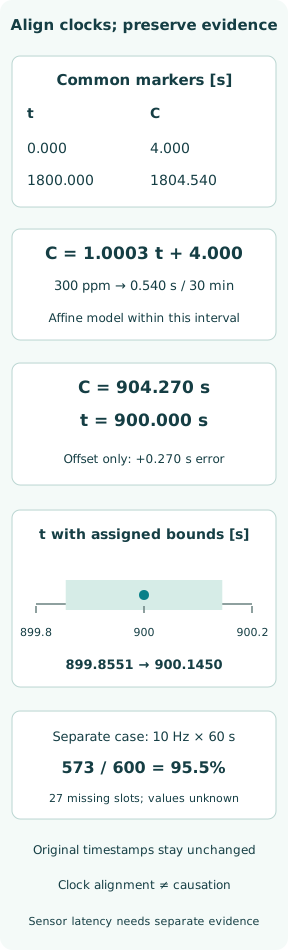
In a fictional test record, two independently established common markers occur at reference elapsed times 0 and 1,800 seconds. Their recorder-clock labels are 4.000 and 1,804.540 seconds. Assume one affine relation C = a t + b throughout that interval, with no clock step or variable delay. Then a = (1804.540 − 4.000)/1800 = 1.0003 and b = 4.000 seconds.
The rate difference is 300 parts per million and accumulates 0.540 second over thirty minutes. An event labeled C = 904.270 seconds maps to t = (904.270 − 4.000)/1.0003 = 900.000 seconds. Subtracting only the initial four-second offset would give 900.270 seconds, retaining a 0.270-second error. These invented numbers illustrate clock-rate correction, not a measured defect or a permitted recorder tolerance.
Carry the uncertainty with the mapped event
Now assign conservative bounds b between 3.9 and 4.1 seconds and a between 1.00025 and 1.00035. Treat these bounds as independently selectable for this teaching exercise. For the fixed positive event numerator, the earliest mapped time uses the largest offset and scale: (904.27 − 4.1)/1.00035 = 899.8551 seconds. The latest uses the smallest: (904.27 − 3.9)/1.00025 = 900.1450 seconds.
The resulting interval is an input-bound sensitivity range, not a statistical confidence interval or a demonstrated instrument specification. Real fit parameters may be correlated, and marker-identification uncertainty may need a different model. Keep native time, mapped time and the transformation's validity interval together. Extrapolating past a reboot or resynchronization without checking for a discontinuity can make a more elaborate clock model less truthful than a clearly marked unknown interval.
Locate gaps instead of reporting only completeness
Take a separate fictional channel sampled at 10 Hz over the half-open interval from 0 to 60 seconds. Expected sample instants are 0, 0.1, through 59.9 seconds, giving 600 samples. If 573 are present, 27 are missing and count completeness is 95.5%. This says nothing about whether the missing samples cluster around the incident or whether the values that remain are correct.
If all 27 missing slots are contiguous, they occupy 2.7 seconds of scheduled sampling coverage; the elapsed span from the first missing sample instant to the last is 2.6 seconds. Dispersed losses have the same count but a different reconstruction consequence. Show missing intervals explicitly. Interpolating a smooth line across them creates an estimate, not recovered evidence, and cannot establish that no short command or excursion occurred there.
Use alignment to test explanations, not manufacture causes
A reconciled timeline makes competing explanations easier to compare, but chronological order alone does not establish causation. A recorded command can precede a response without proving it produced that response. Shared upstream conditions, independent controls and recorder latency may explain the relationship. The strongest reconstruction connects the timeline with the actual control configuration and physical evidence, while retaining alternatives that the record cannot resolve.
The affine example deliberately estimates clocks from common markers, not from a presumed command-response pair. That choice avoids making the desired explanation a hidden calibration input. Where only approximate shared events exist, report the alternatives and sensitivity. A precise timestamp printed to milliseconds should not conceal a much larger uncertainty in what physical event the channel represents or when that event reached the recorder.
Make the analysis reproducible and purpose-bound
Retain a transformation log identifying source files, hashes, decoder version, unit conversions, clock maps, excluded samples and the reason for every exclusion. The output should allow another investigator to follow one plotted point back to its native record. Preserve separate versions when a new clock model changes the timeline; do not overwrite the earlier analysis without retaining its provenance and the reason for revision.
Bridge audio and other records may contain identifiable personal information. MAIB's current explanation ties its use of such information to investigation powers and protected processing under the 2026 framework. Authorized access for analysis is not automatic permission to circulate raw audio or extracts to a wider audience. The useful technical deliverable can identify evidential limits without disclosing unrelated private material.
State what the reconstruction can and cannot establish
Storage retention depends on the applicable standard, medium and actual recorder condition. A nominal design period should not be treated as a deadline until which preservation can safely wait. Verify the available record promptly through the appropriate procedures and retain the context around the event. A successful file copy does not prove complete retrieval, and a missing channel does not prove absence of the event it might have recorded.
The sources were checked on 8 October 2026, including MSC.333(90), its MSC.494(104) amendment and the current UK preservation framework. The example establishes a 300-ppm affine clock difference, a bounded mapped time and a separate missing-sample count. It does not assign responsibility, prove a causal sequence, certify a VDR or authorize editing original evidence. A defensible reconstruction keeps those conclusions distinct from the calculations that support them.
Sources
- IMO MSC.333(90): Revised performance standards for shipborne VDRs. 22 May 2012; read with MSC.494(104); checked 8 October 2026 — Sections 5.3–5.5 and 9: integrity, retention, timing, source identity, configuration and playback
- IMO MSC.494(104): Amendments to VDR performance standards. 7 October 2021; relevant amended standard for installations on or after 1 July 2022 — Operative paragraph 2 separates installation eras; annex revises float-free recording medium
- UK SI 2026/430: Merchant Shipping (Accident Reporting and Investigation) Regulations 2026. 2026 instrument; MAIB confirms in force 15 May 2026; public text checked 8 October 2026 — Regulation 10(1)–(2): preservation of recordings and avoiding overwrite after reportable accidents within its scope
- MAIB: How we work. Current public page read 8 October 2026; cites the 2026 Regulations — Investigation evidence and section 10 data protection