Knowledge / Machinery and energy
EEBD and SCBA: task boundaries of escape and intervention breathing equipment
Distinguish escape-only devices from suitable intervention SCBA, with an original variable air-demand example that calculates no entry allowance.
On this page
Breathing equipment must match the task before its capacity is discussed. An emergency escape breathing device helps a person leave a hazardous atmosphere; it does not become rescue or firefighting equipment because its label shows a duration. Suitable intervention SCBA is part of a trained, controlled response, and its presence alone does not authorize entry.
Start with the direction of the task
Escape means leaving a hazardous atmosphere to reach safety. Intervention means deliberately undertaking a task that may involve entry, work and withdrawal. The protection, controls, monitoring and support needed for those tasks are different. Equipment intended for a short escape cannot acquire another approved purpose merely because a proposed task sounds brief.
MCA MGN 659 Amendment 3, section 8.6, states that an EEBD is for escape and must not substitute for breathing apparatus during enclosed-space entry or rescue. The rule concerns purpose. It is not a calculation that can be overturned by estimating that a rescue will take fewer minutes than the label.
Do not treat SCBA as one universal approval
SCBA means self-contained breathing apparatus, but that describes a broad equipment family. The specific approval and instructions determine whether a device is suitable for firefighting, hazardous-atmosphere entry, escape only or another application. A cylinder or hood visible in a photograph does not establish the approved task or operating mode.
NIOSH distinguishes open- and closed-circuit SCBA, including closed-circuit devices approved for escape only. The terminology therefore overlaps across industries. In this article, “intervention SCBA” means equipment actually approved and suitable for the intended intervention; it does not mean every product that can technically be called self-contained.
Independent breathing supply is one part of protection
An air-purifying filter depends on the surrounding atmosphere and does not replace missing oxygen. An atmosphere-supplying device provides breathing gas from a separate source, but the delivery arrangement, facepiece or hood, fit and condition remain important. A supply source cannot compensate for a configuration that does not provide its intended protection to the wearer.
IMO MSC.581(110), section 9.2, calls for suitable positive-pressure breathing apparatus and trained users when the enclosed-space atmosphere is known or suspected unsafe. This is a conditional task requirement within the wider entry framework. It is not a statement that donning such equipment makes every space or planned activity acceptable.
Separate rated duration from air demand
A nominal duration belongs to stated test conditions and equipment characteristics. Actual demand can vary during movement, exertion and distress, while leaks or other equipment conditions can affect supply. An assigned number of minutes is therefore not a guaranteed amount of working time and never changes an escape-only approval into an entry approval.
For an open-circuit teaching model, cumulative air demand is the integral of the air-use rate over time. Both must use a consistent reference volume basis. The next example compares only demand histories; it specifies no cylinder pressure, starting inventory, reserve, alarm point, withdrawal point or allowable time in a hazardous space.
Define two original six-minute histories
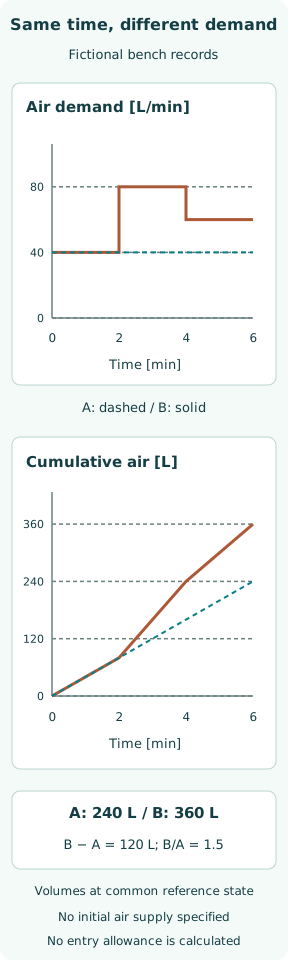
Consider fictional bench demand records A and B, with every air volume referred to the same fixed pressure and temperature. Record A uses 40 L/min for six minutes. Record B uses 40 L/min for the first two minutes, 80 L/min for the next two and 60 L/min for the final two.
These rates are selected mathematical inputs, not assigned physiological demands for a named activity or person. The six-minute observation window is not a task duration recommendation. No one is entering a space in the example. A bench demand history also omits the cyclic peak flows and pressure behavior needed to assess actual breathing performance.
Integrate the demand rather than reading only the clock
For A, the cumulative volumes at 2, 4 and 6 min are 80, 160 and 240 L. For B, they are 80, 240 and 360 L. Its three segment contributions are 80, 160 and 120 L. Equal elapsed time has produced different consumption because the area under the rate curve differs.
B uses 120 L more over the window, a 50% increase relative to A. Its average rate is 60 L/min, compared with A’s 40 L/min. These are accounting results at the declared reference conditions. They do not estimate remaining air because no starting supply is given, and they do not establish either device’s service duration.
A time estimate inherits its demand assumption
If the initial 40 L/min were extrapolated through all six minutes, the predicted demand would be 240 L. That prediction is correct for A and underestimates B by 120 L. A measurement can therefore be accurate for the observed interval while being insufficient to predict a later, different workload.
As a concrete product example, MSA’s G1 2025 manual warns that a remaining-time calculation based on recent average breathing can overestimate the actual time when breathing increases. The example here does not reproduce that product’s algorithm. It shows the more general reason a forecast must not be treated as an unconditional promise.
Air capacity does not resolve the other hazards
Breathing protection does not itself control fire heat, entanglement, falls, unstable structures or a blocked route. The bulk and mobility of equipment can matter in a narrow opening. Communication, a trained supporting team and a workable recovery arrangement are separate parts of the intervention, rather than benefits automatically supplied with the breathing set.
The task assessment must consider both the outward and return demands, foreseeable deterioration and the actual approved equipment. This article deliberately supplies no fraction-of-cylinder rule. Such a fraction would depend on the operation and governing procedures, and adding one to the bench calculation would create an unsupported operating instruction.
An EEBD cannot be upgraded by an urgent intention
A nearby casualty creates urgency, but urgency does not change the device’s design or approval. An escape-only set remains for escape. An improvised entry can expose another person to the same atmosphere and complicate the planned response. The appropriate trained rescue organization and shipboard emergency arrangements remain essential.
Likewise, a successful demonstration in ordinary air cannot prove suitability for firefighting or a suspect atmosphere. Training should use the appropriate training equipment and manufacturer-supported arrangements. Device identification, condition, service status and familiarization matter, but none supplies the missing task authorization when the equipment’s approved purpose is different.
Record purpose before capacity
A useful equipment comparison records approved use, breathing-gas system, wearer interface, relevant environmental limits and the supporting training and maintenance basis. Capacity information comes with its reference conditions and limitations. An unexplained “minutes” column conceals the difference between a test rating, an estimate and the approved task.
The original demand example shows why equal elapsed time does not imply equal air consumption: the selected variable profile uses 360 L while the steady profile uses 240 L. It gives no safe entry allowance. The enduring distinction is task suitability first, then equipment condition and controlled use within the complete emergency or work arrangement.
Sources
- MCA MGN 659 (M+F) Amendment 3: Entry into Enclosed Spaces. 6 January 2026 — Sections 2.2, 8.5.2 and 8.6
- NIOSH: Atmosphere-Supplying Respirators. Page dated 3 February 2025, inspected 8 October 2026 — SCBA open-circuit/closed-circuit and entry/escape-only distinctions
- IMO MSC.581(110), Revised recommendations for entering enclosed spaces aboard ships. Adopted 27 June 2025 — Sections 7–9 and 11; especially 7.1–7.2, 7.7, 9.2 and 11.5
- MSA G1 SCBA 2025 CBRN Edition: Control Module. 2025 CBRN Edition official online manual — Warning on calculated service time and recent average breathing rate