Knowledge / Machinery and energy
Exhaust SOx scrubbing: alkalinity, mass transfer and washwater balance
Separate SO2 absorption from neutralization, calculate an ideal alkali demand, and distinguish washwater recirculation from makeup and discharge.
On this page
A wet exhaust-gas scrubber transfers sulphur compounds from a gas stream into a liquid and manages the resulting chemistry. Water flow alone is not the whole mechanism. Gas–liquid contact determines how quickly SO2 can be absorbed; alkalinity determines how much acid can be neutralized; circulation, cooling and bleed determine what accumulates in the liquid system. These are linked balances, but they are not interchangeable indicators of performance.
Absorption and neutralization are separate steps
SO2 must first cross the gas–liquid interface. In water it participates in dissolved SO2, bisulphite and sulphite equilibria; oxidation can then produce sulphate. Alkali consumes the acidity associated with the absorbed sulphur and helps maintain a favourable absorption driving force. It is misleading to picture a scrubber as a filter that physically catches every SO2 molecule without liquid chemistry.
Wärtsilä distinguishes seawater alkalinity in open-loop operation from added alkali in a recirculating closed loop. The physical principle is useful, but a historical product description is not evidence that discharge is harmless or allowed at a particular location. Exhaust cleaning and receiving-water protection must be evaluated separately.
Good chemistry cannot compensate for poor contact
A simplified gas-side transfer expression is absorption rate proportional to KGa times a suitable mean concentration or partial-pressure driving difference. KG represents an overall transfer coefficient and a the effective interfacial area per volume. This is a conceptual relationship, not a sizing correlation: the definitions and units must match the chosen model.
Spray distribution, droplet size, packing wetting where fitted, gas residence time and temperature all affect contact. Flooding, fouling or bypass can reduce usable area while a sump pH reading remains satisfactory. EPA’s wet-scrubber guidance identifies gas–liquid contact, liquid flow and pressure differential as relevant performance evidence. The marine installation also has an engine back-pressure limit; simply increasing liquid flow is not a universal cure.
pH is not the same as alkalinity
pH expresses hydrogen-ion activity at the measured condition. Alkalinity is an acid-neutralizing capacity defined by a specified chemical/titration basis. Two waters can have similar pH but different capacities to absorb an acid load before their pH changes. Salinity or geographical location can provide context, but neither replaces the required water analysis for a design condition.
For an alkalinity balance, use equivalents consistently. One equivalent neutralizes one mole of hydrogen-ion charge. Numerically, 1 meq/L equals 1 eq/m³. The fraction that can be credited in a practical scrubber depends on the required residual condition and process performance; assuming complete utilization can be an optimistic chemical bound rather than a workable design.
Worked example: convert fuel sulphur into SO2
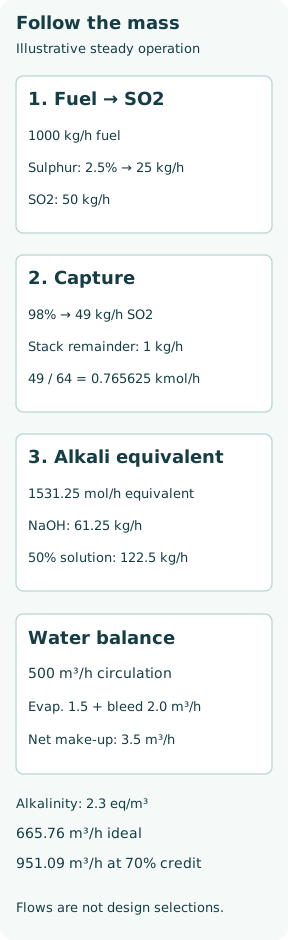
Assume an invented fuel flow of 1,000 kg/h with 2.5% sulphur by mass. For this teaching balance, all fuel sulphur becomes SO2 and 98% of that SO2 is captured. Ignore SO3, ash-bound sulphur and other reactions. Use rounded molar masses S = 32 kg/kmol and SO2 = 64 kg/kmol.
Sulphur flow is 1,000 × 0.025 = 25 kg/h. SO2 entering is 25 × 64/32 = 50 kg/h; capture is 49 kg/h and the remaining SO2 is 1 kg/h. The calculation tracks sulphur, not the entire exhaust stream. The selected capture percentage is an assumption, not an inferred compliance result.
An ideal caustic demand follows the assumed endpoint
For a fully neutralized, oxidized sulphate endpoint, use SO2 + 2NaOH + ½O2 → Na2SO4 + H2O. Captured SO2 is 49/64 = 0.765625 kmol/h. Two alkali equivalents per mole require 1.53125 kmol/h NaOH. With a rounded molar mass of 40 kg/kmol, pure NaOH demand is 61.25 kg/h.
A 50% NaOH solution would provide that ideal amount at 61.25/0.50 = 122.5 kg/h of solution. This is not a dosing instruction. Actual demand depends on the liquid’s initial alkalinity, chosen chemistry, residual alkalinity, other acid uptake and losses. Bisulphite-rich liquid and complete sulphate neutralization do not have the same immediate alkali requirement. The chemical endpoint must be stated before a reagent number is meaningful.
Alfa Laval treats alkali dosing, water cleaning and residue management as distinct closed-loop design functions. A stoichiometric amount alone does not specify dosing control, safe chemical handling, tank volume or treatment capacity.
A seawater alkalinity calculation is not a pump selection
The example’s ideal sulphate-neutralization requirement is 1,531.25 mol of charge equivalents per hour. Suppose incoming seawater has an assumed alkalinity of 2.3 eq/m³. Crediting all of it would require 1,531.25/2.3 = 665.76 m³/h. Crediting an illustrative 70% utilization instead gives 951.09 m³/h.
These are alkalinity-only flow estimates using invented inputs. They do not establish required installed flow: heat removal, gas–liquid transfer, residual liquid chemistry, discharge criteria, pump availability and engine back-pressure can impose other constraints. The 70% factor is not a standard or recommended value. It simply makes the difference between available and credited neutralizing capacity visible.
Circulation does not equal water consumption
In a closed loop, a large internal flow can repeatedly pass through the scrubber and cooler without being consumed. For constant inventory, total net liquid addition must balance evaporation, bleed and other actual liquid losses, with any condensation or reaction-volume changes included as appropriate. Internal recirculation appears on both sides and cancels.
In a separate simplified liquid-volume example, recirculation is 500 m³/h, evaporation is 1.5 m³/h and bleed is 2.0 m³/h. Ignore condensation, carryover and reaction-volume changes. Total net liquid makeup is 3.5 m³/h, not 503.5 m³/h. Here makeup includes all liquid additions together, including reagent-solution water; it is not necessarily a freshwater meter reading.
Bleed controls accumulation in the circulating liquid, while treatment separates only the species that its process can remove. Removing suspended particles does not necessarily remove dissolved sulphate. Routing bleed to a holding tank avoids immediate overboard discharge but consumes holding capacity; it does not eliminate the material balance.
Verify exhaust and liquid performance independently
A gas-side result requires the appropriate inlet/outlet basis and calibrated measurements; dilution or changed engine condition can alter concentration without the claimed mass removal. A liquid-side result needs the designated measurement points and parameters. Sump pH, discharge pH, alkalinity and pollutant content answer different questions.
IMO’s EGCS guidelines include discharge-water criteria in addition to exhaust-system verification. Applicable amendments/corrigenda, the vessel’s approved documents and local restrictions govern actual operation. Meeting one pH value is not proof of full discharge compliance or permission to discharge. Residues and stored water also require their approved handling route.
A useful diagnosis closes all three balances
For a changed operating condition, compare fuel sulphur and flow, gas load, washwater flow and temperature, inlet alkalinity, alkali addition, circulating inventory, bleed/treatment condition and gas-side performance. A falling pH can indicate increased acid load or reduced chemical capacity, but it does not by itself identify a pump or dosing fault. A stable pH can coexist with poor gas distribution.
The durable method is to close the sulphur balance, the neutralizing-equivalent balance and the water inventory separately, then connect them through the actual equipment. That approach shows why additional caustic, additional pump flow and additional bleed solve different problems. Any chemical, valve or protection change must follow the installed system’s approved operating and safety procedures.