Knowledge / Machinery and energy
Enclosure integrity in fixed CO2 firefighting: pre-release assurance and re-entry boundaries
Follow a two-volume gas-inventory balance to distinguish CO2 retention, migration to adjacent spaces and evidence required before re-entry.
On this page
A fixed CO2 system depends on the enclosure as well as the cylinders. Gas that leaves the intended compartment can weaken suppression there and create a hazard somewhere else. A connected-volume example makes those two consequences visible without assigning an extinguishing concentration or a time at which anyone may enter.
Define the boundary before the quantity
The protected enclosure is a three-dimensional boundary, including its doors, ventilation paths, penetrations and connections to other spaces. A cylinder inventory describes available agent; it does not describe where the discharged agent will remain. The useful engineering question is which gas-transfer paths exist in the actual arrangement and which boundary states the approved system assumes.
A connection can matter even when it is absent from a simplified room sketch. A duct, access trunk or damaged closure may join spaces that look separate on a plan. Conversely, a nearby space may have a fully effective boundary. Proximity alone does not establish communication; drawings and the installed boundary must support that conclusion.
Keep personnel clearance separate from closure evidence
MCA MGN 354, sections 2.4–2.5, links personnel accountability with the intended isolation of ventilation and fuel systems. These are distinct assurances. A closure report cannot establish that everyone has left; a completed head count cannot establish that the gas boundary is effective. The responsible emergency organization must use the ship’s approved arrangements.
For a technical review, an assurance record should identify the protected space, relevant boundaries, means of observing their state and the responsible decision point. That record should not turn this article into a release sequence. The design, alarms, controls and operating authority belong to the actual installation; the calculation below contains none of them.
Use a two-volume model to expose migration
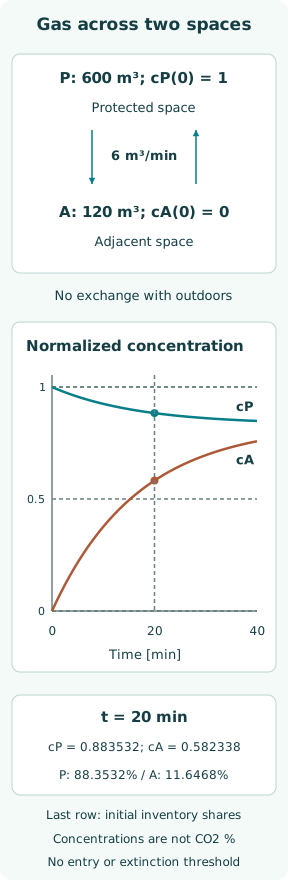
Consider two fictional rigid volumes: protected space P is 600 m³ and adjacent space A is 120 m³. Both are internally well mixed at the same constant temperature and pressure. Neither exchanges gas with the outdoors. A prescribed bidirectional mixing flow q = 6 m³/min transfers the same volume in each direction, so both space volumes remain constant.
This represents net mixing through an imperfect internal boundary, not a resolved doorway flow or a pressure-driven jet. Let cP and cA be agent concentrations divided by the initial concentration in P. Set cP(0) = 1 and cA(0) = 0. The number 1 means one initial concentration unit, not pure CO2 and not a stated percentage by volume.
Conserve the agent across both spaces
The balances are VP dcP/dt = −q(cP − cA) and VA dcA/dt = q(cP − cA). Their sum gives VP cP + VA cA = 600 m³ in normalized concentration-volume units. Agent is redistributed between spaces; no gas disappears from the combined system. Concentration and the amount remaining in a particular space are related but different quantities.
The concentration difference decays as exp[−q(1/VP + 1/VA)t]. Here the exponent coefficient is 0.06 min⁻¹. Solving with the initial conditions gives cP = 5/6 + (1/6)exp(−0.06t) and cA = (5/6)[1 − exp(−0.06t)], with t in minutes. Both expressions are dimensionless and conserve the stated total exactly.
Read the original case without inventing a safe level
After 20 min, cP = 0.883532 and cA = 0.582338. The fraction of the initial agent inventory still in P is also 0.883532 because VP is unchanged. The fraction transferred to A is VA cA/VP = 0.116468. Thus an apparently modest 11.6468% inventory transfer produces an adjacent-space concentration exceeding half the initial concentration in P.
The figure contrasts this mixing case with an ideal sealed internal boundary, q = 0, for which cP remains 1 and cA remains 0. No plotted level means extinguishment, tenability or safe entry. The 20-minute point is simply a comparison time selected for the calculation, and the model never assigns an actual initial CO2 concentration.
Distinguish retention from suppression performance
The limiting concentration in both connected spaces is 600/720 = 0.833333 of the initial P concentration. This common value follows from conservation and equal final concentration, not from any extinguishing criterion. It illustrates why an adjacent volume changes the eventual distribution even though the total agent in the combined enclosure has not changed.
A real fire adds temperature gradients, buoyancy, pressure transients, combustion products and heat stored in equipment. Flow can be asymmetric or connect to outdoors; internal mixing can be incomplete. The two-volume result cannot establish local agent distribution around a shielded fire, the required agent quantity or the duration of suppression. Each is a different claim requiring additional evidence.
Treat the adjacent space as a separate exposure question
At the comparison time, the normalized amount in A is 69.880579 m³ of concentration-volume units, compared with 530.119421 in P. Those units are a bookkeeping product, not the volume of a pure gas released from cylinders. Neither result predicts what a person would breathe at a particular position or height in either space.
The example assumes instant mixing within A; a real arriving plume can create higher local concentrations before the whole space mixes. Gas density alone does not locate every hazardous pocket because temperature, ventilation and the connection geometry also matter. An adjacent-space assessment therefore needs its own transport and atmospheric evidence, rather than reassurance based on P retaining most of the inventory.
Do not infer CO2 safety from oxygen alone
NIOSH identifies direct adverse effects of carbon dioxide on breathing and the nervous system. CO2 is not merely an inert subtraction from the oxygen fraction. An oxygen channel measures oxygen; it cannot quantify the CO2 or other combustion products present. An assumed or apparently ordinary oxygen reading therefore cannot establish that a post-release atmosphere is safe.
The algebra above supplies no oxygen reading at all. It also excludes carbon monoxide and other fire products. Converting cP or cA into a health conclusion would require an actual initial composition, relevant calibrated measurements and an applicable assessment. Even then, one sample cannot automatically characterize every location or future condition in a connected enclosure.
Separate re-entry assurance from a falling trend
IMO MSC.581(110), sections 7–9, distinguishes relevant gas testing, representative locations and controlled entry into an unsafe or suspect atmosphere. Its current framework is broader than elapsed time or one oxygen value. A falling CO2 trend is information about measured conditions, not a decision that the fire is extinguished or the work environment is suitable.
Re-entry also concerns heat, visibility, structural condition, access, communication and rescue arrangements. Changing ventilation can affect both gas distribution and the fire environment. The model does not justify reopening a closure to accelerate mixing or turning on ventilation. These choices belong to the incident assessment and the ship’s authorized emergency procedures, with suitable specialist support.
Make the boundary claim reviewable
A useful engineering record connects each claimed function to its evidence: personnel accountability, achieved boundary state, agent delivery, conditions in connected spaces and the separate basis for eventual entry. These records may involve different observers, instruments and times. Treating them as one green status loses the distinction between a completed command and a demonstrated physical condition.
The case proves only redistribution under a specified two-volume exchange. It explains how loss from one compartment can create exposure elsewhere while total inventory is conserved. It cannot authorize release, prescribe a holding period or clear either space for entry. The review question is which real boundaries and measurements support the particular claim being made.
Sources
- MCA MGN 354 (M+F), Fishing and Small Vessels: Safe Operation of Fixed CO2 Gas Fire Extinguishing Systems. November 2007; official current landing page inspected 8 October 2026 — 2.4–2.5; 3.1 and 3.4
- IMO MSC.581(110), Revised recommendations for entering enclosed spaces aboard ships. Adopted 27 June 2025 — Sections 7–9 and 11; especially 7.1–7.2, 7.7, 9.2 and 11.5
- NIOSH Pocket Guide to Chemical Hazards: Carbon dioxide. Official online pocket-guide entry inspected 8 October 2026 — Exposure routes, symptoms and target organs