Knowledge / Machinery and energy
Steam-turbine wetness: expansion path, droplet erosion and power loss
Calculate exhaust quality and shaft power from a steam expansion, distinguish equilibrium wetness from erosion risk, and explain why a drier outlet can accompany lower efficiency.
On this page
Steam can enter a turbine superheated and leave as a mixture of vapour and liquid. Expansion converts part of its enthalpy into work while its pressure falls; the path can enter the two-phase region. Exhaust wetness matters, but one moisture percentage does not describe the droplet population, the blade impact conditions or the power recovered. A useful analysis keeps those questions separate.
Quality is a mass fraction in a two-phase state
For equilibrium saturated liquid and vapour, steam quality x is vapour mass divided by total mixture mass. Wetness is 1 − x. Thus x = 0.90 means 10% liquid by mass, not 10% liquid by volume. Because liquid and vapour densities differ greatly, confusing those two bases gives a very different picture of the flow.
At a specified saturation pressure, mixture properties are h = hf + x hfg and s = sf + x sfg. Subscript f denotes saturated liquid; fg is the vapour-minus-liquid difference. Pressure and temperature alone do not determine quality inside the equilibrium two-phase region because the saturation temperature is already fixed by pressure. Additional information, such as enthalpy or a suitable measurement, is needed. Quality is not a valid 0-to-1 label for superheated steam.
Expansion work and throttling are different processes
For a steady, approximately adiabatic turbine with one inlet and one outlet, negligible potential-energy change and consistently negligible kinetic-energy change, fluid power is mass flow multiplied by h1 − h2. A reversible adiabatic reference expansion has s2s = s1 at the same outlet pressure. Turbine isentropic efficiency is ηis = (h1 − h2)/(h1 − h2s). The reference outlet is a calculated comparator, not a second measured stream.
The DOE Steam System Survey Guide uses the enthalpy-drop and isentropic-efficiency framework. A pressure-reducing valve instead has approximately constant enthalpy when heat transfer and velocity changes are negligible; it produces no shaft work. The same pressure reduction through a valve and a turbine therefore need not produce the same outlet state. In a real exhaust with substantial velocity, use a consistent total/static-state convention rather than silently dropping kinetic energy.
Set the inlet, outlet pressure and property basis
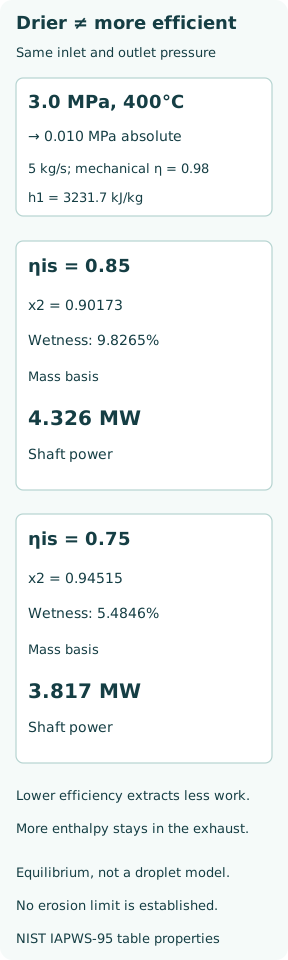
Consider an illustrative unextracted steam flow of 5 kg/s entering at 3.0 MPa absolute and 400°C, expanding to 0.010 MPa absolute. Use rounded NIST IAPWS-95 table values: h1 = 3231.7 kJ/kg and s1 = 6.9234 kJ/(kg·K). At the outlet pressure, saturation temperature is 45.806°C, hf = 191.81 kJ/kg, hfg = 2392.1 kJ/kg, sf = 0.64920 kJ/(kg·K) and sfg = 7.4996 kJ/(kg·K).
Assume ηis = 0.85 and a separate mechanical efficiency of 0.98 between fluid work and useful shaft output. There is no extraction, leakage, interstage reheat or moisture removal in this model. These efficiencies are stipulated, not a performance claim for a particular marine turbine. The pressure is absolute; a condenser vacuum reading relative to atmospheric pressure cannot be inserted directly as 0.010 MPa.
First calculate the isentropic reference state
The reference quality is x2s = (s1 − sf)/sfg = (6.9234 − 0.64920)/7.4996 = 0.83660. Since it lies between zero and one, the two-phase calculation is self-consistent. Then h2s = 191.81 + 0.8366046 × 2392.1 = 2193.05 kJ/kg. The ideal enthalpy drop is 3231.7 − 2193.05 = 1038.65 kJ/kg.
If the calculated quality were above one, the reference state would be superheated and a superheated-property calculation would replace the mixture formula. If it were below zero, that formula would also be outside its intended region. Checking the phase is part of the calculation, not an optional formatting detail. Retain extra digits internally, but report engineering results at precision consistent with rounded input tables.
Then calculate actual wetness and shaft power
The actual enthalpy drop is 0.85 × 1038.6481 = 882.8509 kJ/kg. Hence h2 = 2348.8491 kJ/kg and x2 = (2348.8491 − 191.81)/2392.1 = 0.90173. The illustrative exhaust is 9.8265% liquid by mass under the equilibrium model. It is wetter than dry saturated vapour, but drier than the isentropic reference outlet.
Fluid power is 5 kg/s × 882.8509 kJ/kg = 4414.25 kW. Applying the separately defined mechanical efficiency gives shaft power 0.98 × 4414.25 = 4325.97 kW, or about 4.326 MW. Generator efficiency, auxiliaries and whole-cycle heat input are outside this shaft boundary. Multiplying again by an arbitrary wetness penalty would double-count losses if they are already represented in the assumed turbine efficiency.
A drier exhaust does not prove better performance
Keep the same inlet, outlet pressure and mass flow, but assume ηis = 0.75. Outlet enthalpy rises to 2452.71 kJ/kg; equilibrium quality rises to 0.94515, leaving only 5.4846% wetness. Yet fluid power falls to 3894.93 kW and shaft power to 3817.03 kW. Less energy has been converted into work, so more remains in the exhaust.
This controlled comparison is not a recommendation to make a turbine inefficient to protect its blades. It shows why exhaust dryness is not an efficiency indicator by itself. Reheat, improved inlet conditions or a designed moisture-separation arrangement can change the expansion path and moisture exposure through different mechanisms. Their heat input, pressure losses, extraction effects and operating limits must be included in the complete design comparison.
Equilibrium wetness does not predict erosion by itself
Condensation in rapidly expanding steam can depart from instantaneous equilibrium. Droplets can form, grow, interact with surfaces and collect into films; subsequent liquid shedding can create a different size distribution from the initial condensate. Relative droplet/blade speed, impact angle, droplet size, exposure time and surface condition affect erosion. A bulk mass fraction alone cannot identify those local conditions or predict remaining blade life.
Liquid motion also introduces aerodynamic and momentum-exchange losses; the vapour and liquid need not travel at the same velocity. A detailed wet-steam model needs stage geometry and appropriate phase-change and droplet treatment. The simple outlet-quality calculation here is a thermodynamic screening calculation. It is not a droplet trajectory simulation or a universal permissible-wetness rule.
Moisture management is part of the machine design
Mitsubishi Power describes drain catchers that remove condensed droplets in low-pressure stages to reduce erosion. That source concerns geothermal turbines; it illustrates a physical design measure rather than certifying any marine installation. Materials, erosion-resistant treatments, drainage, separation and reheat arrangements depend on the particular machine and service.
An operating change should be checked against the manufacturer’s inlet conditions, load range, exhaust limits, drainage arrangements and inspection criteria. A favourable bulk quality estimate does not justify changing protective settings or ignoring evidence of liquid carryover. Likewise, surface erosion cannot be assigned to one moisture percentage without examining operating history, deposits, droplet paths and other damage mechanisms.
Build a defensible performance and condition record
Record inlet pressure and temperature, outlet absolute pressure, mass flow, extraction/leakage paths and shaft or electrical measurement boundary. State the property formulation, the treatment of kinetic energy and whether the efficiency already contains relevant wet-steam losses. If the outlet lies in the saturation region, pressure/temperature agreement alone does not independently verify calculated quality.
Then compare like-for-like loads and boundary conditions, and combine the thermodynamic calculation with the machine’s condition evidence. The useful conclusion is twofold: enthalpy drop determines the recoverable work within the stated balance, while liquid distribution and impact conditions govern local erosion exposure. Neither conclusion can be replaced by a single “dryness is good” number.