Knowledge / Machinery and energy
Turbocharger turbine hot corrosion: fuel ash, deposits and metal temperature
Connect fuel-metal input to turbine deposits, distinguish hot corrosion from fouling and erosion, and calculate what a sodium/vanadium analysis can and cannot reveal.
On this page
A dirty turbocharger turbine is not automatically a corroded turbine. Deposits can change the flow area without consuming much base metal; hard particles can remove metal mechanically; chemically aggressive deposits can attack a protective surface at elevated temperature. Those mechanisms may coexist, but they require different evidence. Fuel ash chemistry, local metal temperature and exposure history must be considered together.
Ash carries chemistry into the exhaust path
Residual fuel can contain metal-bearing constituents that become oxides, sulphates and more complex ash compounds during combustion. Some are carried through the exhaust; some adhere to nozzle and blade surfaces. Vanadium-bearing fuel constituents and sodium contamination are important because the resulting mixed deposits can become partly liquid and chemically aggressive under relevant conditions.
CIMAC’s Annex 7 describes ash adhesion and damage on turbocharger blade surfaces. Its physical discussion is useful here; the historical document’s numerical fuel limits and temperature recommendations are not being adopted as universal operating limits for current equipment. A fuel sample reports elemental inventory, not the exact compounds that will exist on a particular hot blade.
Metal temperature is different from exhaust-gas temperature
The temperature seen by a gas thermocouple is not automatically the local surface temperature of every nozzle or rotating blade. Heat transfer, geometry, conduction, cooling where present, deposits and operating transients affect the metal state. A bulk gas-temperature trend can support an investigation but does not directly locate the hottest or most chemically vulnerable surface.
A deposit’s melting behaviour is also a property of its mixture, not a single temperature assigned to “vanadium.” Adding other ash constituents can change which phases are present and when they soften or melt. The relevant overlap is between the deposit’s aggressive state and the metal’s actual exposure. This is why a general temperature number cannot be converted into a safe setting without machine-specific information.
Separate chemical loss, deposits and particle impact
Fouling principally adds material and changes passages, roughness or balance. Hot corrosion involves chemical degradation of the surface and can consume metal beneath a deposit; damage to protective oxide behaviour can accelerate attack. Erosion removes material through particle or droplet impact. Detached deposits can also become impacting debris, so one mechanism can create conditions for another.
The MAN project guide distinguishes ash chemistry from abrasive foreign matter and catalyst residues. Inspection should therefore retain the location and appearance of deposits, metal loss and impact marks rather than labeling every dirty surface “corrosion.” Cross-sections and deposit/metal analysis may be needed to distinguish mechanisms that look similar in an external photograph.
Worked example: convert mg/kg into a metal input rate
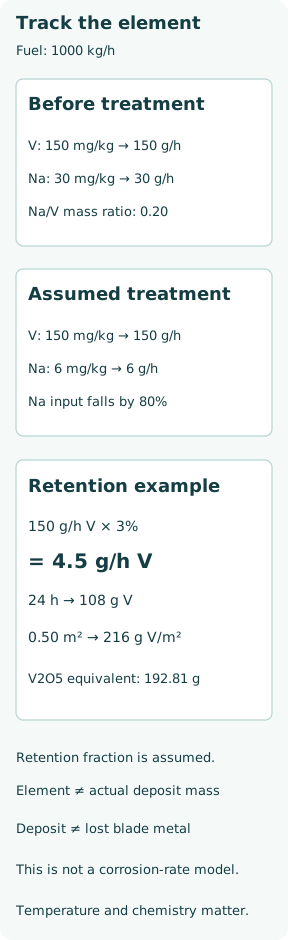
Assume fuel consumption is 1000 kg/h, with vanadium 150 mg/kg and sodium 30 mg/kg. These are illustrative values, not accepted fuel limits. Since 1000 mg =1 g, vanadium input is 1000 ×150 /1000 =150 g/h; sodium input is 30 g/h. Over 24 h, the incoming fuel carries 3.6 kg of vanadium and 0.72 kg of sodium.
The Na/V mass ratio is 30/150 =0.20. If an atomic ratio is wanted, use the stated rounded atomic masses: Na/V = (30/22.99)/(150/50.94) =0.44315. A mass ratio and an atomic ratio are not interchangeable. Neither number alone identifies a unique sodium–vanadium compound, melting point or corrosion rate in a multicomponent exhaust deposit.
Fuel treatment can change sodium without removing vanadium
For a second stipulated sample, suppose fuel treatment reduces sodium from 30 to 6 mg/kg while fuel flow and vanadium concentration remain unchanged. Sodium entering the engine falls from 30 to 6 g/h, a reduction of 24 g/h or 80%. The Na/V mass ratio becomes 6/150 =0.04. The reduction is calculated from the measured-before/measured-after assumption, not predicted for an unspecified separator.
The MAN discussion explains removal of water and associated water-soluble sodium during fuel pretreatment. Oil-associated vanadium does not follow that same removal route. Dissolved or otherwise non-water-associated sodium may remain. Thus a separator’s ability to remove water does not establish equal removal percentages for every element in the fuel analysis.
Retained vanadium is not the same as deposit mass
Assume, purely for inventory illustration, that 3% of the 150 g/h incoming vanadium is retained on a selected turbine surface over 24 h, with no subsequent release. Retained V is 4.5 g/h and 108 g over the period. If the selected area is 0.50 m² and loading is treated as uniform, this is 216 g V/m². The capture fraction and distribution are invented; they are not an erosion or deposition correlation.
If that elemental inventory were expressed as V2O5 equivalent only, its mass would be 108 ×181.88/(2 ×50.94) =192.81 g. Oxygen contributes the additional mass. This conversion does not prove that the deposit is pure V2O5: sulphates, sodium compounds, other metals, carbon and entrained particles can change actual deposit mass and behaviour. No blade-thickness loss follows from these inventory numbers.
A low ratio does not by itself certify harmless ash
Wärtsilä’s fuel-table note warns that ash aggressiveness depends on constituent proportions and total ash, and that lower sodium/vanadium levels do not exclude hot corrosion. A two-element ratio can hide a large change in absolute loading. For example, two fuels may share Na/V =0.20 while one introduces ten times more of both elements per hour at the same fuel consumption.
The same ratio also says nothing about deposit residence time, liquid fraction, sulphur chemistry, other metals or surface temperature. Therefore the example’s 80% sodium reduction is a clear reduction in sodium input, but it is not an 80% reduction in corrosion rate or a proof of a safe ash composition. Chemical and thermal evidence must complete that interpretation.
Cleaning and protection must match the mechanism
Removing a deposit may improve flow area, but it does not restore metal already lost. A cleaned surface may expose previously hidden attack. Conversely, a performance change after cleaning does not prove that corrosion caused the original loss. Compare condition and performance evidence before assigning a mechanism.
Fuel selection, effective removal of water-associated contamination, suitable materials and control of the approved thermal envelope are different parts of prevention. Additives can change ash chemistry but may also increase ash loading or create other deposits; selection and dose require the engine/turbocharger manufacturer’s approval and a verified fuel basis. Generic online advice is not a reason to alter wash media, temperatures, dosing or protective settings.
Build a mechanism-based evidence chain
Keep representative fuel samples with their treatment location and dates, fuel-consumption history, relevant temperature/load trends, cleaning records and inspection maps. Analyse the deposit where useful, and distinguish its elemental composition from the underlying metal condition. Sampling from a cool casing wall may not represent the deposit on a hot nozzle edge.
The defensible sequence is fuel inventory → transport and retention → deposit chemistry and thermal state → material response. The worked balance covers only the first and an assumed part of the second. Hot-corrosion assessment needs the remaining links; fouling, erosion and chemical attack should remain separate hypotheses until the evidence connects them.