Knowledge / Maintenance and reliability
Grease lubrication: replenishment, churning losses and compatibility
Follow oil release from grease into a rolling contact, distinguish replenishment from filling a housing, and connect excess churning and product compatibility to a defensible maintenance decision.
On this page
Grease does more than occupy the space around a bearing. It supplies lubricant to the contact, helps retain that lubricant and can contribute to exclusion of contaminants. Those functions depend on the formulation, its condition and the way it is distributed. Adding more grease is therefore not a universal remedy for noise, temperature or an uncertain maintenance history.
The contact needs lubricant, not a solid plug of grease
Grease contains a base fluid, a thickener structure and usually additives. During operation, oil released from the grease can feed the rolling/sliding contact. The bulk grease distribution changes through displacement and shearing; channels and reservoirs can form around the moving parts. Both oil availability and the contact’s lubrication demand matter.
SKF describes oil bleed as part of grease lubrication. Some separation is therefore functional, but severe oil loss or an exhausted reservoir can leave inadequate supply. Seeing a small amount of oil is not, by itself, proof of failed grease. Conversely, a housing visibly containing grease does not prove enough suitable oil reaches the loaded contact.
NLGI consistency and base-oil viscosity answer different questions
The NLGI consistency grade describes the grease’s resistance to penetration under a specified test basis. Base-oil viscosity describes the fluid’s resistance to flow and changes strongly with temperature. Two NLGI 2 products can have very different base oils, viscosities, additives and service capability. A matching grade number is not a complete substitution specification.
Operating speed, load, temperature, water exposure, sealing and the supply path influence selection. A grease that pumps through a long line at ambient conditions must still supply the contact at operating temperature. Dropping point is also not the same as a recommended continuous bearing temperature. Product and equipment requirements should be read together rather than choosing solely by one prominent catalogue number.
Replenishment and renewal solve different problems
Replenishment adds an appropriate amount before local lubricant deterioration becomes unacceptable. Renewal replaces an existing charge when the arrangement and maintenance procedure require it. Initial fill, periodic replenishment and continuous automatic supply are different tasks. A sealed-for-life bearing should not be assumed to accept the same intervention as a relubricatable open arrangement.
The interval depends on bearing type and size, speed, load, temperature, orientation, contamination and grease performance. The previous interval is evidence only if those conditions remain comparable. A rise in temperature after greasing may reflect churning, but misalignment, bearing damage, changed load or a lubrication-path fault must also be considered.
Worked example: a quantity rule with a stated application
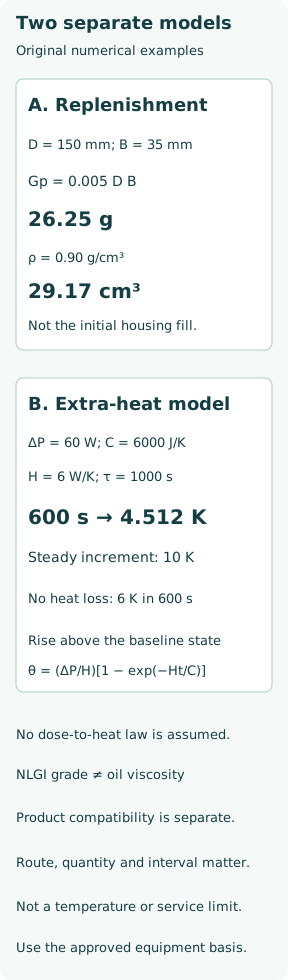
SKF’s maintenance handbook gives Gp = 0.005DB for replenishment from the side, with Gp in grams and bearing outside diameter D and width B in millimetres. The coefficient carries the required empirical unit conversion; it is not dimensionless. For the illustrative D = 150 mm and B = 35 mm, Gp = 0.005 ×150 ×35 = 26.25 g.
The same handbook gives a different expression, 0.002DB, for the specified centre-feed arrangement, which would give 10.50 g for these dimensions. This difference illustrates why the supply route matters. Neither value is a universal initial housing fill, a prescription for every bearing of that size or an instruction to inject a sealed unit. Use the actual equipment’s applicable method and approved quantity.
Translate grams into delivery evidence, not guessed strokes
With a stipulated grease density of 0.90 g/cm³, 26.25 g corresponds to 29.17 cm³. Now suppose a separate calibration collects 9.0 g from 10 complete strokes of the intended grease gun under representative conditions. The measured average is 0.90 g/stroke, so the target mass corresponds mathematically to 26.25/0.90 = 29.17 strokes.
That fractional result is not a command to perform an exact number of strokes on equipment. Delivery variation, trapped air, hose fill and backpressure matter, and the bearing may not receive everything leaving the gun. A metered mass or a validated delivery method gives better evidence than assuming every gun delivers the same amount. Keep lubricant identity, quantity, time and point identification in the maintenance record.
Extra grease can increase heat through churning
Grease repeatedly displaced by moving elements can require additional mechanical work, which becomes heat. A blocked escape path can turn replenishment into overfilling. MOLYKOTE’s conversion guidance highlights the importance of a discharge route and the heating risk of excess fill. This is separate from the friction increase that may accompany an inadequate contact film.
For a thermal illustration, assume an extra 60 W of churning loss, an effective bearing/housing thermal capacity C = 6000 J/K and incremental heat rejection H = 6 W/K. Let θ be temperature rise above the otherwise unchanged baseline. The lumped balance C dθ/dt = 60 −Hθ, starting at θ = 0, gives θ =(60/H)[1 −exp(−Ht/C)]. None of these values predicts churning power from a particular grease dose.
Calculate the temperature response without inventing a safe limit
The example’s time constant is C/H = 1000 s and steady incremental rise 60/6 = 10 K. After 600 s, θ = 10(1 −e⁻⁰·⁶) = 4.512 K. If incremental heat loss were neglected, the same stored-energy calculation would give 60 ×600/6000 = 6 K. Heat rejection changes the observed trend even with the same extra mechanical loss.
Real bearing temperature also depends on conduction paths, cooling, speed and changing grease distribution. The calculation is not a shutdown threshold, a grease-life prediction or proof that every post-greasing rise is harmless. Compare actual trends with the machine’s limits and investigate sustained or abnormal heating using the approved procedure.
Compatibility must be checked for the actual products
Matching thickener names or a generic compatibility chart is only an initial screen. Base oils and additive packages can also interact. Mixtures may soften, harden or separate even when the neat products work well individually. ASTM D6185-24’s public scope describes a relative mixture assessment using dropping point, shear stability and elevated-temperature storage behaviour.
The relevant mixture ratios and application conditions matter; one successful mixture is not a universal clearance for every ratio or duty. MOLYKOTE distinguishes basic thickener-system assessment from supplementary application tests. Passing compatibility checks also does not prove that the new product meets the bearing’s required viscosity, corrosion, load or temperature performance.
A controlled changeover closes the maintenance loop
Before changing products, identify what is already present, obtain suitable compatibility and application evidence, and use the approved cleaning or conversion plan. Old material can remain in lines, pockets and the bearing even when fresh grease appears at an outlet. Mixing incompatible products and trying to solve the resulting heating by adding more can worsen the condition.
For routine work, establish the correct product, the intended supply and escape paths, the applicable quantity and interval, and the evidence that lubricant actually reaches the point. Monitoring then tests whether those assumptions remain valid. Replenishment is a controlled renewal of lubrication capacity; it is not an instruction to keep filling every available space.