Knowledge / Navigation and marine safety
Recovering a person from the water: interfaces from approach to a safe deck
Follow the interfaces between reaching a casualty, supporting recovery and completing a safe deck transfer, using a geometric envelope that cannot approve equipment or a rescue operation.
On this page
Bringing a vessel close to someone in the water solves only part of recovery. The person must become reachable, be supported by suitable means, pass the ship-side interface and reach a receiving area without a new uncontrolled transition. The technical boundary extends beyond approach manoeuvring to the geometry, equipment and people involved in getting the casualty aboard.
Choose an endpoint beyond being alongside
An approach position describes the relationship between ship and casualty, but it does not establish a feasible transfer. Freeboard, overhangs, openings and the intended receiving deck affect the remaining path. The recovery endpoint must include a supported arrival and the next handover, because a person hanging outside the ship or stranded at a deck edge is not yet at that endpoint.
MCA MGN 544 Amendment 1 links ship-specific recovery plans to identified equipment and measures protecting shipboard personnel. That requirement does not select a method for an unknown casualty or vessel. This article examines interfaces in such a plan; it is not an approach instruction, lifting arrangement or emergency recovery procedure.
Include what the casualty can actually do
A visible hand movement does not establish that the person can climb, grip continuously or cooperate with a transfer. Capability may be limited by injury, exhaustion, cold, clothing or the immediate environment. A recovery arrangement that assumes active participation has a different boundary from one capable of supporting a person who cannot assist. Those assumptions must remain explicit.
The same person may behave differently at successive interfaces. Reaching a device, being secured in an approved support and crossing a deck opening are different tasks. A useful technical review asks which tasks depend on the casualty, which depend on crew and which are provided by equipment. It does not replace that assessment with a nominal body mass or a generic adult silhouette.
Define a fictional swept-envelope case
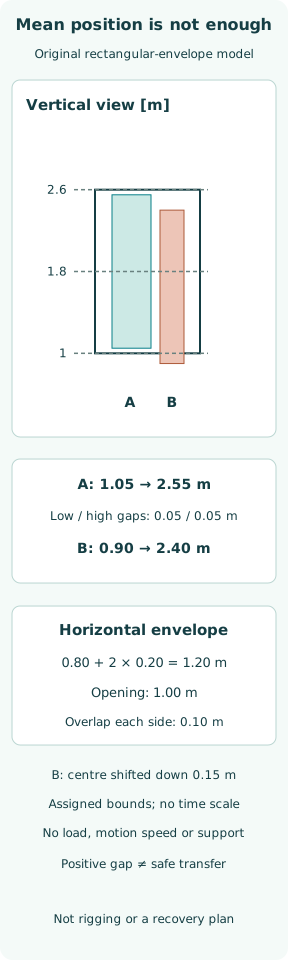
Consider a rectangular teaching package representing occupied space only, not a person or recovery device. Its height is 0.90 m and its width is 0.80 m. In a vertical reference plane attached to an opening, the package centre has mean height 1.80 m and assigned relative vertical displacement bounded by ±0.30 m. Its orientation is fixed.
The opening extends vertically from 1.00 to 2.60 m and is 1.00 m wide. Assign relative horizontal displacement of the package centre between −0.20 and +0.20 m around the opening centreline. These are stipulated bounds with no frequency, phase, speed or probability. They describe a union of possible positions, not a prediction of ship motion or a transfer trajectory.
Compute the vertical envelope and its sensitivity
The package half-height is 0.45 m. Its lowest possible point in case A is 1.80 − 0.30 − 0.45 = 1.05 m; its highest is 1.80 + 0.30 + 0.45 = 2.55 m. Relative to the opening, the resulting lower and upper gaps are both 0.05 m. These are geometric differences, not acceptable clearances.
Now shift the assigned mean centre downward by 0.15 m, keeping every other input unchanged. Case B spans 0.90 to 2.40 m. The lower gap is −0.10 m and the upper gap is 0.20 m. A negative gap denotes overlap in this planar model. The apparently small mean shift changes which boundary the swept package intersects.
Check the horizontal dimension independently
The swept width is 0.80 + 2 × 0.20 = 1.20 m, exceeding the assigned opening width of 1.00 m. With symmetric centring, the envelope extends 0.10 m beyond each side. Case A's positive vertical gaps therefore coexist with horizontal overlap. Passing one dimensional comparison cannot establish that the occupied volume passes through the opening.
The figure separates vertical envelopes A and B for legibility; their side-by-side placement is not an actual pair of devices or a horizontal drawing scale. The horizontal comparison is written separately. A real transfer also has depth, rotation, flexible body geometry and protruding equipment. The simplified rectangle cannot certify clearance, even if all its stated gaps were positive.
Do not turn an envelope into an operating window
The bounds contain no information about when extreme positions occur or how rapidly they are traversed. They cannot identify a favourable instant to lift, a safe sea state or a permissible vessel heading. Adding a sinusoid without measured or justified motion would merely add another assumption. An actual assessment must address relative motion at the recovery interface, including possible contact and loss of support.
Loads are similarly absent. The model has no mass, acceleration, drag, buoyancy change, shock load or structural capacity. It cannot select a lifting appliance, sling, attachment or operating speed. The purpose of the geometry is to reveal an incomplete clearance claim, not to make a rescue plan from a few dimensions or to justify improvising lifting equipment.
Keep support and posture in the same assessment
MSC.1/Circ.1447, as reproduced in MGN 544 Annex 1, calls for a documented assessment of anticipated conditions and ship characteristics and favours horizontal or near-horizontal recovery where practicable. This is a planning consideration with casualty and equipment implications, not a universal guarantee from a drawn rectangle. The real support must be suitable for the intended task.
Changing posture can alter the space occupied, the places where support acts and the transition to the receiving area. Thus a geometry review cannot be completed independently of the actual recovery equipment and casualty needs. This article supplies no body attachment method or improvised strop arrangement. Those details require the approved equipment basis, trained personnel and the ship-specific recovery plan.
Treat landing as another supported transition
Crossing the side opening does not automatically create a safe place to release support. The receiving area must accommodate the person, the equipment and the crew's tasks. A deck edge, threshold, narrow turn or obstruction can create a new problem after the ship-side passage has been completed. The plan needs to connect the final transfer with the intended receiving and care arrangements.
This interface also affects communications. The operator controlling movement may not see the casualty's contact points or the receiving area. A message that movement has stopped is different from confirmation that the person is supported at the destination. The article does not define signals; it identifies the information that must remain unambiguous in the vessel's actual coordinated operation.
Use the correct source and acceptance scope
The cited 2026 MGN 544 Amendment 1 distinguishes UK acceptance routes for recovery equipment. Naming equipment already carried aboard does not make every proposed use automatically suitable. The evidence must address the intended recovery application, equipment limitations and the actual vessel. This article does not extend a carriage approval into an unrestricted authorization to lift people.
The Annex 1 reproduction retains an old reference to MSC.1/Circ.1182. The current IMO SAR index lists the later Guide to Recovery Techniques as MSC.1/Circ.1182/Rev.1. That edition distinction is preserved here. The index verifies a reference identity; it is not a substitute for reading the operative guidance and the controlled ship-specific documents.
Carry the unresolved interfaces into the decision
In the original case, A has vertical gaps of 0.05 m at both ends, but its horizontal envelope exceeds the opening. B also overlaps the lower vertical boundary by 0.10 m. These results identify geometric incompatibilities within assigned bounds. They establish no probability of contact and do not demonstrate that any real arrangement is safe or unsafe under all conditions.
The IMO guidance leaves initiation or continuation of recovery to the master's discretion. The useful engineering contribution is a clear record of reachability, casualty participation, support, movement, transfer and receiving constraints. Missing information should remain visible at that decision. Approaching successfully cannot stand in for evidence that the entire path to a supported deck arrival can be completed.
Sources
- MCA MGN 544 Amendment 1: recovery of persons from the water. Published 13 April 2026; Amendment 1 — §§2–3: ship-specific plans, named recovery equipment and UK acceptance scope; actual official text inspected 2026-10-08
- IMO MSC.1/Circ.1447, reproduced in MCA MGN 544 Amendment 1 Annex 1. IMO circular 14 December 2012, official MCA reproduction published 13 April 2026 — §§1.4 and 2: master’s discretion, risk assessment, recovery posture and ship-specific conditions; Annex retains old reference to 1182, so it is not called a current consolidation of recovery guides
- IMO: documents relevant to search and rescue. Live instrument index checked 2026-10-08 — Lists MSC.1/Circ.1182/Rev.1 dated 21 November 2014, 1185/Rev.1 and 1447; used only to distinguish reference editions, not as technical operational guidance