Knowledge / Navigation and marine safety
Lifejacket and immersion-suit compatibility: buoyancy, movement and heat loss
Compare total buoyancy with its moment distribution and an original water-ingress energy example, while keeping actual flotation, mobility and thermal protection dependent on tested equipment compatibility.
On this page
A lifejacket and an immersion suit can each have an approval marking without every possible pairing being suitable. Their combined geometry affects the wearer, and their different protective functions cannot be reduced to one buoyancy number. Two small bench models separate force distribution and water-related heat demand from the much larger question of human survival in water.
Evaluate a combination rather than two labels
The relevant object is the worn combination: jacket, suit, clothing, closures, accessories and the person using them. Separate inventory entries do not describe how these pieces fit together. A bulky suit may change the position of a jacket; an accessory may affect a closure or movement. The question is whether the identified combination performs its required functions in its intended conditions.
MCA MGN 396 explicitly addresses compatibility of immersion suits and lifejackets, including flotation position and self-righting. Its 2009 numerical quotations from the LSA Code are not used here as current test limits. The durable point is the need for combination-specific evidence, with the actual approval basis and instructions established separately.
Distinguish upward force from orientation
Total buoyant force is the sum of upward contributions, but orientation also depends on where those contributions act relative to weight and other forces. Two distributions can produce the same upward resultant with different moments. That mechanical fact helps explain why adding buoyancy does not, by itself, prove the mouth will remain clear of the water.
For a person, shape, trapped air, fit and posture can change as immersion and movement occur. A single static orientation cannot represent the complete response. The example below therefore uses assigned vertical forces on a rigid bench surrogate; it does not calculate the body's buoyancy, breathing position, flotation angle or recovery from a face-down position.
Specify an original two-force bench comparison
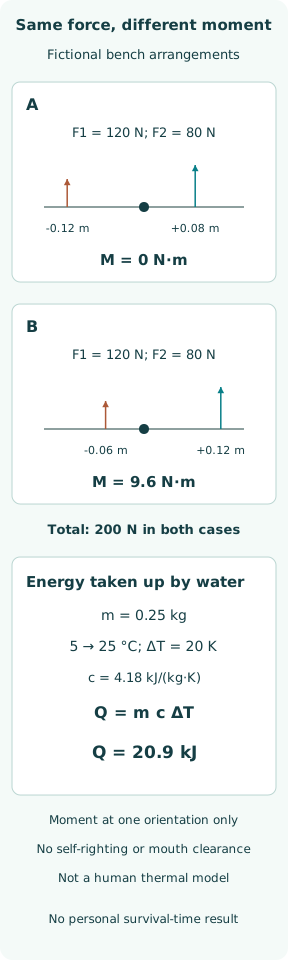
At one imposed orientation, apply two upward forces to a fictional rigid surrogate: F1 = 120 N and F2 = 80 N. Measure horizontal positions x from an origin through which its weight acts, so weight has zero moment about that origin in this snapshot. Define the signed moment M = F1 x1 + F2 x2.
For arrangement A, assign x1 = +0.08 m and x2 = −0.12 m. The individual contributions are +9.6 and −9.6 N·m, giving M_A = 0. Total upward force is 200 N. No equilibrium of vertical forces is claimed because the surrogate's weight magnitude is not specified; the model compares moments at a fixed orientation only.
Change distribution while retaining the total
Arrangement B retains the same two forces but moves their assigned positions to x1 = +0.12 m and x2 = −0.06 m. The contributions become +14.4 and −4.8 N·m, so M_B = +9.6 N·m. Upward force remains 200 N. The difference comes entirely from the prescribed distribution, not an increase in total buoyancy.
A has zero moment at the chosen orientation, but that does not establish stable equilibrium. B has a nonzero moment, but its sign does not identify a beneficial direction for a real wearer. We have supplied no body geometry or mapping from positive rotation to mouth clearance. Neither result approves a jacket-and-suit pairing or tells a user how to alter it.
Keep movement inside the compatibility question
A combination must be assessed across the relevant tasks, not only as a floating shape. Reaching closures, moving arms, using access routes and entering the intended survival craft can impose different constraints. A fitting that is unobtrusive in a standing photograph may become an obstruction during a task. The necessary evidence concerns the complete task and actual equipment combination.
The figure's two bench arrangements illustrate only force distribution. They contain no usable clothing pattern, attachment location or donning instruction. Their force points must not be mapped onto a person's body. Appropriate fitting and training follow the approved equipment instructions and controlled arrangements; the schematic provides no basis for private in-water experimentation or modification of buoyancy placement.
Distinguish insulation from water-entry control
Thermal protection involves more than nominal material thickness. Closures, seams, fit and water entry change what the complete suit does. A material specimen tested in isolation cannot establish the thermal performance of a worn assembly. Likewise, a flotation result does not measure water ingress or heat transfer through the suit; the protective claims need their own evidence.
MCA recommendation UK21/L021 addresses a specific controlled water-ingress test interpretation for immersion and anti-exposure suits. It is evidence that ingress is a defined test question, not a general forecast for a wearer. The next calculation does not reproduce that test, use its acceptance criterion or propose a test a person should perform.
Calculate the heat taken up by an assigned water mass
In a separate fictional bench case, 0.25 kg of liquid water warms from 5 °C to 25 °C without phase change. Assign constant specific heat c = 4.18 kJ/(kg·K). The water's energy increase is Q = mcΔT = 0.25 × 4.18 × 20 = 20.9 kJ. This is an energy, not a heat-transfer rate.
Doubling the assigned water mass to 0.50 kg with the same temperature change gives 41.8 kJ. The values describe water heated by an unspecified external source; they do not say that a person loses exactly this energy. No leakage rate, heating time, heat-transfer area, metabolic heat or core temperature is provided. The selected masses are not acceptable suit-leakage limits.
Do not convert the bench energy into survival time
Dividing 20.9 kJ by an invented human heat-loss rate would create a time without establishing the needed physiology or exposure model. Real heat exchange can vary with water movement, insulation compression, suit fit, activity and repeated ingress. The initial cold response and ability to act also cannot be represented by one stored-heat quantity or a single water temperature.
The example is useful because it exposes what is missing. An energy balance for the water is not an energy balance for the person, and neither automatically predicts safe exposure duration. The article therefore supplies no personal survival time, maximum immersion time or reassurance based on a buoyancy rating. Equipment performance and casualty condition require their appropriate specialized evidence.
Connect pairing evidence to the issued equipment
MGN 396 recommends seeking manufacturer advice on combinations that have been tested satisfactorily. A useful equipment record therefore identifies the exact models, sizes and approved pairing information rather than stating that both items are compliant. Instructions for one size or product revision should not silently become instructions for every visually similar item in the store.
Issued equipment also needs traceability through servicing and replacement. Replacing only the jacket may change a previously documented combination; replacing a closure or adding a locator can alter an interface. A review should retain the difference between a verified pairing, an unsupported pairing and a demonstrated defect. Absence of a reported problem is not equivalent to evidence for the combination.
Read the two models together without merging them
The first model gives 200 N upward force in both arrangements but moments of 0 and +9.6 N·m at one prescribed orientation. The second gives 20.9 kJ for heating an assigned 0.25 kg of water by 20 K. These independent calculations answer different questions and cannot be added into a combined safety score.
A meaningful compatibility assessment follows flotation, movement, ingress, thermal protection and the task interfaces of the actual worn system. A larger buoyancy label cannot fill a missing thermal result, and a thermal test cannot establish an untested flotation combination. The numerical examples clarify these boundaries; they do not identify a safe pairing, a safe exposure or a universal equipment choice.
Sources
- MCA MGN 396 (M+F): compatibility of life-saving equipment. June 2009; still linked by current MCA emergency-equipment guidance; historical numerical LSA quotations not adopted as current requirements — §§1–2: combination compatibility, buoyancy distribution and tested pairing; actual four-page PDF inspected 2026-10-08
- MCA UK21/L021: thermal protective tests for immersion suits. Published 18 July 2023; live official recommendation checked 2026-10-08 — Question, recommendation and affected items: controlled water-ingress test interpretation; no test performed or approval inferred here