Knowledge / Machinery and energy
Smoke transport in fire detection: detector placement and ventilation effects
Use an original room-transport and dilution comparison to separate smoke arrival, chamber exposure and a detector’s certified alarm response.
On this page
A detector can work correctly and still receive smoke late, weakly or intermittently. The journey from the fire to the detector is part of the detection problem. A simple comparison shows how faster transport can coexist with a weaker signal, and why neither a travel time nor a toy response curve is a certified alarm time.
Begin at the fire, not the control panel
A fire produces gases and particles in amounts that depend on the burning material and combustion conditions. Their route through a room depends on buoyancy, entrainment, surfaces and imposed air motion. Before considering an alarm’s electrical message, ask whether the relevant fire products can reach the sensing location and in what form.
The nearest detector by straight-line distance need not lie on the dominant smoke path. A beam or ventilation jet can make the path longer or redirect it. This is a transport question, separate from the priority assigned to a message after the detection system has produced one.
Ventilation affects concentration as well as speed
Air movement can carry smoke toward a detector, carry it away or dilute it through mixing. These effects need not improve detection together. A larger local airspeed may reduce a travel time while lowering the concentration carried along that route. Room-average air changes do not describe every local velocity or recirculation region.
NIST’s smoke-alarm research overview links measured response to fire growth and dilution associated with fire location and ventilation. The cited work concerns residential research, not a marine approval. It supports examining the physical smoke exposure, while the actual ship arrangement requires its own applicable evidence.
Keep room transport and chamber entry distinct
Smoke outside a detector has not necessarily reached its internal sensing region. The housing and inlet geometry introduce another transfer process. Particle size and the sensing principle also affect the relationship between an external aerosol and the device’s electrical response. A room-flow model does not automatically reproduce those internal effects.
NISTIR 6242 describes particulate entry lag and its dependence on approach velocity. The example below therefore separates an assigned external concentration from a simple chamber state. Its chosen chamber constant is an invented parameter. It is not a rating for a commercial detector and does not include the device’s alarm algorithm.
Define two fictional room paths
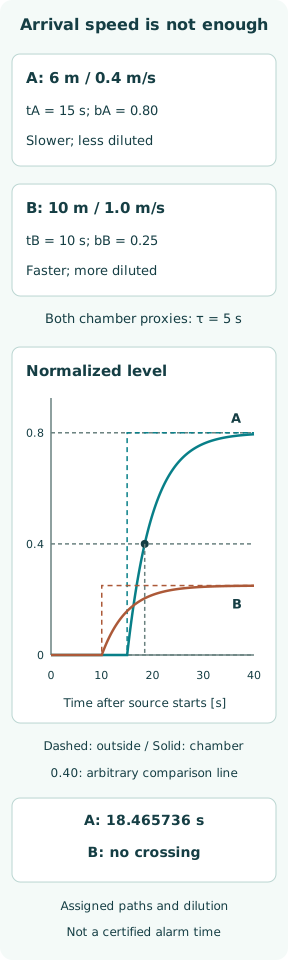
Assume a persistent normalized smoke source begins at t = 0, with source level 1. Route A has effective path length 6 m and prescribed average advection speed 0.4 m/s. Route B has length 10 m and speed 1.0 m/s. Their ideal arrival times L/u are 15 s and 10 s respectively.
To represent different mixing histories, assign external smoke levels after arrival of bA = 0.80 and bB = 0.25. Before arrival both are zero; after arrival each remains constant. These dilution factors and speeds are inputs, not predictions from ventilation rate. The model omits fire growth, diffusion, deposition, transient plumes and changes in flow direction.
Calculate an illustrative chamber response
Let y be a dimensionless chamber concentration proxy with y(0) = 0. For each route, define dy/dt = (b − y)/τ after arrival and choose the same illustrative τ = 5 s. The solution is y(t) = b[1 − exp(−(t − ta)/τ)] for t ≥ ta, and zero earlier.
Choose yref = 0.40 solely as a comparison line, not a smoke-detector setting. Route A reaches it at 15 − 5 ln(1 − 0.40/0.80) = 18.465736 s. Route B tends toward 0.25 and never reaches 0.40 under the constant-input assumptions. Earlier arrival therefore does not guarantee earlier crossing of a chosen response level.
Read the curves and their limits
At t = 20 s, the model gives yA = 0.505696 and yB = 0.216166. The latter has had smoke outside its housing for longer, yet its internal proxy remains lower because its prescribed external level is much smaller. The figure plots both external steps and internal curves so that dilution is visible instead of hidden inside a single delay.
The absence of a crossing for B is conditional. A growing fire or changed airflow could raise its external level and change the result. It does not prove a real detector would fail, remain silent forever or be unsuitable. Likewise, A’s crossing does not establish any approved detection or evacuation time.
Geometry determines which scenario deserves testing
Ceiling beams, deep equipment and partial partitions can divide a nominally open volume into different transport regions. A supply jet may create a clean-air corridor near one sensing point, while an extraction path draws smoke elsewhere. Those possibilities explain why a coverage circle drawn only from floor-plan distance is incomplete evidence.
The original FSS Code text in MSC.98(73), chapter 9, paragraph 2.4.2.1, already recognizes adverse airflow near beams and ventilation ducts. This historical text anchors the placement principle, not a current spacing table. A vessel assessment must use the applicable amended code, approval and installation documentation.
Tests demonstrate the part of the chain they exercise
A local functional test can show that a detector and its reporting path respond to the applied stimulus in the test conditions. It does not, by itself, demonstrate that smoke from every relevant fire location will reach that point promptly. Conversely, a smoke-transport study does not establish the reliability of the electrical loop or panel.
A useful test record states stimulus, location, ventilation configuration and what was observed. It should distinguish arrival at the housing, device response and panel indication where those stages are actually measured. Filling an unobserved stage with the model’s 5 s parameter would replace missing evidence with an assumption.
Use simulation with a defined claim
A room-flow calculation needs a credible source, geometry, boundary conditions and a description of the particles or smoke quantity being transported. A detector model also needs a justified relation between that transported quantity and response. Optical obscuration, soot mass fraction and a proprietary algorithm are not automatically interchangeable signals.
The simple equations here deliberately avoid a claim of predictive fire simulation. They are a counterexample to the idea that shortening L/u necessarily improves detection. In a more detailed analysis, sensitivity to fire location, ventilation mode and source evolution would test whether that conclusion persists across the scenarios relevant to the ship.
Preserve the separation from alarm handling
Once a detector produces an output, communication, panel processing and human response add further stages. Acknowledging the resulting alarm does not change the smoke path. A reliable panel likewise cannot make smoke reach a poorly exposed sensing location. Improvements should address the stage for which the evidence identifies a problem.
The original case establishes an arrival-and-amplitude tradeoff: B receives its assigned smoke five seconds earlier but remains below the illustrative comparison level, while A crosses it later. No certified alarm time follows. The reviewable conclusion is that placement and ventilation must be assessed through their effect on smoke exposure as well as transport speed.
Sources
- NIST: Smoke Alarm Research. Research overview inspected 8 October 2026 — Alarm performance; fire growth and dilution associated with location and ventilation
- NISTIR 6242: Particulate Entry Lag in Smoke Detectors. October 1998 — Abstract: smoke transport through housing and velocity-dependent sensing lag
- IMO MSC.98(73): original FSS Code, chapter 9. Original text adopted 5 December 2000; not the consolidated current code — Chapter 9, paragraph 2.4.2.1