A CLOSER LOOK AT THE PROJECT
AURA: following a cooling failure through seven risk methods
A risk study becomes useful when its assumptions, event definitions and evidence can be followed. AURA brings several analytical views into one workspace. This illustrated example starts with a simple physical question: what happens when a heat-producing unit loses the cooling flow it needs?
Start with the function, not the score
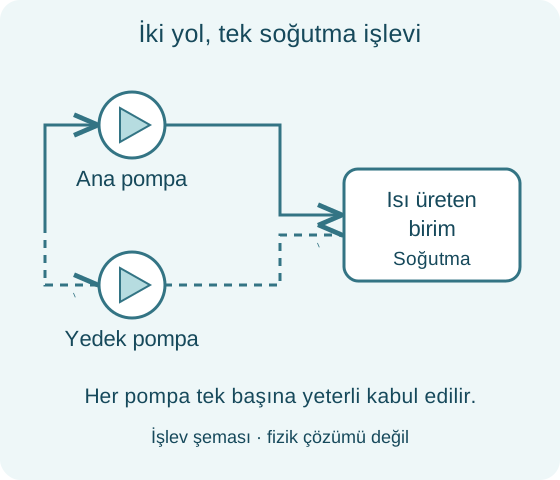
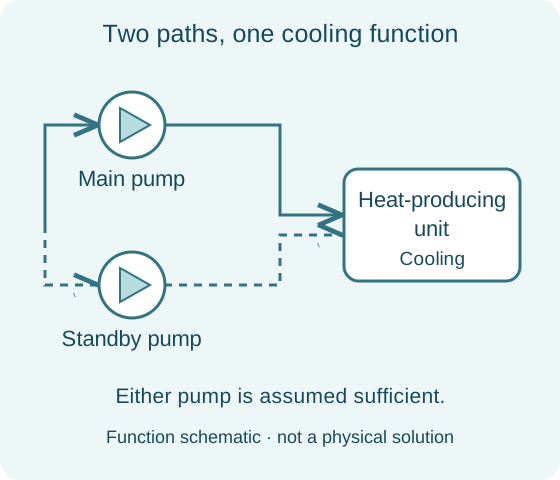
Consider an illustrative cooling arrangement with a main pump and a standby pump. Either pump can provide the required cooling duty on its own. During normal operation the main pump supplies flow; the standby pump is available if that supply is lost. The function being protected is continued cooling, rather than the operation of one particular piece of equipment. This distinction matters: a stopped main pump is a component failure, but it does not necessarily mean that the overall cooling function has failed.
The example therefore separates two outcomes after main-pump loss. If the standby pump starts and restores the required flow, cooling is available again. If the standby pump also fails to provide flow, cooling is unavailable within the stated model. Heating is a possible consequence only while heat input continues. These statements define a bounded teaching case. They do not establish actual pump capacity, transfer time, temperature response or the behaviour of an installed system.
Turn one problem into several precise questions
AURA presents HAZOP, FMEA, LOPA, FTA, ETA, PSA and BowTie as different ways to interrogate a study. Their value is not that seven methods produce seven independent confirmations. Each method organises a different question, and the answer must retain its relationship to the underlying scenario. A cause, a failure mode, a missing function and a consequence should not become interchangeable just because they appear on the same diagram.
HAZOP asks how a process can depart from its intended condition. In this case, main-pump loss is a cause; no flow in the main branch is the deviation; standby flow is then needed. FMEA asks what a component can fail to do and how that failure propagates. The illustrative standby-pump record follows shaft seizure through failure to start and absent standby flow to an unavailable standby path. Actual-flow monitoring is recorded as a control; a start test is a proposed action. These records do not establish that either has been verified in service.
Use the fault tree to expose the combination
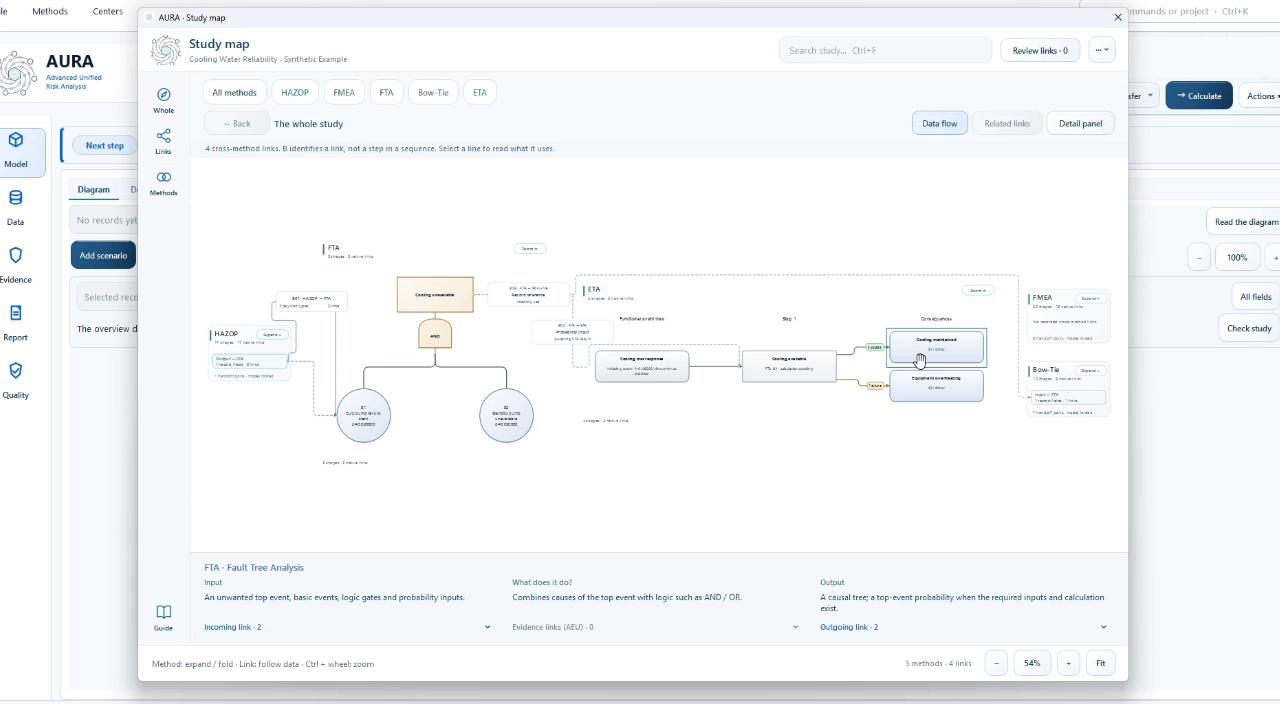
The fault-tree question is deliberately narrow: which combination makes cooling unavailable? With either pump assumed sufficient, the two required conditions are main-pump loss and standby-pump failure. The top event is connected through an AND relationship. Main-pump loss alone is not enough; neither is an unavailable standby pump while the main pump continues to meet the duty. Naming both conditions makes the redundancy assumption visible instead of leaving it hidden in the word “backup”.
This is a logical statement within the example, not a numerical reliability result. Shared electrical supply, a blocked common suction, maintenance configuration and response delays would require additional modelling if relevant to an actual installation. Drawing two pump branches does not establish that their failures are independent. A reviewer should be able to challenge the boundary before anyone attaches a frequency or probability to the top event.
Read the event tree from the initiating event
The event-tree view begins after main-pump loss has been given. It asks whether standby flow is restored and follows the resulting paths. The successful branch describes restoration of a positive function; the failed branch describes failure to restore it. This is a different reading direction from the fault tree even though both views reference the same cooling arrangement. The starting condition must stay visible, otherwise a conditional branch can easily be mistaken for an unconditional system result.
AURA’s linked records help keep those identities aligned. A reference to the fault-tree event does not create another independent contribution to risk. Likewise, a branch labelled “restored” is not proof that a transfer has occurred quickly enough to prevent damage. Timing, capacity and acceptable operating limits remain questions for the study’s supporting evidence. The diagram makes a question inspectable; it does not answer every engineering question by itself.
Separate prevention, recovery and consequence control
BowTie places the cooling-loss event between threats and consequences. In this example, each pump-related threat path retains the condition that the companion pump is unavailable. That qualification prevents the picture from quietly contradicting the fault tree. The hazard is associated with the heat load, while loss of cooling is the central event. Continued heating is a possible downstream consequence if the heat source remains active.
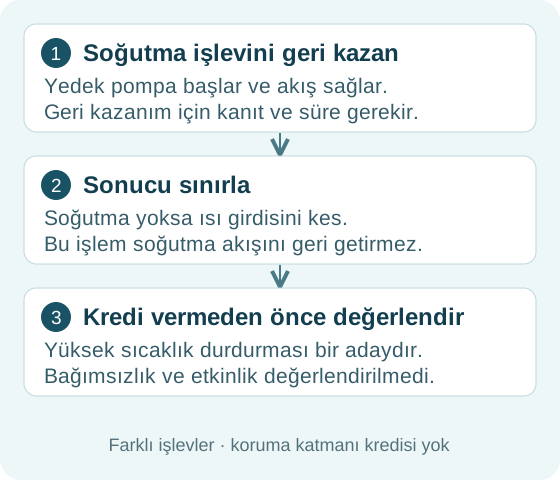
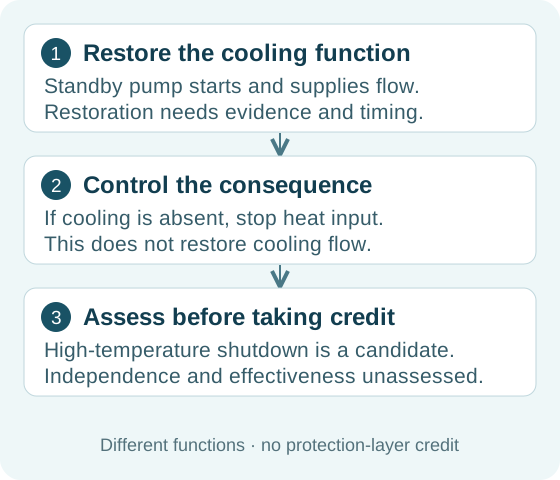
A standby supply can help preserve or restore cooling. Cutting heat input or a high-temperature shutdown instead addresses the consequence when cooling is not available. These measures should not be described as performing the same function. In the LOPA view, high-temperature shutdown is a candidate protection measure only. Its eligibility, effectiveness and independence have not been assessed, so the demonstration gives it no independent-protection-layer credit and reports no calculated risk reduction.
Preserve uncertainty when connecting the study
The PSA view follows selected qualitative paths, including restored standby cooling with or without temperature monitoring and a no-flow path followed by protective shutdown of heat input. Some branches are deliberately omitted. The purpose is to show how selected event and function records can be connected, not to claim that all possible outcomes have been enumerated or that a complete probabilistic model has been solved.
A useful review asks what changes when a shared assumption changes. If the standby pump cannot meet full duty, the original function definition needs revision. If both pumps share a vulnerable supply, the cause model needs another look. If shutdown is only proposed, a report should preserve that status. Connections between methods are valuable when they carry those qualifications forward, rather than making an incomplete record appear settled simply because it is reused.
From a diagram to a reviewable work product
The intended work product is more than a picture. It includes a defined system boundary, named events and functions, method-specific records, links between those records, and actions that can be checked. A proposed standby-chain test, for example, should remain traceable to the failure it is meant to investigate. Reporting can then bring the scenario, assumptions and open questions together so another reviewer can understand why a branch or barrier appears.
In a review meeting, the physical arrangement can be read first, followed by a comparison of event names across methods. If one record says “main-pump loss” and another says “cooling loss”, the difference needs an explanation: they are not the same event. The next step is to identify proposed tests and unassessed conditions. This sequence puts study consistency ahead of the diagram’s appearance and keeps missing evidence visible.
AURA’s current foundation includes multi-method workspaces, calculation and visual reporting components, together with study, experiment and learning surfaces. The film is an illustrative, authored explanation using synthetic study content. It is not a physical cooling simulation or evidence of field reliability. The next meaningful step for an engineering application would be to replace illustrative assumptions with appropriate system evidence and complete the outstanding reviews. The software helps structure that work; confidence still depends on the quality and scope of the evidence.
Select the image to open it at full size.