
A CLOSER LOOK AT THE PROJECT
Colav Lab: following decisions in a changing encounter
Colav Lab’s five-vessel open-sea narrative connects observations, movement assumptions, manoeuvre requests and vessel response within one geometry and a shared scenario clock.
The problem is the whole encounter
Clear water ahead does not, by itself, explain a manoeuvre. Traffic approaching from astern, a crossing target, a slowing vessel ahead and environmental effects can all matter to the same decision. Colav Lab is a local, offline research platform focused on examining these relationships. It connects vessel movement, alternatives and the reasoning behind a selection.
The animation develops this question through one encounter. Its initial vessels, reference route and environment come from synthetic inputs. Subsequent movements, comparison branches and outcomes are authored explanatory content. The sequence explains a decision process; it is not a recorded planner run.
Five vessels share one geometry
OWN represents our vessel, a cargo ship approximately 200 metres long and 32.26 metres wide. Four targets retain their identities throughout. T01 is the faster vessel approaching from astern. T02 crosses northward. T03 occupies the area ahead and slows during the sequence. T04 is a workboat initially heading east; its later turn prompts a second assessment.
Positions use a local east–north plane measured in metres. The reference route runs east before turning northeast and remains fixed during avoidance. Detailed views enlarge particular crossings while the overview preserves the wider encounter. Hull dimensions matter: centre-point separation and the space occupied by two hulls are different questions. The drawing plane is not a navigation chart.
Separate observation, assumption and time
All five vessels advance on the same scenario clock. T01’s movement astern, T03’s slowdown and T02’s crossing are observed within that shared time. A solid trail records movement already observed in the example. A dashed line ahead carries a movement assumption. Connecting these lines does not establish that the assumed future will occur.
The first alternatives start from the same state at 240 seconds. They are also examined at the same future instant, with the animation highlighting a snapshot 252 seconds after that observation. Crossing order can then be interpreted against requested heading and speed. Playback time is distinct from scenario time; pausing or changing the view does not create another physical event.
Heading and ground track tell different stories
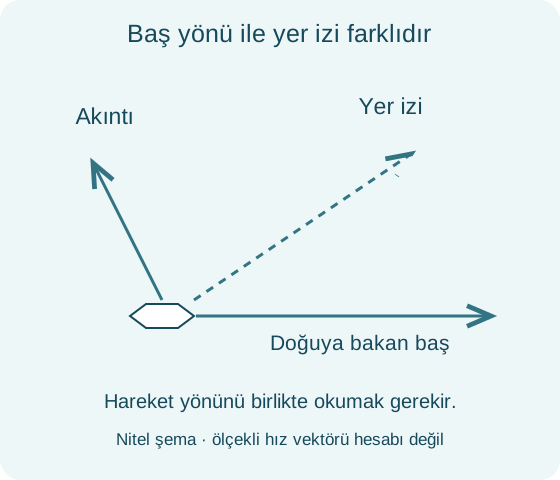
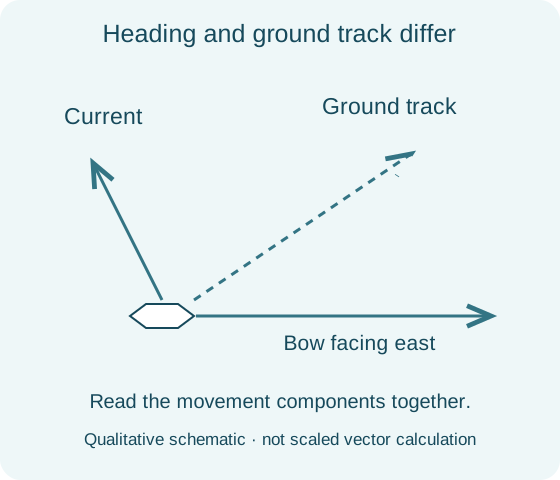
The bow’s direction and the resulting ground track are followed separately. In this example, wind points northeast and current northwest. The current components are −0.65 m/s eastward and 0.75 m/s northward. Wave inputs include a significant height of 3.2 metres and a period of 8.5 seconds. These values describe the environmental context; they do not establish validated vessel response.
T04 makes the distinction visible. The first assumption holds its heading and through-water speed fixed: its bow faces east while drift carries its ground track northeast. Its subsequent northward turn must be read separately from that earlier drift. The illustration uses simplified response and drift treatment to keep movement continuous, rather than reproducing the native dynamics model.
Compare a bounded set of requests
Three candidates enter the first comparison. A continues with a request for 0° and 6.3 m/s. B requests a port turn at +35° and 5.4 m/s. C requests a starboard turn and slowdown at −20° and 4.2 m/s. Angles follow the drawing’s local convention, with east at 0°. The candidates and comparison instant are explicit; the sequence does not claim to search every possible manoeuvre.
In A’s conditional snapshot, the drawings of OWN and T02 overlap. B moves into the northern area used by T01 and farther from the reference route. C’s lower speed gives T02 time to cross first. The narrative selects C while also examining the other three targets and route departure at that same future instant.
Response takes time, and new observations change the request
A requested state and a reached state are different. When OWN receives −20° and 4.2 m/s, heading and speed do not immediately jump to those values. Turning and slowing develop gradually while all four targets keep moving. The interval after selection therefore brings new information about both vessel response and the encounter.
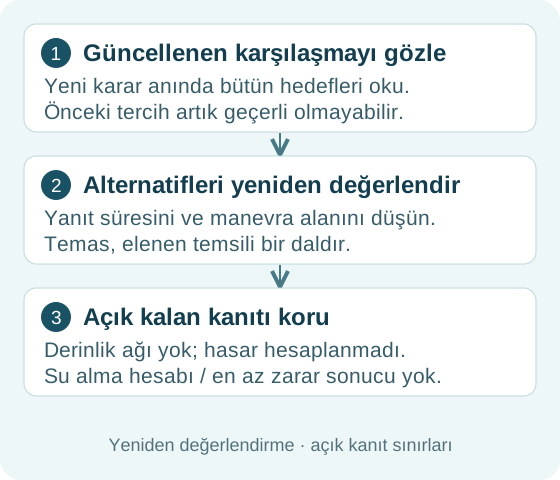
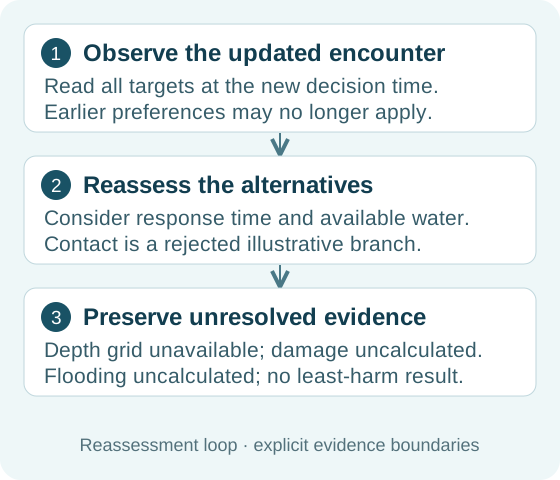
T04’s observed northward turn departs from the earlier eastward assumption. At 390 seconds, a new observation anchors another comparison: retain the previous request, or slow further with 0° and 1.4 m/s. Both are examined 179 seconds ahead. Assuming T04 continues its turn, the previous request produces overlapping hull drawings; the lower-speed branch leaves time for T04 to pass ahead. Reassessment preserves the first decision’s context while responding to changed information.
Read the outcome as one segment of a voyage
Along the selected track, the first slowdown makes time for T02 and the revised request makes time for T04. Once the crossings open, OWN increases speed and progresses toward the same reference route. The state shown at 1300 seconds closes the examined segment. The route continues ahead; the sequence does not claim arrival or assessment of the entire voyage.
Review then returns to the earlier decision. The conditional forecast and later observed track can be examined together, preserving the observation times at 240 and 390 seconds. Tactical, radar-style and inclined views show the same state differently. A change of view adds no new observation source. Inputs, decisions and outcome remain linked so their sequence can be inspected.
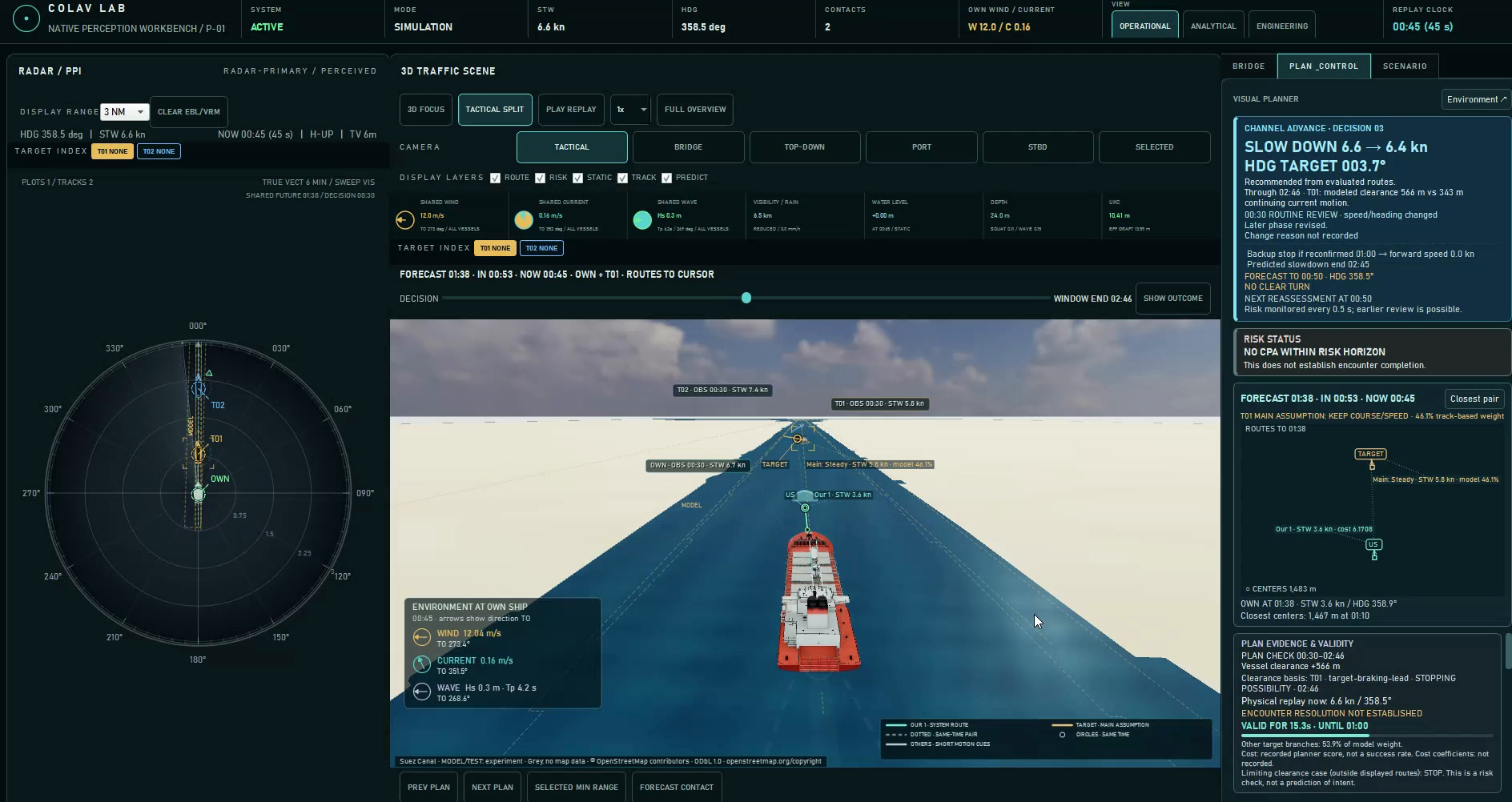
Select the image to open it at full size.
Keep the rejected contact branch separate
A separate review reopens the rejected Continue branch. Its possible contact did not occur on the selected path. The purpose is to examine questions that arise under a different request from the same initial observation: which hull area is involved, and from which direction the approach occurs.
Approach toward a surface and sliding along it are considered separately. Damage and flooding research additionally needs verified structural and compartment inputs. Those results have not been calculated for this example, so missing information cannot be treated as zero damage. Nor does the review establish which option causes the least harm. Closing the conditional branch leaves the selected track’s state at 1300 seconds unchanged.
An inspectable record and a clear research boundary
This explanation connects observation, selection, request, response and reassessment, showing which information remains fixed and which changes. Further research would need recorded solver output tied to the same inputs, times and alternatives, alongside examination of model assumptions and the limits of the results. That validation is not presented as completed here.
This example has no native solver replay, depth grid or calculated under-keel clearance. Its movement and outcome remain illustrative. The page therefore provides no operational navigation recommendation, compliance certification or validated safety result. It offers an explicit framework for examining the questions, assumptions and decision points within a multi-vessel encounter.