Knowledge / Navigation and collision
Heading and motion through water and over ground
A ship can point one way while moving in another. Its bow orientation, movement relative to the water, and movement relative to the Earth answer different questions. Separating them makes a chart trace, a weather observation, or a scientific motion diagram much easier to understand.
On this page
This article develops that distinction using vectors and deliberately invented examples. It explains terminology and physical relationships, not how to steer a vessel. The examples assume local, horizontal motion over short distances; they contain no route, operational limit, or assessment of a real ship.
Begin with the reference frame
A reference frame says what counts as stationary. Someone standing on a quay sees a ship move relative to the shore. A hypothetical observer travelling with the surrounding water sees movement relative to that water. Both descriptions can be correct, although their velocity measurements differ.
Velocity includes direction and magnitude. Speed is its magnitude and is normally nonnegative. An eastward velocity component can be negative, meaning westward motion, without implying a negative speed. Direction also needs a reference: true north, magnetic north, the vessel's bow, or a local drawing axis. Numbers with different references cannot be compared directly.
This is a kinematic description: it describes movement. Dynamics explains why movement changes, using forces, mass, moments and inertia. Adding a current vector is a kinematic relationship; predicting how a gust changes a ship's motion requires dynamics as well.
Heading and the several meanings of course
Heading is the direction in which the ship's longitudinal forward axis points. It describes orientation, not the direction in which every point on the hull is travelling. A vessel can have a well-defined heading while stationary, drifting sideways or moving astern.
Course is a context-sensitive word. It may refer to an intended direction or to a direction of movement. Course over ground, abbreviated COG, is specifically the direction of the vessel's ground-referenced velocity. A planned course is an intention, while measured COG describes motion. A ground track is the path traced by successive ground positions. On a curved track, its local direction changes with time.
The line joining two recorded positions gives a direction made good across that interval. It need not match the instantaneous COG at either end. For example, a vessel tracing an arc can finish due east of its starting point without pointing or travelling due east throughout the arc.
The distinction is visible in official data definitions: the US Coast Guard's AIS position-report description lists COG, speed over ground and true heading as separate fields, including separate unavailable-value conventions. A heading value should therefore not be silently substituted for missing COG, or vice versa.
Speed through water and speed over ground
Speed through water, or STW, concerns movement relative to the surrounding water. Speed over ground, or SOG, concerns movement relative to the Earth. In a full horizontal description each belongs to a velocity vector. Some instruments report only the forward component along the vessel's axis rather than the complete vector magnitude.
That distinction matters if the vessel also moves sideways through the water. A forward reading of 6 m/s and a sideways component of 1 m/s describe a resultant water-relative speed of about 6.08 m/s. Treating the forward reading as the full vector would discard the sideways movement.
IMO Resolution A.824(19) distinguishes through-water and over-ground instrument modes and discusses forward, transverse and resultant motion information. Here it is used only to document the measurement distinction, not to state current equipment approval requirements.
A knot is one nautical mile per hour. Using the international nautical mile of 1,852 m, 1 kn equals 1,852/3,600 m/s, approximately 0.514444 m/s. Values must be converted to consistent units before calculation. Six metres per second is about 11.66 kn, rather than six knots.
The velocity triangle
For vectors expressed in the same local axes and at the same time:
Ground velocity = water-relative vessel velocity + ground-relative current velocity.
Write the east and north components separately. If the vessel's water-relative components are (uE, uN), and the current components are (cE, cN), its ground components are (uE + cE, uN + cN). This component addition automatically handles cross-currents and opposing currents.
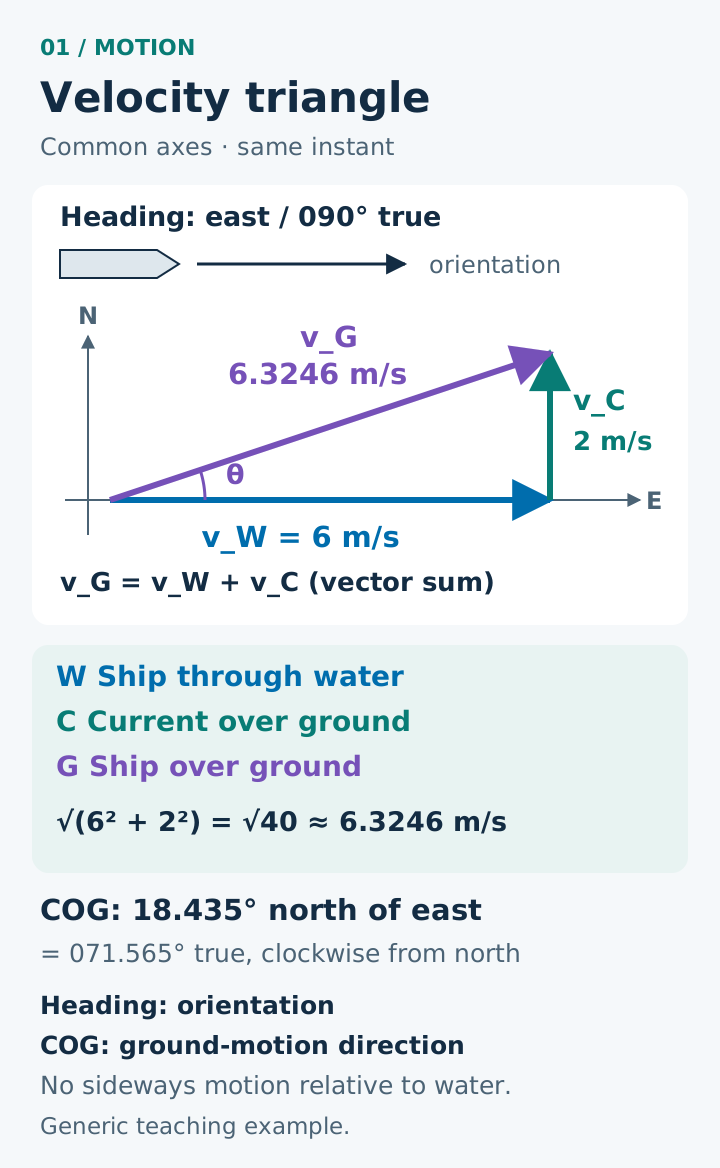
An arrow can be moved parallel to itself without changing its vector. Place the tail of the current arrow at the tip of the vessel's water-relative arrow. The arrow from the original tail to the final tip is the ground velocity. This is why the picture is called a velocity triangle.
Wind speed is not a third velocity to add directly to that equation. Wind acts through aerodynamic forces, which can change the vessel's water-relative motion. If that motion is already measured, adding an arbitrary wind-drift vector can double-count an effect already present. A separate leeway model needs a precise definition and evidence for its assumptions.
A worked cross-current example
Imagine an idealized vessel moving through water at 6 m/s due east. Its heading is also due east because this example assumes no sideways water-relative motion. The water moves at 2 m/s due north relative to the ground. Both velocities remain constant for 60 seconds.
The ground-velocity components are 6 m/s east and 2 m/s north. Its magnitude is √(6² + 2²) = √40, approximately 6.325 m/s. Its direction is arctan(2/6), approximately 18.435° north of east. In the clockwise-from-true-north convention, that is approximately 071.565° true. The heading remains 090° true under the stated assumption.
Over 60 seconds, ground displacement is 360 m east and 120 m north. Its magnitude is approximately 379.47 m. Water-relative distance travelled is 360 m. These are different distances because they belong to different frames; neither is an arithmetic error.
The difference between heading and COG here arises entirely from current. It does not establish a mechanical defect, an incorrect instrument, or a deliberate turn. In a real record, those other possibilities would require their own evidence.
Simple limiting cases clarify the idea
For collinear motion, signed components can be added as ordinary numbers. A hypothetical 6 m/s eastward water-relative velocity plus a 2 m/s eastward current gives 8 m/s east over ground. With a 2 m/s westward current, the result is 4 m/s east. These special cases should not be used for a cross-current, where directions differ.
A vessel can also have zero ground speed while moving relative to water. If the water-relative and current vectors are equal and opposite, they cancel. That does not mean the surrounding water is stationary or that hydrodynamic forces disappear.
Conversely, a body carried with a uniform current can move over ground while having little water-relative translational motion. These observations explain why an unqualified statement such as “the vessel has stopped” is incomplete. It should identify stopped relative to what, and which part of the motion is being described.
Wind introduces both force and measurement questions
Wind acting on the exposed hull and superstructure can generate sideways force and a turning moment. The resulting motion depends on geometry, loading, underwater resistance and other forces. There is no universal conversion from a given wind speed to a fixed lateral ship speed.
Apparent wind is the air movement relative to the moving observer. Earth-referenced wind describes air movement relative to the ground. If both are expressed as vectors pointing towards the direction of air travel, apparent air velocity equals ground-relative air velocity minus the observer's ground velocity.
An original example makes the subtraction tangible: air moving east at 8 m/s and an observer moving east at 3 m/s produce an apparent air velocity of 5 m/s east. A stationary observer experiences 8 m/s. This concerns an ideal point measurement, not airflow disturbed by a real mast or deckhouse.
Meteorological directions normally name where wind comes from, whereas a current direction names where water flows towards. An eastward air-velocity vector therefore describes wind from the west. The US National Weather Service glossary explains the wind-direction convention. Confusing “from” with “towards” reverses a vector.
NOAA's discussion of ship wind reports also highlights observational difficulties. Ship movement, exposure and airflow distortion need attention when interpreting an onboard wind measurement. The phrase “true wind” should be accompanied by its intended reference frame rather than assumed to mean the same calculation on every display.
Why a real track bends and measurements disagree
Current varies in place, depth and time. A vector sampled at one buoy may not represent water along an entire hull or across a long journey. Tidal current is also different from tidal height: one describes horizontal movement, the other water level. High water does not universally coincide with zero current, as NOAA's tide and current explanation makes clear.
A time series adds another complication. A recent heading reading and an older COG estimate may describe different moments during a turn. A smoothed velocity estimate represents an interval. A raw orientation sensor may respond more quickly. Disagreement is therefore evidence to investigate, rather than automatic proof that one source is wrong.
At very low SOG, small position or velocity errors can produce large changes in estimated COG. Mathematically, the direction of a zero-length vector is undefined. A stationary ship still has an orientation, so heading can remain meaningful when COG does not.
Rotation matters too. The velocity of an antenna on a rotating vessel differs from that of its centre of mass by a rotational contribution. A track of one measurement point is not automatically the swept path of the whole hull.
How uncertainty enters a movement description
Suppose an invented record gives 6.0 m/s east and 2.0 m/s north but rounds each component to the nearest 0.1 m/s. Reporting the resulting direction to six decimal places would not create six-decimal-place knowledge. Numerical precision and measurement accuracy are different properties.
Potential errors include timing offsets, sensor bias, coordinate transformation mistakes, data gaps and uncertainty about the local current. Some are shared by several measurements. Averaging correlated observations does not remove a common bias. Comparing independent kinds of evidence can reveal inconsistency, but agreement alone does not establish that all underlying assumptions are correct.
A useful scientific description therefore names the measured quantity, reference frame, units, time interval, measurement location, uncertainty and any smoothing. It also separates an observation from a forecast. Extending today's velocity arrow into the future assumes the motion persists; it is a model assumption, not an observed future track.
Questions to test understanding
Can heading and COG differ without a turn?
Yes. In the cross-current example, orientation is constant while ground motion has a northward component. Sideways water-relative movement is another possible contribution in more general cases.
Does higher SOG necessarily mean stronger flow past the hull?
No. A following current can increase ground speed without the same increase in water-relative speed. Understanding forces requires the relevant relative flow, geometry and conditions.
Can wind and current speeds simply be added to STW?
Current belongs in the velocity relationship after its direction and reference are defined. Wind is not an interchangeable current vector. Its effect on vessel movement must be described by the resulting motion or a justified force-and-response model.
Is a straight line between two positions the exact track?
Only if motion between them justifies that assumption. Many curved paths share the same endpoints. More samples improve the record but do not remove all measurement uncertainty.
What is the central lesson?
Always ask “relative to what?” Heading is orientation; water-relative velocity describes movement through water; ground velocity describes movement across the Earth. A clear diagram preserves all three distinctions instead of hiding them behind the single word “course.”