Knowledge / Navigation and collision
Ship collision mechanics from relative motion to consequences
Collision energy helps explain how moving bodies can deform each other, but it is not a complete measure of harm. Two contacts with similar energy can produce very different damage, and a lower-energy contact can have worse consequences if it opens a critical compartment or exposes people to danger.
On this page
This article builds a scientific explanation from relative motion to contact forces, structural response and consequences. The examples are invented mechanical exercises, not reconstructions, predictions or instructions for choosing a manoeuvre. No actual ship, design, collision strategy or safe impact level is assessed.
Separate the questions before calculating
A collision study can ask several different questions. Will the bodies meet? What are their relative movements at contact? How much motion changes during contact? Which structures deform or rupture? What happens after the damage? Each question requires additional information.
Kinematics describes the approach. External collision mechanics describes the overall translation and rotation during impact. Internal mechanics describes local deformation and structural failure. Consequence analysis considers effects such as flooding, fire, loss of essential functions, injury and pollution. The separation of external and internal dynamics is discussed in Yichi Zhang’s Newcastle University thesis, section 2.3.
The separation is useful because an answer at one level is not automatically an answer at the next. A predicted contact location does not determine penetration. A penetration estimate does not determine flooding extent without compartment geometry. A flooded volume alone does not determine whether a vessel remains stable.
Relative velocity is the starting point
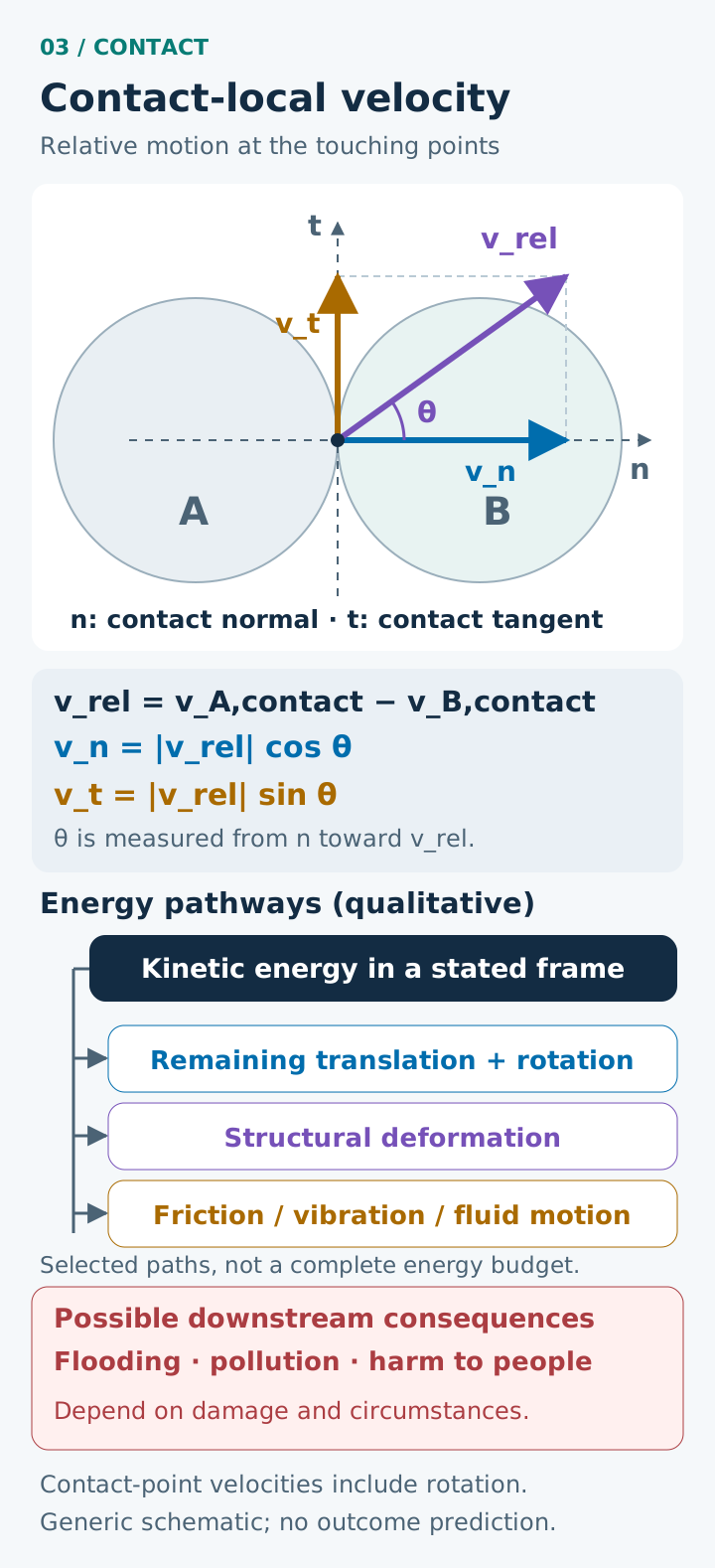
In one shared reference frame, the relative velocity of body A with respect to body B is vA − vB. If both move east at the same velocity, their relative velocity is zero even though both have kinetic energy in a shore-fixed frame. If their directions oppose, the closing component may be much larger than either speed considered in isolation.
Speeds alone are insufficient. Two 3 m/s motions in the same direction have zero relative speed; perpendicular 3 m/s motions have relative speed √18, about 4.243 m/s. Opposing 3 m/s motions have relative speed 6 m/s. These are ideal vector comparisons, with no claim that contact necessarily occurs.
Subtracting the same uniform translation from both velocities leaves their difference unchanged. Relative velocity therefore does not depend on choosing one uniformly translating observer rather than another. Total kinetic energy measured by those observers can differ, so a collision-energy statement should identify the frame and the particular energy quantity.
Water complicates the dynamics even though this vector identity remains true. Fluid forces depend on motion relative to water, not solely the relative motion between two hulls. A current cannot be declared irrelevant to every part of a collision merely because a common translational velocity cancels in one subtraction.
Use the velocity at the contact point
Ships can rotate as well as translate. For a rigid-body idealization, the velocity of a point equals centre-of-mass velocity plus the rotational contribution ω × r. Here ω is angular velocity in radians per second and r is the vector from the centre of mass to that point in metres. Their cross product has units of metres per second.
For example, a point 20 m from an ideal rotation axis has tangential speed 0.20 m/s when angular speed is 0.01 rad/s. The direction depends on the point and rotation sense. Two vessels with the same centre-of-mass velocities can therefore have different contact-point velocities if their rotations differ.
An off-centre impact also generates angular momentum changes. The distance from the centre of mass to the line of action matters, not merely the distance to the contact point. A force whose line passes through the centre produces no moment about that centre, even if contact occurs on the outer surface.
Contact angle needs a definition
At a local contact surface, define a normal perpendicular to the surface and a tangent along it. Relative contact velocity can be separated into normal and tangential components. The normal component describes approach or separation across the surface; the tangential component describes sliding along it.
For an approaching contact, choose the normal to point into the approached surface, so that the angle θ between it and the relative-velocity vector is between 0° and 90°. Then, its normal magnitude is u cos θ and its tangential magnitude is u sin θ. If the angle were measured from the tangent instead, the sine and cosine roles would switch. A statement such as “a 30-degree collision” is ambiguous until the reference lines are given.
The angle between ship headings is not necessarily this contact angle. Curved hull surfaces have local normals that differ from the vessel axes. Contact geometry can also change as structures deform and bodies rotate. The initial angle cannot describe the entire event by itself.
Mass is not the same as effective impact mass
Displacement mass is the mass of the floating vessel and its contents in the specified condition. Gross tonnage is a measure related to enclosed volume, not a mass to place into a kinetic-energy equation. Deadweight is a carrying-capacity measure; it is not automatically the vessel's actual mass at contact.
For two freely translating point masses mA and mB, the reduced mass is μ = mA mB / (mA + mB). The kinetic energy associated with their relative translation is one half μu², where u is relative speed. This useful model excludes rotation, fluid coupling and detailed structural behaviour.
An extended body can move away from a contact by translating and rotating. In a planar, frictionless, single-normal-impulse model, the inverse effective mass includes 1/mA + 1/mB and rotational terms bA²/IA + bB²/IB. Each b is the perpendicular lever arm from a centre of mass to the normal force line; I is the corresponding mass moment of inertia in kg·m². The expression is a restricted mechanical model, not a ready-made ship calculation.
Surrounding water also resists acceleration. Added mass is a modelling representation of this fluid-inertia effect. It is not extra cargo physically attached to the hull, and it is not generally one fixed percentage for every direction and event. Shengming Zhang's collision-mechanics research is listed in DTU's research catalogue for further study.
A fully specified one-dimensional example
Consider two hypothetical point masses moving along one line. Let mA = 2,000,000 kg and mB = 3,000,000 kg. Their initial velocities are 3 m/s east and 1 m/s east. Assume an isolated, perfectly inelastic interaction: they share a final velocity, with no external impulse, rotation, water or elastic rebound in this teaching model.
Initial momentum is 2,000,000 × 3 + 3,000,000 × 1 = 9,000,000 kg·m/s east. Dividing by the combined mass gives final velocity 1.8 m/s east.
Initial kinetic energy is 0.5 × 2,000,000 × 3² + 0.5 × 3,000,000 × 1² = 10,500,000 J, or 10.5 MJ. Final translational kinetic energy is 0.5 × 5,000,000 × 1.8² = 8.1 MJ. The difference is 2.4 MJ.
The reduced mass is 1,200,000 kg and relative speed is 2 m/s. The independent calculation 0.5 × 1,200,000 × 2² also gives 2.4 MJ. Agreement verifies the arithmetic and model consistency. It does not prove that a real ship contact would absorb 2.4 MJ in its hull structure.
Most of the shore-frame initial energy remains as common translation in this example. Calling the full 10.5 MJ “energy absorbed in the collision” would therefore be wrong. The model specifies loss of relative translational kinetic energy; it does not specify how that loss partitions among physical mechanisms.
What the speed-squared relationship does and does not say
At fixed mass in the same model, doubling the relevant speed multiplies kinetic energy by four. That is an important sensitivity, but the word “relevant” matters. Ground speed of one ship is not automatically the relative normal contact speed or the complete initial condition.
For another isolated illustration, take effective mass 1,200,000 kg and relative speed 4 m/s. With the velocity aligned with the normal, the ideal normal-energy scale is 9.6 MJ. With θ = 60° measured from that normal, the normal component is 2 m/s and its energy scale is 2.4 MJ.
The remaining tangential component has not vanished. Sliding, friction, changing contact, snagging or subsequent impacts may matter. The quarter-energy result applies only to the stated normal-component comparison, with effective mass held fixed. It does not establish that one real contact geometry is four times safer.
Energy absorption is a structural process
Energy transferred into a structure can produce elastic deformation, permanent plastic deformation, buckling, tearing and fracture. Plates, stiffeners, frames and connections carry load together. The response depends on material behaviour, thickness, geometry, support conditions, strain rate and existing damage.
A local contact can concentrate load into a small area or spread it across several members. Two structures absorbing equal energy may have different penetration depths, rupture locations and surviving load paths. A high absorbed-energy value is not inherently a good or bad outcome without defining where and how that energy was absorbed.
Work done through deformation is the integral of force over displacement. In a deliberately constant-force illustration, absorbing 2 MJ over 0.5 m corresponds to a mean force of 4 MN; over 2 m it corresponds to 1 MN. Real force histories fluctuate. These averages neither determine peak force nor describe human injury.
Pedersen and Li's study of hull-bending energy examines elastic vibration alongside other energy pathways. Its model-specific results should not be converted into a universal fraction. More generally, an energy balance must distinguish energy remaining in motion, temporarily stored elastically and irreversibly dissipated.
Why minimum kinetic energy is not minimum total harm
Imagine two purely conceptual outcomes. One distributes deformation through an unoccupied, non-critical outer structure without opening a fluid boundary. Another, with less deformation energy, creates a concentrated opening into a vulnerable compartment. There is no contradiction if the second produces more serious downstream harm.
What follows depends on damage location and extent, water ingress, watertight boundaries, stability, cargo properties, ignition sources and exposure of people and the environment. These are separate physical pathways. A single scalar energy value cannot encode all of them.
IMO's damage-stability overview explains the importance of subdivision and progressive flooding after damage. The educational point is that loss of stability is a downstream question requiring the damaged configuration, not a direct conversion of joules into a survival answer.
Even a consequence measure is not automatically a risk measure. Risk also needs likelihood and exposure. Comparing expected outcomes requires transparent assumptions about possible events and their consequences. Weighting unlike outcomes into one score introduces value choices; it is not a law of mechanics. Nothing in this discussion provides a rule for selecting an actual manoeuvre.
What makes a model credible
A credible analysis declares its boundary: two-dimensional or three-dimensional, rigid or deformable bodies, fluid model, contact/friction assumptions and treatment of rupture. It checks conservation and energy accounting within those assumptions. It also examines sensitivity to uncertain mass, velocity, angle, contact position and material behaviour.
Verification asks whether the equations were solved as intended. Validation asks whether the model adequately represents relevant physical evidence for its intended use. A balanced energy ledger is a verification check, not independent validation of fracture behaviour. A detailed-looking simulation can still be wrong if its contact or material assumptions are unsuitable.
The presentation of uncertainty matters as well. A very precise-looking penetration value should not replace an explanation of which inputs change the result. Success in the cases used to test a model does not automatically establish applicability to every size, material and contact configuration. The intended use must be read alongside the scope of the supporting evidence.
Questions to test understanding
Is one ship's SOG enough to calculate collision damage?
No. Relative contact motion, geometry, both bodies' response, water interaction and structural properties matter. A single speed leaves those questions unresolved.
Is the total initial kinetic energy necessarily lost?
No. Translation, rotation and rebound can remain after contact. The worked example retains 8.1 MJ as common translation.
Does a smaller normal component eliminate harm?
No. Tangential interaction, rupture location and downstream consequences remain. An ideal component calculation does not settle them.
Can equal absorbed energy mean equal damage?
No. Energy is an integral quantity. Different force paths and structural arrangements can produce different local failures at the same energy.
What is the central lesson?
Move carefully from relative motion to contact mechanics, from mechanics to damage, and from damage to consequences. Every step adds information. Kinetic energy is an essential physical quantity, but reducing it alone does not establish the minimum total harm.